Line Clearance Checklist: Free GMP Template for Batch Changes
Free GMP line clearance checklist for pharma and food packaging lines: materials, labels, documents, cleaning and QA verification. With guide and example.

Short answer
A line clearance checklist confirms that a production or packaging line is free of materials, labels, product and documents from the previous batch before the next batch starts. Line clearance prevents mix-ups, one of the main causes of recalls in pharma and food. This free line clearance checklist covers removal, cleaning, line-specific checks and independent QA verification.
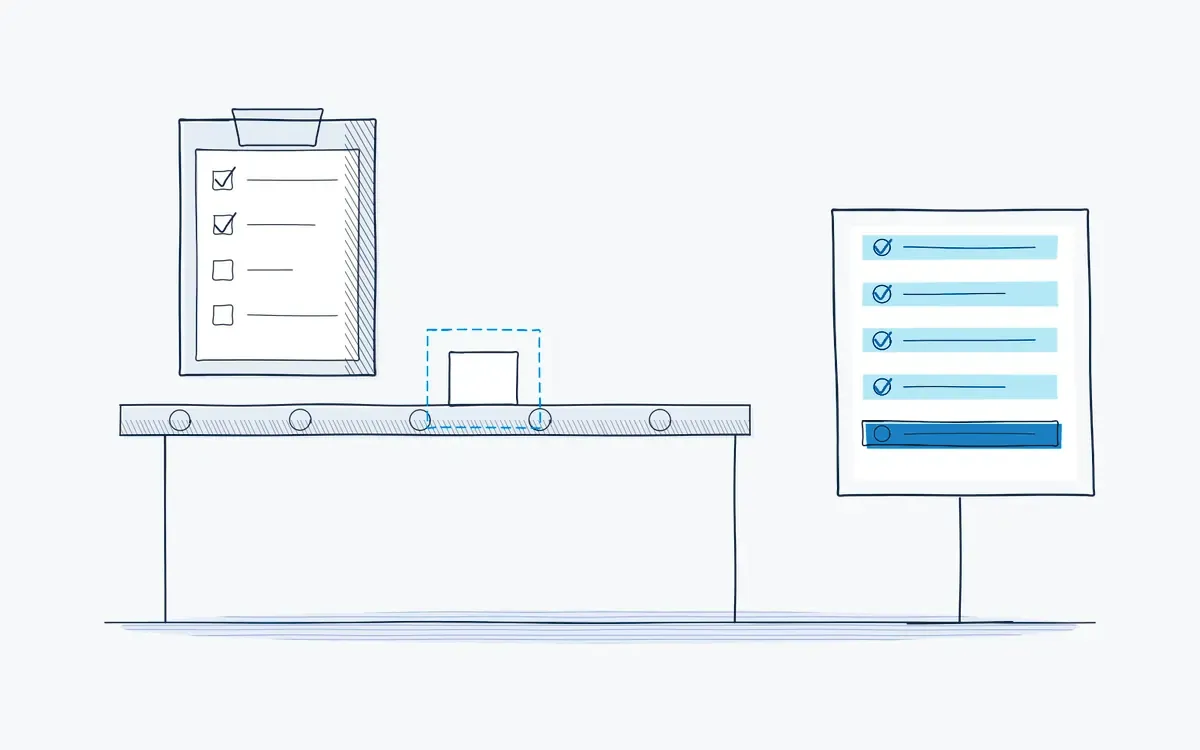
Why do mix-ups still happen?
- One leftover leaflet or label roll ends up in the next batch.
- Hidden spots (reject bins, under guides, in the feeder) are not checked.
- The checklist is signed at the end of the shift instead of at the line.
- The second check is a signature, not a real inspection.
What is line clearance and when is it required?
Line clearance is the documented check that a line is free of everything from the previous operation. The EU GMP Guide (Part I, Chapter 5) requires that work areas and equipment are free of materials, products and documents not needed for the current operation before processing starts. In the US, 21 CFR 211.130 requires inspection of packaging and labeling facilities immediately before use. Perform it at every batch change, product change and after maintenance.
The line clearance checklist
Header
| Field | Entry |
|---|---|
| Line / room | |
| Previous product / batch no. | |
| Next product / batch no. | |
| Date / time start | |
| Performed by (operator) | |
| Verified by (QA / second person) |
1. Removal of previous batch
- All finished product removed and reconciled
- All remaining components (bulk, blisters, bottles, caps) removed
- All printed materials (labels, leaflets, cartons) removed and reconciled
- Reject bins and sample containers emptied
- All batch documents of previous batch removed
2. Line-specific checks
| # | Location | Check | OK | NOK | Comment |
|---|---|---|---|---|---|
| 1 | Feeder / hopper | Empty, no product | [ ] | [ ] | |
| 2 | Conveyors and guides | No product or components, also underneath | [ ] | [ ] | |
| 3 | Labeler / printer | No old labels; print set to new batch | [ ] | [ ] | |
| 4 | Leaflet / carton feeder | Empty | [ ] | [ ] | |
| 5 | Vision / check systems | Configured for new product, tested | [ ] | [ ] | |
| 6 | Reject station | Empty | [ ] | [ ] | |
| 7 | Floor, benches, waste bins | Clear of product and printed material | [ ] | [ ] |
3. Cleaning and status
- Line cleaned according to cleaning SOP; cleaning log signed
- Status label changed to "cleaned / cleared"
- Change parts for new product fitted and checked
4. Release
- Materials for next batch delivered and checked against batch record
- Operator sign-off ______ Time ______
- Independent verification (QA) ______ Time ______
- Line released for batch ______
How do you fill in the checklist?
- 1Make it line-specific. Replace section 2 with every place on your line where product or print can hide. Add photos of those spots.
- 2Reconcile printed materials. Count issued, used, destroyed and returned labels. Differences must be investigated before release.
- 3Check, then sign. Fill in at the line, step by step, with the time. Retrospective signatures undermine data integrity (ALCOA+).
- 4Independent second check. QA or a trained second person physically inspects; they do not just countersign.
- 5NOK = stop. Any NOK blocks release until resolved and documented.
Example (blister packaging line, extract)
| Location | Finding | Status |
|---|---|---|
| Blister feeder | 2 tablets in feed channel | NOK → removed, recleaned, OK 10:42 |
| Carton feeder | Empty | OK |
| Labeler | Old roll removed, new batch code verified | OK |
From paper to digital with Actarion
- AR on hidden spots: the operator is guided to every location on the line, including the ones people forget.
- Photo evidence: a photo per critical location, time-stamped.
- Real-time data: no retrospective signatures; each step is logged when it is done, supporting ALCOA+.
- Remote QA verification: QA can review photos and confirm remotely where your procedures allow it.
See the quality inspections use case.
Frequently asked questions
Line clearance is the documented verification that a line is free of all materials, products and documents of the previous batch before a new batch starts.
Operators perform it; QA or a trained second person independently verifies it before release.
At every batch or product change, after maintenance on the line, and after cleaning.
Yes. Food and beverage lines use it to prevent allergen and label mix-ups.