SOP Template for Manufacturing: Free and Audit-Ready
Free SOP template for manufacturing: purpose, scope, roles, procedure, records and revision history. With fill-in guide and example. Copy it into your own system.

Short answer
An SOP template (standard operating procedure template) is a controlled format that defines a process: its purpose, scope, responsibilities, procedure steps, records and revision history. This free SOP template follows common ISO 9001 and GMP practice. Use it to standardize processes, then let Actarion turn the procedure into AR-guided digital work instructions.
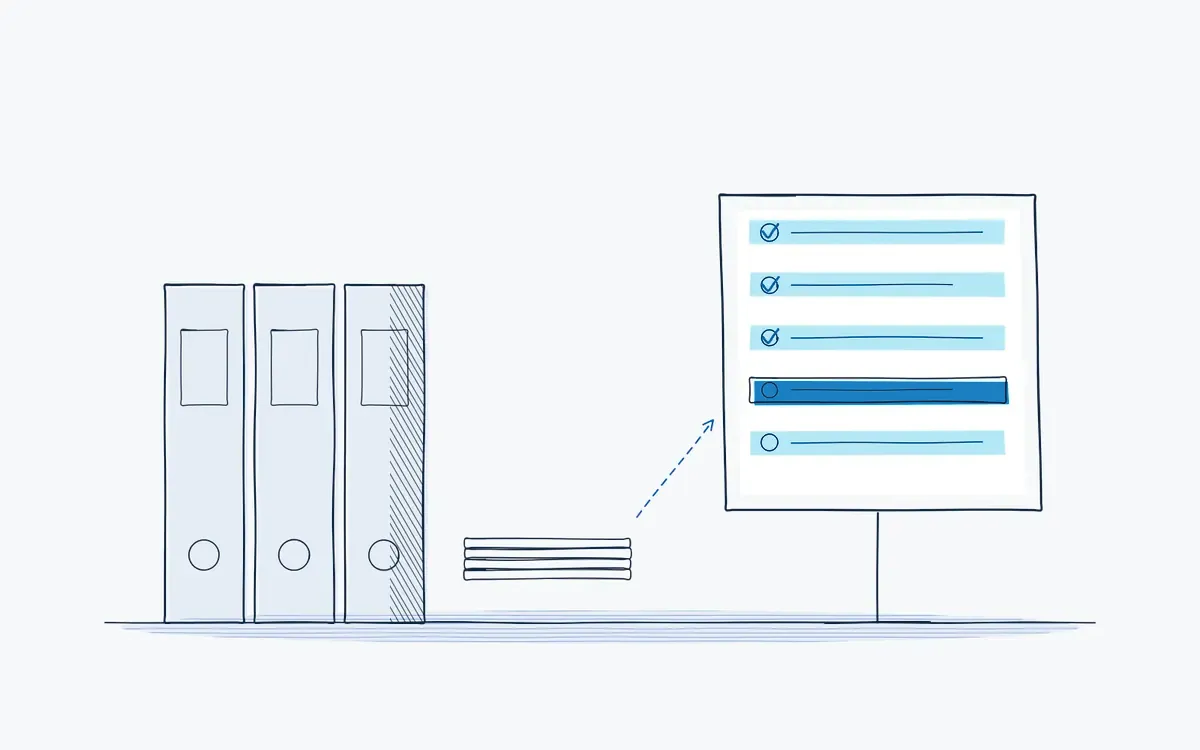
Why do SOPs end up in a binder?
- They are written for the auditor, not for the person doing the work.
- Review dates pass without anyone noticing.
- Nobody can show who was trained on which revision.
- Operators follow the "real" method, not the written one.
What is an SOP and when do you need one?
An SOP is a document that describes what must happen in a process, who is responsible and which records prove it was done. You need one for every process that affects product quality, safety or compliance. Task-level detail goes into a work instruction, which the SOP references.
The SOP template
| Section | Content |
|---|---|
| 1. Header | Title · SOP number · Revision · Effective date · Next review date · Page x of y |
| 2. Purpose | Why this SOP exists (1–2 sentences) |
| 3. Scope | Which sites, lines, products and activities are covered, and which are not |
| 4. Definitions | Terms and abbreviations used |
| 5. Responsibilities | Role → responsibility (see table below) |
| 6. Safety and prerequisites | PPE, hazards, training required, materials and equipment |
| 7. Procedure | Numbered steps (see table below) |
| 8. Records | Forms, logs and where they are kept, retention period |
| 9. References | Related SOPs, work instructions, standards |
| 10. Revision history | Revision, date, change, author |
| 11. Approval | Author, reviewer, approver: name, signature, date |
Responsibilities
| Role | Responsibility |
|---|---|
Procedure
| Step | Action | Responsible | Record / output | Reference (WI) |
|---|---|---|---|---|
| 7.1 | ||||
| 7.2 | ||||
| 7.3 | ||||
| 7.4 |
Revision history
| Rev. | Date | Description of change | Author |
|---|---|---|---|
| 00 | First issue |
How do you fill in the SOP template?
- 1Purpose and scope. be explicit about what is out of scope. Most audit findings come from unclear boundaries.
- 2Responsibilities. use roles, not names. People change, roles stay.
- 3Procedure. one action per step, written as an instruction ("Verify…", "Record…"). Link to work instructions for detailed tasks.
- 4Records. name every form or log that proves the step happened. Auditors ask for these first.
- 5Revision history and approval. never overwrite. Every change gets a new revision and approval. In GMP environments this supports data integrity (ALCOA+).
- 6Review. set a review interval, typically one to three years, or sooner after any process change.
Example: SOP for line start-up after cleaning
| Step | Action | Responsible | Record |
|---|---|---|---|
| 7.1 | Verify cleaning is signed off in the cleaning log | Operator | Cleaning log |
| 7.2 | Complete the pre-shift checklist | Operator | Pre-shift checklist |
| 7.3 | Perform line clearance before introducing materials | Operator + QA | Line clearance record |
| 7.4 | Produce first article and inspect | Quality inspector | First-article report |
| 7.5 | Release line for production | Team leader | Batch record |
From paper to digital with Actarion
- AI conversion: Actarion converts existing SOPs (Word, PDF) into structured, step-by-step digital instructions.
- AR guidance: operators execute each step on a tablet or AR glasses instead of reading a binder.
- Proof of execution: time stamps, confirmations and deviations are logged per step, ready for audit.
- Training per revision: see who was trained on which revision, directly in the skills matrix.
- Controlled release: only the approved revision is available on the shop floor.
Learn more about SOP software.
Frequently asked questions
At minimum: purpose, scope, responsibilities, procedure, records, references, revision history and approval.
As short as possible. Most manufacturing SOPs fit on two to five pages; detail belongs in work instructions.
Set a fixed interval, commonly one to three years, and review immediately after process, equipment or regulatory changes.
The structure follows common GMP practice. Compliance depends on your document control, approvals and training records.