Pre-Start Checklist: Free Template for Every Shift and Machine
Free pre-start checklist for machines and production lines: safety, condition, utilities, materials and handover checks before every shift. With example.

Short answer
A pre-start checklist is a short check an operator completes before starting a machine or line at the beginning of a shift. It confirms that guards and emergency stops work, the machine is in good condition, utilities and materials are ready and the previous shift's issues are known. Actarion makes it a guided digital check.
Why do problems show up an hour into the shift?
- A guard or E-stop fault is noticed only when someone needs it.
- Low oil or air pressure causes a stop that a quick check would have caught.
- The previous shift's problem was not handed over.
- The paper check sheet is ticked in one go without looking.
What is a pre-start checklist and when do you use it?
A pre-start (or pre-shift) checklist is a daily operator check of safety, condition and readiness before production starts. It is a core part of autonomous maintenance in TPM (Total Productive Maintenance). For powered industrial trucks, OSHA 1910.178(q)(7) requires an examination before use at least daily. For other machines, a pre-start check is the practical way to catch defects early.
The pre-start checklist
Header: Machine / line ______ · Shift ______ · Operator ______ · Date / time ______
1. Handover
- Shift handover read; open issues from previous shift known
- Any machine tagged out or under maintenance? If yes, do not start
2. Safety
| # | Check | Standard | OK | NOK |
|---|---|---|---|---|
| 1 | Emergency stop buttons | Tested, machine stops | [ ] | [ ] |
| 2 | Guards and interlocks | In place, door opens = stop | [ ] | [ ] |
| 3 | Light curtains / scanners | Clean, functional | [ ] | [ ] |
| 4 | Warning signs and floor markings | Visible, undamaged | [ ] | [ ] |
| 5 | Required PPE | Available and worn | [ ] | [ ] |
3. Machine condition
| # | Check | Standard | OK | NOK |
|---|---|---|---|---|
| 6 | Leaks (oil, air, water, product) | None | [ ] | [ ] |
| 7 | Oil / lubricant levels | Between min and max | [ ] | [ ] |
| 8 | Air pressure | ___ bar ± ___ | [ ] | [ ] |
| 9 | Abnormal noise, vibration, smell at start-up | None | [ ] | [ ] |
| 10 | Belts, chains, tooling | No visible damage | [ ] | [ ] |
| 11 | Sensors and cameras | Clean | [ ] | [ ] |
4. Readiness
| # | Check | Standard | OK | NOK |
|---|---|---|---|---|
| 12 | Work order and specification | Correct and current | [ ] | [ ] |
| 13 | Materials and packaging | Available, correct batch | [ ] | [ ] |
| 14 | Settings / recipe | Matches order | [ ] | [ ] |
| 15 | Work area | Clean, 5S standard OK | [ ] | [ ] |
NOK action: describe ______ · Reported to ______ · Machine started? [ ] Yes [ ] No
Sign-off: Operator ______ · Team leader (if NOK) ______
How do you fill in the checklist?
- 1Machine-specific. adapt items 6–11 to your machine. Add the actual values (pressure, levels) to the standard column.
- 2Order matters. handover and safety first. Never start a machine with a safety NOK.
- 3Physically check. press the E-stop, open the guard. A tick without a test is not a check.
- 4Escalate NOKs. define which NOKs block start-up (all safety items) and which can be logged for maintenance.
- 5Keep it short. 10 to 20 items, five to ten minutes. Longer lists get skipped.
Example (filling machine, early shift)
| Check | Result |
|---|---|
| E-stop test | OK |
| Air pressure 6 bar ± 0.5 | 5.2 bar → NOK, reported to maintenance, started after fix at 06:25 |
| Settings match order | OK |
From paper to digital with Actarion
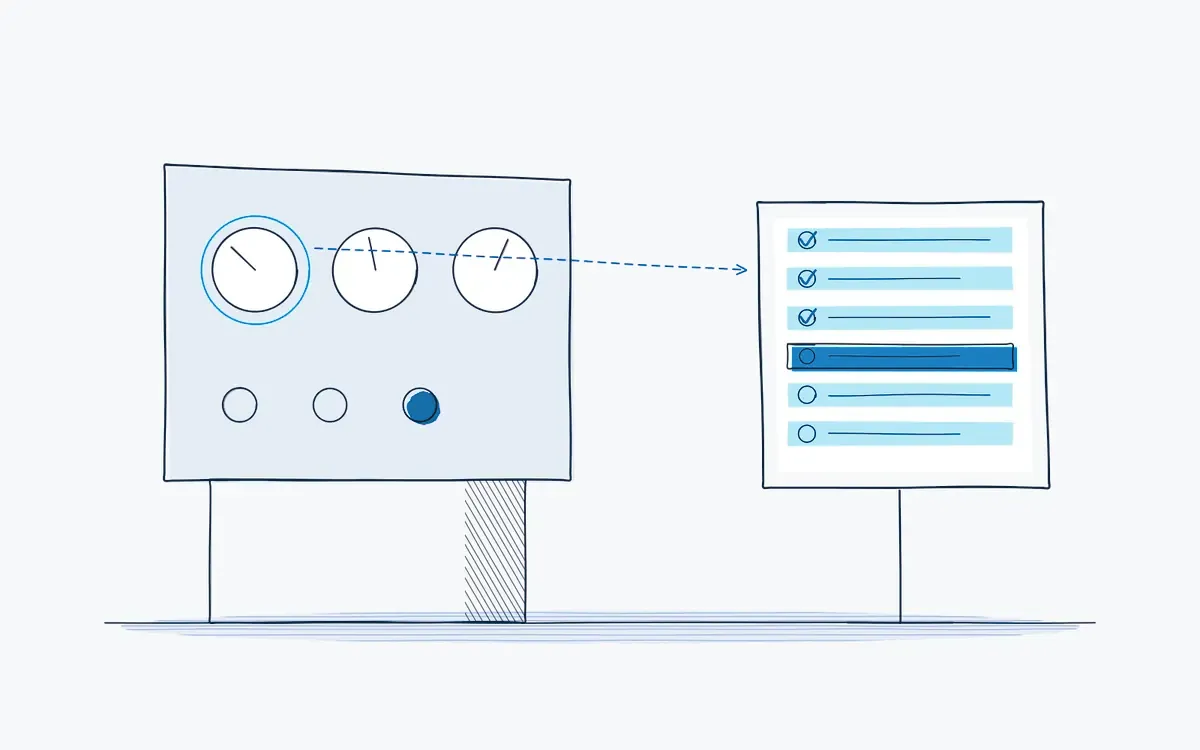
- Guided check: each item appears on a tablet or AR glasses at the right spot on the machine.
- Enforced order: the start-up step only opens after all safety items are confirmed.
- Instant escalation: a NOK notifies maintenance or the team leader immediately.
- Audit trail: every check is time-stamped per operator and machine, with no back-filled sheets.
See digital checklists.
Frequently asked questions
Handover, safety devices, machine condition, utilities, and readiness of order, materials and settings.
Five to ten minutes for most machines. If it takes longer, split daily and weekly items.
The operator who will run the machine, at the start of every shift or before first use.
Safety failures block start-up until fixed. Other failures are reported and assessed by the team leader or maintenance.