Lockout Tagout Procedure Template: Machine-Specific and OSHA-Aligned
Free lockout tagout procedure template per OSHA 1910.147: energy sources, shutdown, isolation, verification and release. With fill-in guide and example.

Short answer
A lockout tagout procedure is a machine-specific document that tells authorized employees how to shut down, isolate, lock, release stored energy and verify zero energy before service or maintenance. This free lockout tagout procedure template follows the structure of OSHA 29 CFR 1910.147 and common EU practice (EN ISO 14118). Actarion guides each LOTO step with AR and logs it.
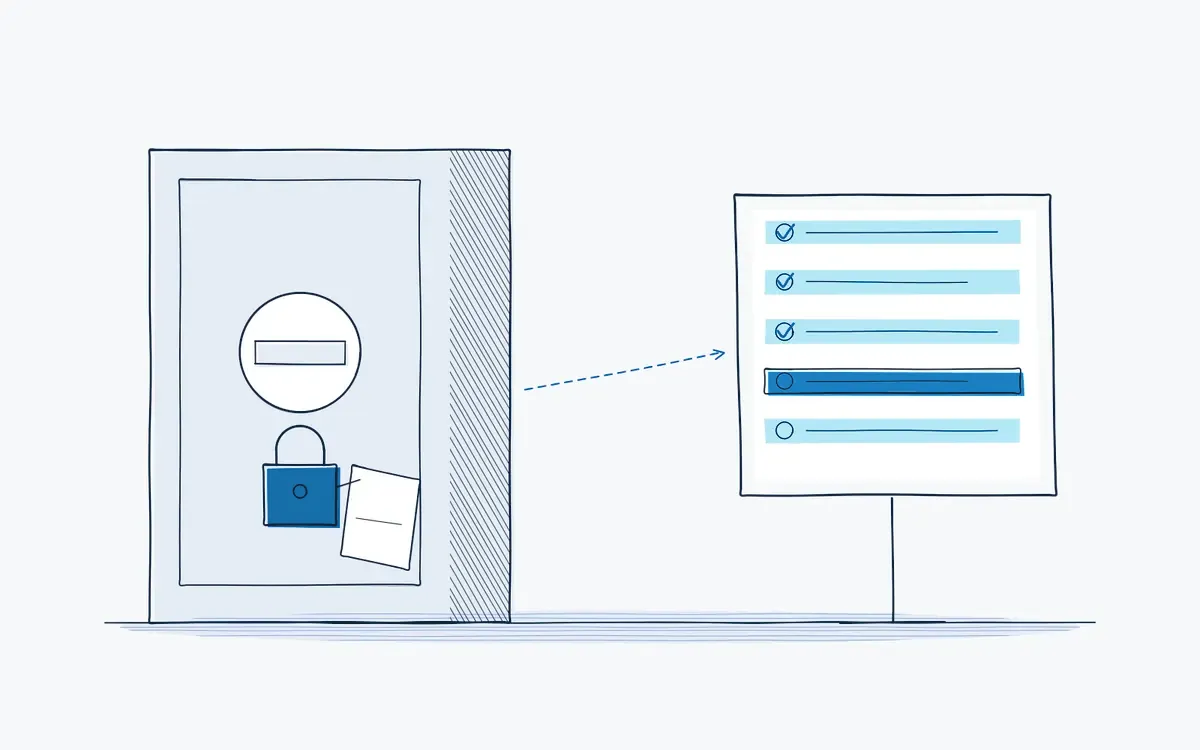
Why do lockout procedures fail?
- A generic plant-wide procedure does not show where the isolation points are on this machine.
- Stored energy (pneumatics, springs, gravity) is forgotten.
- The verification step, the try-start, is skipped under time pressure.
- There is no record of who locked out what, and when.
What is a LOTO procedure and when is it required?
Lockout/tagout (LOTO) is the practice of isolating all energy sources and securing them with personal locks so a machine cannot start or move during servicing. In the US, OSHA 1910.147 requires a documented energy control procedure for each machine with more than one energy source, plus training and annual periodic inspections. In the EU, employers must prevent unexpected start-up under the Work Equipment Directive 2009/104/EC and national rules; EN ISO 14118 describes the technical principles. This template is a starting point. Your HSE team must validate it per machine.
The lockout tagout procedure template
Header
| Field | Entry |
|---|---|
| Machine / equipment and ID | |
| Location | |
| Procedure number / revision / date | |
| Purpose and scope (which tasks) | |
| Authorized employees (role) | |
| Affected employees (role) | |
| Required lockout devices | |
| Prepared by / approved by |
Energy sources and isolation points
| # | Energy type | Magnitude | Isolation device and location | Lock / tag method | Stored energy release | Verification method |
|---|---|---|---|---|---|---|
| E1 | Electrical | ___ V | Try-start + voltage test | |||
| P1 | Pneumatic | ___ bar | Bleed valve | Gauge reads 0 | ||
| H1 | Hydraulic | ___ bar | Depressurize accumulator | Gauge reads 0 | ||
| M1 | Mechanical / gravity | Block / lower load | Visual | |||
| T1 | Thermal / chemical | Cool down / drain | Measurement |
Lockout sequence
| Step | Action | Done |
|---|---|---|
| 1 | Prepare: identify all energy sources from the table above | [ ] |
| 2 | Notify affected employees that lockout will be applied | [ ] |
| 3 | Shut down the machine with normal stop controls | [ ] |
| 4 | Isolate every energy source at its isolation device | [ ] |
| 5 | Apply locks and tags: one personal lock per authorized employee on each isolation point (use a hasp or group box) | [ ] |
| 6 | Release stored energy: bleed, block, discharge, cool down | [ ] |
| 7 | Verify zero energy: clear the area, press start, check gauges and test voltage, return controls to off | [ ] |
Release from lockout
| Step | Action | Done |
|---|---|---|
| 1 | Remove tools, refit guards, check machine is intact | [ ] |
| 2 | Check that all employees are clear | [ ] |
| 3 | Notify affected employees | [ ] |
| 4 | Each employee removes their own lock and tag | [ ] |
| 5 | Re-energize and test run | [ ] |
Sign-off: Authorized employee ______ · Date / time on ______ off ______
How do you fill in the template?
- 1One procedure per machine. Walk the machine with maintenance and HSE. Photograph every isolation point.
- 2Energy table. include all types: electrical, pneumatic, hydraulic, gravity, springs, thermal, chemical. Missing one is the most common cause of injuries during LOTO.
- 3Locks. every person working on the machine applies their own lock. Never lock out for someone else.
- 4Verification. always try to start the machine after isolation. Return the control to off afterwards.
- 5Shift change. describe how locks are transferred so protection is never interrupted.
- 6Review. inspect the procedure in use at least annually, as OSHA requires.
Example (horizontal packaging machine, extract)
| # | Energy | Isolation point | Release | Verify |
|---|---|---|---|---|
| E1 | 400 V electrical | Main disconnect, cabinet door | Wait 2 min for drive discharge | Try-start, test voltage |
| P1 | 6 bar pneumatic | Lockable ball valve with dump, rear | Bleed via dump valve | Gauge 0 bar |
| M1 | Sealing jaw (gravity) | n/a | Lower to bottom stop | Visual |
From paper to digital with Actarion
- AR on the isolation point: each lockout step is shown on the actual switch or valve, on tablet or AR glasses.
- No skipped steps: the next step only opens after confirmation or a photo of the applied lock.
- Audit trail: who applied which lock, when, and the verification result, per machine.
- Training: new technicians learn the machine-specific procedure with guidance before working alone.
See the safety and LOTO use case.
Frequently asked questions
Prepare, notify, shut down, isolate, apply locks and tags, release stored energy and verify zero energy. Release follows its own sequence.
Under OSHA 1910.147, yes, unless the machine meets all conditions of the exception, such as a single energy source that can be locked by one device.
Lockout physically prevents operation with a lock. Tagout is a warning tag only and is allowed under OSHA only when a device cannot be locked out, with additional safeguards.
OSHA requires a periodic inspection at least annually by an authorized employee other than those using the procedure.