
Whitepaper · frontline worker training
The frontline training and onboarding playbook
How manufacturing, pharma, food and maintenance teams bring new operators and technicians to independent, safe work faster, with a skills matrix, a structured onboarding plan and digital and AR work instructions
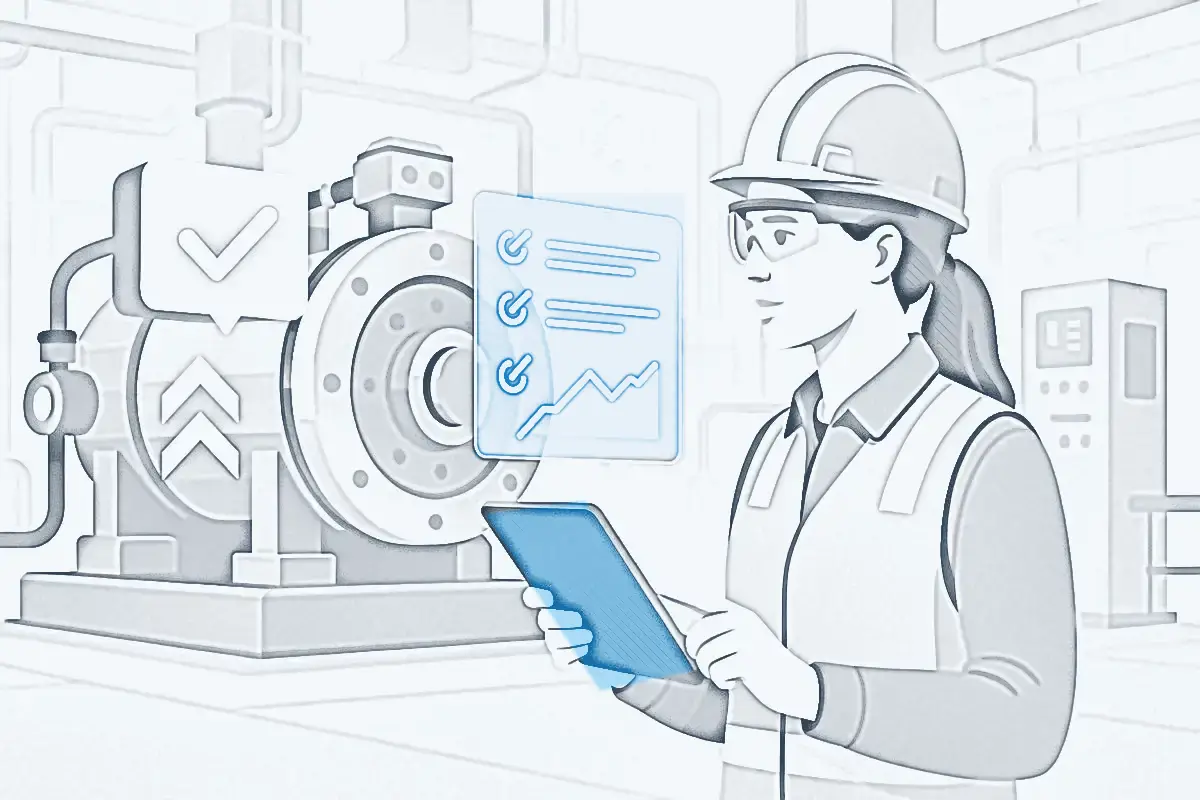
The frontline training and onboarding playbook
Just the newsletter?
Once a month: a practical example, a KPI to steer on and news from DeepSight.
Key takeaways
- Manage onboarding on time-to-competence per task, not on the number of training days completed.
- A skills matrix with four levels turns training into a plan: who can do what, who can teach it and where the gaps are.
- Digital and AR work instructions let new operators learn at the workstation, while the trainer coaches instead of repeating the same explanation.
- Measure before you start: a baseline of current onboarding time and first-time-right is the only way to prove improvement.
Chapters
01 · Why does frontline onboarding take so long?
Because most of the knowledge new operators need is not written down usably: it sits in the heads of a few experienced colleagues who also have to keep production running. Onboarding then depends on who happens to be on shift.
02 · How do you define competence with a skills matrix?
List the tasks per workstation, define four competence levels and record per person which level has been reached and signed off. The matrix then shows gaps, single points of failure and who can train whom.
03 · What does a structured onboarding plan look like?
A structured onboarding plan sequences safety, basic tasks and progressively more complex tasks over a fixed number of weeks, with a defined sign-off moment per step. It makes onboarding predictable and independent of who is on shift.
04 · How do digital and AR work instructions support training on the job?
They put the standard at the workstation: the new operator sees each step, with photos, video or AR overlays on the real equipment, in their own language. The trainer coaches and checks instead of explaining every step again.
05 · How do you train a multilingual workforce with limited trainer capacity?
Offer instructions in the operators' own languages, rely on visuals more than text, and protect trainer time explicitly in the shift plan. Scale trainer capacity by training more level-4 colleagues rather than by adding classroom hours.
06 · How do you manage certifications and requalification?
Give every critical task a validity period, plan requalification from the skills matrix and use instruction runs plus observation as evidence. This keeps competence current after process changes and during audits.
07 · How do you measure results and roll out in 90 days?
Measure time-to-competence, first-time-right in the first weeks, trainer hours and early retention, starting with a baseline before you change anything. Then follow a 30-60-90 day plan from one pilot line to a repeatable approach.
Frequently asked questions
What is the difference between training and onboarding?
Onboarding is the whole process of bringing a new employee to independent work, including preboarding, safety, social integration and administration. Training is the part that builds task competence. This playbook links both through the skills matrix.
How long should operator onboarding take?
It depends on the complexity of the tasks and the level of regulation. Rather than a fixed number of weeks, define the target level per task and measure time-to-competence. Many plants use an 8 to 12 week plan for a first workstation as a starting point.
Is AR necessary for good frontline training?
No. Step-by-step digital instructions on a tablet cover most tasks. AR adds value for spatial tasks, such as locating components on large equipment or complex assembly. Choose the format per task.
How do we keep training content current?
Assign a content owner and review date to every instruction, let operators flag unclear steps, and link instruction changes to requalification of qualified staff.
Can we use instruction logs to assess individual employees?
Only within the agreements made with your data protection officer and works council. Most organisations use logs for training progress and quality traceability, and report performance at team level.


Rather get a direct answer to your question? Talk to an expert.
In 30 minutes we look at your process, your numbers and the fastest route to a measurable pilot. No sales pitch, just concrete advice.