
Whitepaper · digital work instructions
Digital work instructions: the practical guide for manufacturing
From paper binders to digital and AR-guided work instructions: what they are, where AI and AR genuinely help, and how to roll them out in four phases
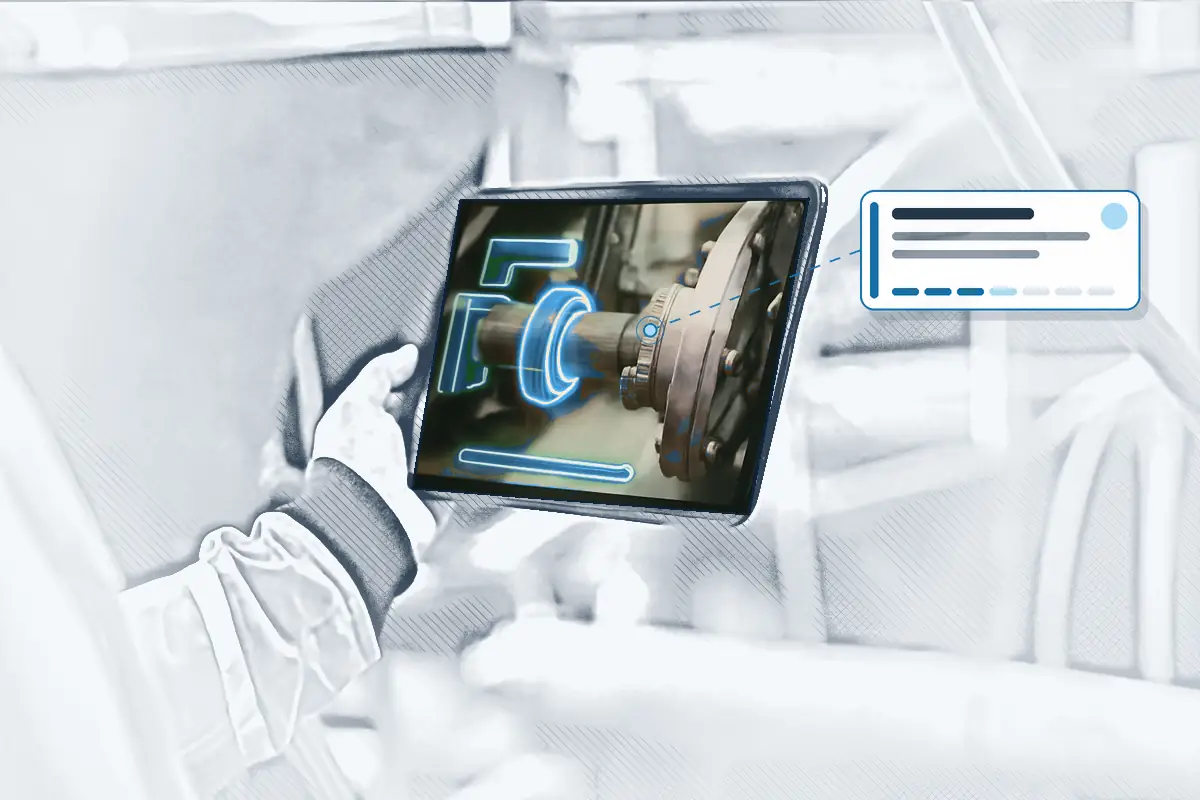
Digital work instructions
Just the newsletter?
Once a month: a practical example, a KPI to steer on and news from DeepSight.
Key takeaways
- Digital work instructions only pay off on processes with a measurable problem: errors, long onboarding, many variants or safety-critical steps.
- A tablet with clear photos solves most problems; AR is worth it where location, orientation or sequence in 3D is the real difficulty.
- AI shortens authoring and translation considerably, but a subject-matter expert must always review and approve the result.
- Measure a baseline before the pilot, otherwise you cannot prove anything afterwards.
- Adoption is decided on the shop floor: involve operators in writing and testing, and make feedback on instructions easy.
Chapters
01 · What are digital work instructions?
Digital work instructions are step-by-step procedures that an operator follows on a device at the workstation, instead of in a binder or PDF. Each step combines a short instruction, a visual and, where needed, a check or confirmation that is recorded automatically.
02 · Where does AI help with work instructions?
AI helps mainly in authoring and maintenance: turning photos, video and speech into draft steps, and translating instructions. It does not replace the subject-matter expert, who remains responsible for content and safety.
03 · When does AR add value, and when is a tablet enough?
AR adds value where the difficulty is spatial: finding the right part, connector or bolt in a complex machine, or performing steps in a precise 3D sequence. For linear tasks with clear visuals, a tablet is usually enough.
04 · How do you write a good work instruction?
A good work instruction has one action per step, starts with a verb, shows the result visually and states only what the operator needs at that moment. Write for the least experienced person who has to perform the task.
05 · How do you roll out digital work instructions in four phases?
Roll out in four phases: choose the right process, measure a baseline, run a time-boxed pilot with clear success criteria, and then scale using a fixed standard for content and governance.
06 · How do you get operators to actually use the instructions?
Adoption follows from usefulness: operators use digital instructions when these are faster and clearer than asking a colleague. Involve them in writing, give team leaders a clear role and act visibly on feedback.
07 · Checklist: are you ready for digital work instructions?
Use this checklist to determine whether your organisation is ready to start a pilot. If you can tick most items, you can start within a few weeks.
Frequently asked questions
What is the difference between work instructions and an SOP?
An SOP describes what must happen and who is responsible, often at process level. A work instruction describes step by step how a specific task is performed at the workstation. Digital work instructions make the SOP executable.
Do we need smart glasses for AR work instructions?
No. Most AR applications run on tablets and smartphones. Smart glasses are useful when both hands are needed throughout the task, but they require more change management.
How long does a pilot take?
A focused pilot on one or two processes usually takes 6 to 12 weeks, including baseline measurement, content creation, training and evaluation.
Can AI write work instructions on its own?
AI can generate a good draft from video, photos or existing documents and translate it. A subject-matter expert must always review and approve the content, especially for safety-critical steps.
Do digital work instructions need to be integrated with MES or ERP?
Not for a pilot. Integration becomes relevant when scaling, for example to open the right instruction from a work order or to send execution data to quality systems.


Rather get a direct answer to your question? Talk to an expert.
In 30 minutes we look at your process, your numbers and the fastest route to a measurable pilot. No sales pitch, just concrete advice.