Knowledge Capture in Manufacturing: Secure Expertise Before It Leaves
Contents

Short answer
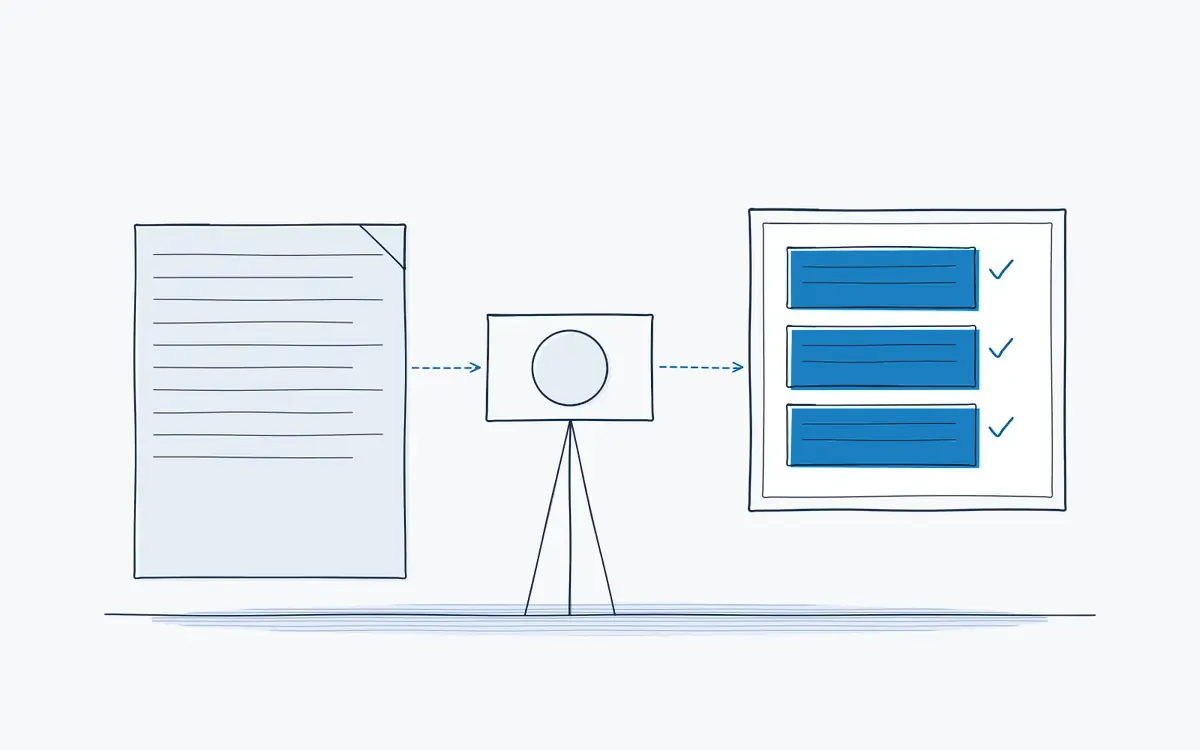
Knowledge capture is the systematic recording of the know-how of experienced employees, especially the unwritten tricks, so others can perform the work to the same standard. In manufacturing it is urgent because experienced operators and technicians retire. Actarion captures expert work on video, turns it into digital work instructions with AI and lets new people follow it with AR guidance.
Why is knowledge walking out the door?
- Your most experienced technician retires next year, and only he can fix the old extruder.
- Critical tasks are done by feel: "you hear when it's right".
- Documentation is decades old and does not match the modified machine.
- New hires take longer to reach the same level, and there are fewer of them.
What is knowledge capture?
Knowledge capture turns tacit knowledge (what an expert knows but rarely writes down) into explicit knowledge (instructions others can follow). Knowledge transfer is the next step: making sure others actually learn and apply it.
| Type of knowledge | Example | Best way to capture |
|---|---|---|
| Explicit | Torque values, settings | Document, checklist |
| Procedural | Sequence of a changeover | Step-by-step work instruction |
| Tacit / sensory | Sound of a worn bearing, feel of a good seal | Video with expert commentary, OK/NOK examples |
| Decision knowledge | What to do when alarm X appears | Decision tree, troubleshooting guide |
How do you capture and transfer knowledge in 6 steps?
- 1Map the risk. Which tasks depend on one or two people, and when do they leave? A skills matrix shows this quickly.
- 2Prioritize. Critical, rare and person-dependent tasks first.
- 3Capture at the workstation. Film the expert doing the task, from their point of view, and let them explain out loud.
- 4Convert to instructions. Turn the video and notes into step-by-step instructions with photos and checks.
- 5Validate with a second person. Let someone else perform the task with the instruction while the expert watches.
- 6Transfer and track. Train successors with the instruction and record in the skills matrix when they are qualified.
The knowledge transfer plan template helps you plan this per person.
Example
A paper mill has one senior technician who knows how to realign the felt guide rolls after a breakdown.
- 1He wears glasses with a camera during the next realignment and talks through wha. He wears glasses with a camera during the next realignment and talks through what he does.
- 2The video is turned into a draft instruction of 22 steps, including three "liste. The video is turned into a draft instruction of 22 steps, including three "listen and feel" checks with OK/NOK clips.
- 3A younger technician performs the next realignment with the instruction, the sen. A younger technician performs the next realignment with the instruction, the senior watches and corrects two steps.
- 4The instruction is released, and two successors are trained before the senior re. The instruction is released, and two successors are trained before the senior retires.
Common mistakes
- Starting six weeks before retirement. Capturing and validating takes months.
- Asking experts to write it down themselves. Most won't, and it misses the tacit part.
- Interviews without the machine. Knowledge shows up when people work, not in a meeting room.
- Capturing but not transferring. A video in a folder is not a qualified successor.
How do you measure success?
Measure before you change anything. Record a baseline for two to four weeks, then compare after the rollout using the same definitions. These KPIs are the most useful:
| KPI | What it tells you | How you measure it |
|---|---|---|
| Critical tasks captured | Coverage of at-risk knowledge | Captured tasks vs tasks on the risk list |
| Trained backups per task | Whether knowledge is spread | People signed off per critical task |
| Expert calls | Whether others can work alone | Calls or escalations to the expert per week |
| Time to competence | How fast successors learn | Days to sign-off for captured tasks |
Keep the list short: three KPIs that the team leader reviews every week beat ten that nobody looks at. Agree on the definitions with quality and finance up front, so the results hold up in a business case.
How Actarion helps
- Capture on the job: record expert work with a phone, tablet or glasses.
- AI authoring: turn video and notes into a draft step-by-step instruction.
- AR guidance: successors follow the expert's method at the real machine.
- Skills matrix: see who is qualified and where knowledge still depends on one person, via technology partner DeepSight.
- Pilot on your most at-risk tasks first.
See knowledge capture.
Get started
Download the free knowledge transfer plan template.
Frequently asked questions
Know-how that exists only in the heads of experienced employees and is passed on informally, if at all.
Make it easy and respectful: film them at work, let them explain in their own words, and give them the role of reviewer and trainer.
Per task, the capture itself is often a single session; validation and training take longer. Plan per person well before they leave.
No. Video is a good source, but people need structured steps and checks to perform the task consistently.