
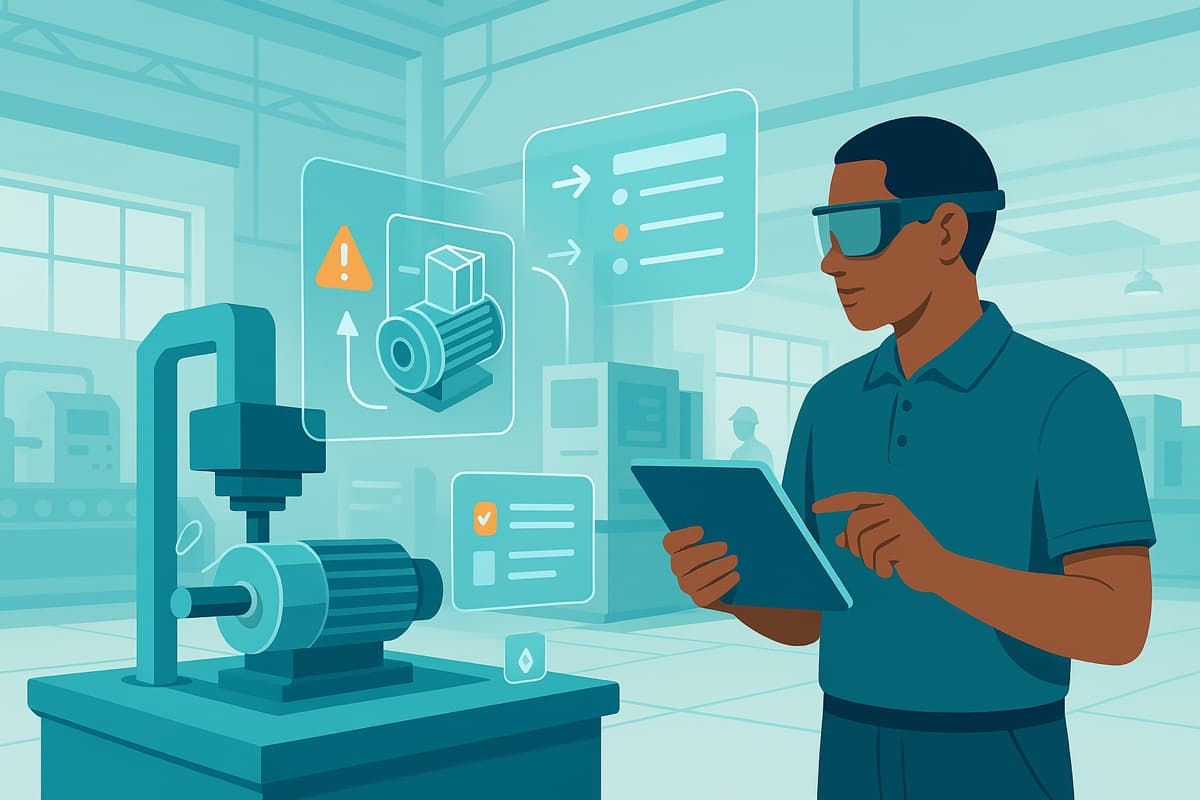
Operations, maintenance, training and HSE teams face a common challenge: how to ensure that frontline workers execute tasks correctly, safely and consistently—every time. AI and AR–guided work instructions offer a practical answer. This whitepaper explains what these technologies are, why they are becoming viable now, and how operations teams can apply them to reduce errors, shorten onboarding, improve safety and preserve critical know-how.
The challenge operations teams face today
Industrial organisations are under pressure from multiple directions. Experienced workers are retiring faster than new talent can be trained. Knowledge that took decades to accumulate walks out the door when a senior technician leaves. Meanwhile, production complexity is increasing, product variants multiply, and customers demand higher quality with shorter lead times.
The result is a widening gap between what frontline workers need to know and what they can realistically learn through traditional training. Paper-based SOPs and classroom sessions cannot keep pace. Operators forget steps, skip checks, or improvise when they encounter unfamiliar situations. The consequences show up as quality escapes, safety incidents, unplanned downtime and compliance gaps.
At the same time, regulatory requirements are tightening. Auditors expect documented proof that procedures were followed. Operations managers need visibility into execution—not just whether a task was completed, but how it was performed and by whom.
Traditional approaches—more training, more supervision, more documentation—are reaching their limits. Teams need a better way to deliver the right guidance at the right moment, directly at the point of work.
What are AI and AR–guided work instructions?
AI and AR–guided work instructions combine three capabilities to support frontline workers during task execution:
-
Digital work instructions: Step-by-step procedures delivered on a device (tablet, smartphone, smart glasses) instead of paper. Each step includes clear visuals, checklists and decision logic. Completion data is captured automatically.
-
Augmented reality (AR): Visual overlays projected onto the real world, highlighting exactly where to look, what to do and in what sequence. AR guidance reduces ambiguity and helps workers navigate complex assemblies or equipment.
-
Artificial intelligence (AI): Algorithms that assist with content creation, translation, anomaly detection and continuous improvement. AI can turn photos and videos into structured instructions, suggest next steps based on context, or flag deviations from expected patterns.
Together, these technologies create a "see-what-I-see" experience for operators. Instead of memorising procedures or searching through manuals, workers receive contextual guidance as they perform each step. The system records what was done, enabling traceability and analytics.
Why AI and AR–guided work instructions are becoming practical now
Until recently, AR and AI remained confined to pilot projects and innovation labs. Several trends have changed the equation:
Hardware maturity: Tablets and smartphones are already present on most shop floors. Ruggedised devices, improved cameras and better battery life make mobile AR practical for industrial use. Smart glasses are maturing, offering hands-free operation for tasks that require both hands.
Workforce changes: The skills gap is no longer a future risk—it is a present reality. Companies cannot hire their way out of the problem. They need tools that make less experienced workers productive faster, while capturing what experts know before they leave.
AI-assisted authoring: Creating AR content used to require specialised skills and significant effort. New AI capabilities allow subject-matter experts to capture procedures using photos and videos, with software automatically generating step-by-step instructions and translations.
Continuous improvement needs: Operations leaders want data on how work is actually performed, not just whether it was completed. Digital work instructions generate execution analytics that feed Lean and Six Sigma initiatives.
These factors combine to lower the barriers that previously kept AR and AI out of mainstream operations. The question is no longer whether these technologies work, but how to apply them effectively.
Ready to estimate the impact? Use the ActARion ROI Calculator to see potential savings for training, errors, and downtime in your organisation.
Where AI and AR–guided work instructions add value
AI and AR–guided work instructions are not a solution in search of a problem. They address specific operational challenges where traditional methods fall short.
Onboarding and training new technicians
New hires typically shadow experienced colleagues for weeks or months before working independently. This ties up senior staff and delays productivity. With AR-guided onboarding, new operators follow step-by-step instructions at their own pace, with visual cues showing exactly what to do. Experts are freed to handle exceptions rather than routine supervision.
The result is shorter time-to-competence, higher first-time-right rates and reduced dependency on a few experienced people.
Learn more about onboarding and training with AR SOPs
Maintenance and troubleshooting
Maintenance technicians often face unfamiliar equipment, especially when supporting multiple sites or product lines. AR-guided procedures walk them through inspections, repairs and calibrations step by step. When they encounter something unexpected, remote expert support lets a specialist see what the technician sees and guide them in real time.
This reduces mean time to repair, lowers travel costs and keeps production running.
Explore preventive and predictive maintenance
Discover remote expert support for corrective maintenance
Safety, quality and compliance
High-risk tasks—lockout/tagout, confined space entry, critical quality checks—demand strict adherence to procedure. AR guidance ensures that safety steps are completed in the correct order, with mandatory confirmations and photo evidence where required. Audit trails are generated automatically, simplifying compliance reporting.
Quality inspections benefit similarly. Visual overlays highlight inspection points, and AI can assist with defect detection. The result is fewer escapes, faster audits and documented proof of conformance.
See how AR-guided assembly reduces errors and rework
Explore AR-guided changeovers for batch preparation
How AI and AR–guided work instructions work in practice
Implementing AI and AR–guided work instructions follows a straightforward cycle:
Capture: Subject-matter experts record procedures using photos, videos or screen captures. AI tools can assist by transcribing narration, identifying key steps and suggesting structure.
Build: Content authors assemble captured material into structured work instructions. The platform supports branching logic, checklists, timers and multimedia. Translations can be generated automatically and reviewed by native speakers.
Deploy: Instructions are published to the devices workers use—tablets, smartphones or smart glasses. Workers access the relevant procedure for their task, location or equipment. Offline access ensures guidance is available even without connectivity.
Improve: Execution data flows back to operations and training teams. Dashboards show completion rates, step durations, common errors and knowledge gaps. Content owners update instructions based on feedback and observed issues.
This cycle repeats continuously. As processes change, instructions are updated and redeployed. The system becomes a living repository of operational knowledge, not a static document library.
What operations teams should consider before getting started
Adopting AI and AR–guided work instructions is as much an organisational change as a technology project. Several factors influence success:
Devices: What hardware is already available? Tablets and smartphones offer a low-friction starting point. Smart glasses provide hands-free operation but require more change management. Start with the devices workers are comfortable using.
Content effort: Creating high-quality work instructions takes time. Prioritise high-impact procedures—those with frequent errors, long training times or safety-critical steps. AI-assisted authoring can accelerate content creation, but subject-matter expertise remains essential.
Adoption and change: Technology only delivers value if workers use it. Involve operators early, gather feedback and iterate. Celebrate quick wins to build momentum. Ensure supervisors and team leaders understand their role in supporting adoption.
Integration: Consider how digital work instructions connect to existing systems—MES, ERP, CMMS, LMS. Integration enables triggering the right procedure from a work order, syncing training records or feeding execution data into quality systems.
A phased approach—pilot, prove value, scale—reduces risk and builds internal capability.
Applying AI and AR–guided work instructions with ActARion
ActARion provides a platform for capturing, building, deploying and improving AI and AR–guided work instructions. Our approach focuses on making frontline workers successful from day one, while giving operations leaders the visibility they need.
We work with industrial, logistics and energy companies to digitise standard work, accelerate onboarding and preserve critical know-how. Together with our partner DeepSight, we deliver AR guidance that fits real-world constraints—ruggedised devices, offline operation, multilingual teams and integration with existing IT landscapes.
Our goal is not to replace experienced workers, but to multiply their impact. When expert knowledge is captured digitally, it becomes available to every operator, every shift, every site.
Explore what this looks like in your organisation
AI and AR–guided work instructions are not a distant future—they are being applied today in manufacturing, logistics and energy operations. The question is whether they fit your specific challenges and how to get started.
If you want to understand the potential impact, try the ROI calculator to estimate savings from reduced training time, fewer errors and less downtime.
If you prefer a conversation, schedule a discovery call to discuss your use case and see examples from similar organisations.
Related reading
AI-assisted content creation
- How AI can turn photos and videos into multilingual work instructions — Explore how AI accelerates the creation of step-by-step procedures from existing media.
- How AR and AI help capture expert knowledge before it walks out the door — Strategies for preserving institutional knowledge from retiring experts.
Implementation guidance
- From paper SOP to AR workflow: how to digitise work instructions step by step — A practical roadmap for transforming existing procedures.
- From pilot to global rollout: a practical roadmap for AR and AI in operations — How to scale from initial proof-of-concept to enterprise deployment.
Measuring success
- How to measure the ROI of AR and AI-guided work instructions — Key metrics and calculation methods for quantifying impact.
- The future of industrial training: how AR, AI and simulation come together — Where training technology is heading.
Related whitepapers:
- Digital work instructions and AR SOPs for standard work and compliance — For quality, HSE and compliance leaders focused on executable, auditable procedures.
- Connected worker platforms: enabling knowledge transfer and operational support — For teams evaluating connected worker solutions and understanding where AR adds value.
This whitepaper is intended as a reference guide for operations, maintenance, training and HSE professionals evaluating AI and AR–guided work instructions. For questions or feedback, contact us.