
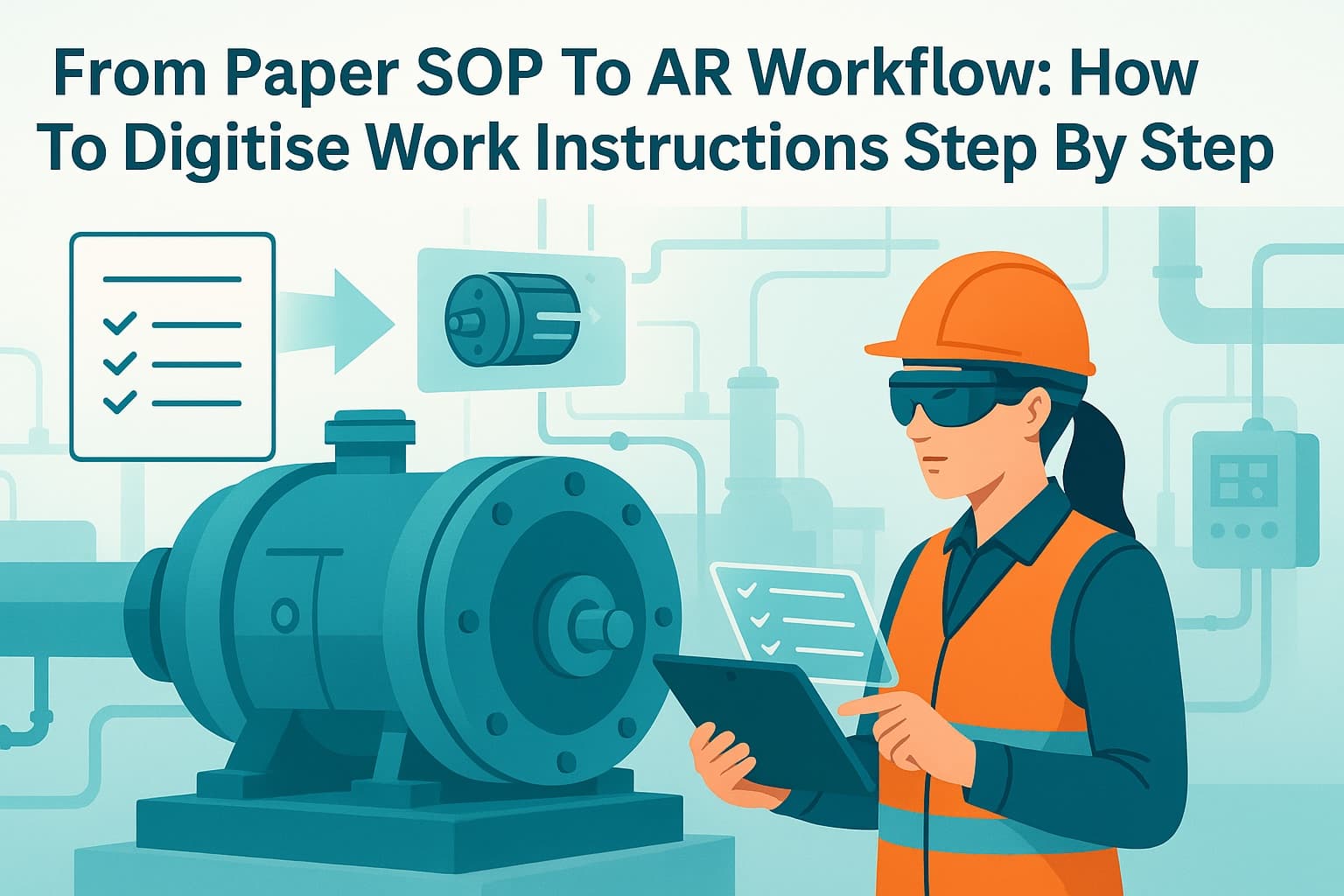
Paper SOPs have been the backbone of industrial operations for decades. But as teams face stricter compliance, more complex equipment, and workforce turnover, paper-based processes can't keep up. Digitising work instructions with AI and AR workflows helps operations, safety, and training leaders deliver safer, faster, and more consistent results—without the bottlenecks and risks of paper.
Why paper SOPs are holding industrial teams back
Paper-based SOPs (standard operating procedures) are familiar and easy to create. But they come with clear downsides that grow more costly as operations scale:
- Updates are slow and hard to track. Teams often use outdated instructions, risking quality and compliance.
- Information is static and hard to visualise. Operators interpret text and diagrams differently, leading to inconsistent execution.
- Training new technicians is time-consuming. Onboarding relies on shadowing and manual checks, not always on best practice.
- Compliance audits are manual and error-prone. Proving adherence means chasing signatures and physical records.
Many industrial leaders are now expected to demonstrate measurable improvement in safety, quality, and productivity. Relying on paper instructions makes this difficult, especially as equipment and regulatory demands increase.
According to a 2023 McKinsey report, digitising core processes can improve productivity by 20–30% and reduce compliance incidents by up to 50% in industrial settings ().
Why now is the time to digitise work instructions
The shift from paper SOPs to digital, AR-guided workflows is accelerating across manufacturing, energy, utilities, and other asset-intensive sectors. Several factors are driving this change:
- Aging workforce and skills gap: Experienced technicians are retiring, taking unwritten know-how with them. New hires need clear, visual guidance—fast.
- Increasing complexity: Equipment, processes, and regulations are more demanding. Visual and interactive work instructions reduce errors and training time.
- Remote and distributed teams: Operations need to ensure consistency across sites, shifts, and languages.
- Audit and compliance pressure: Digital records and real-time tracking simplify proof of compliance and continuous improvement.
Industrial leaders who delay digitisation risk higher incident rates, slower onboarding, and missed opportunities for process optimisation.
How AI and AR–guided work instructions solve common challenges
Digital work instructions—especially those delivered via AR headsets, tablets, or smart glasses—offer practical advantages over paper SOPs:
- Step-by-step visual guidance: Operators see exactly what to do, with images, animations, and 3D models overlaid on real equipment.
- Real-time data and AI support: Instructions can adapt to machine status, environmental conditions, or operator input.
- Instant updates and version control: All teams access the latest SOPs, and changes are tracked automatically.
- Built-in compliance and traceability: Digital logs capture who did what, when, and how—supporting audits and root cause analysis.
- Faster onboarding and upskilling: New technicians learn by doing, with hands-on support and contextual feedback.
These benefits drive measurable improvements in safety, quality, and productivity. For example, a global chemicals manufacturer reduced critical maintenance errors by 40% after digitising SOPs with AR guidance (Deloitte, 2022).
Step-by-step: moving from paper SOP to AR workflow
Digitising work instructions is not just about scanning documents. It requires a structured approach that combines process analysis, content digitisation, change management, and technology integration. Here's how to do it:
1. Map existing SOPs and prioritise
- Inventory all current paper SOPs, work instructions, and checklists.
- Identify high-impact processes: safety-critical, high-frequency, or error-prone tasks.
- Prioritise processes where digital guidance will deliver the most value (e.g., maintenance procedures, equipment changeovers, inspections).
2. Standardise and structure content
- Review SOPs for clarity, accuracy, and completeness.
- Break down instructions into clear, actionable steps.
- Remove ambiguity—use precise language, photos, and diagrams where possible.
3. Choose the right digital platform
- Select a platform that supports AI and AR–guided work instructions. Look for:
- Easy content authoring and updates
- Support for images, video, 3D models, and IoT integration
- Device flexibility (tablets, AR headsets, smartphones)
- Compliance tracking and analytics
Note: ActARion's platform is purpose-built for industrial teams, supporting rapid SOP digitisation and AR workflow deployment.
4. Convert SOPs to digital and AR format
- Digitise text, diagrams, and photos from paper SOPs.
- Create step-by-step digital instructions, adding AR overlays or animations where they add clarity.
- Use AI features to suggest improvements, automate translations, or flag missing steps.
5. Pilot with a core team
- Select a pilot group (e.g., maintenance technicians, HSE leads) to test the digital work instructions.
- Gather feedback on usability, clarity, and completeness.
- Monitor for reduction in errors, faster task completion, or improved compliance.
6. Train and roll out
- Provide hands-on training for operators, supervisors, and trainers.
- Use digital work instructions for onboarding new hires.
- Roll out across additional teams and processes based on pilot results.
7. Monitor, improve, and scale
- Use analytics to track adoption, task completion times, and compliance.
- Continuously update and improve instructions based on field feedback.
- Scale the AR workflow approach to more sites, lines, or functions.
Use cases: AR SOPs and digital work instructions in action
Digitising SOPs with AI and AR is already delivering results in operations, maintenance, HSE, and training across industries:
- Maintenance and repair: Technicians access step-by-step AR SOPs on-site, reducing errors and downtime. For example, a food processor cut unplanned stoppages by 30% after moving to AR-guided maintenance.
- Safety-critical tasks: HSE teams use digital checklists and AR overlays to verify PPE, lockout/tagout, and confined space entry, improving compliance and audit readiness.
- Onboarding and training: New operators follow guided digital work instructions during live tasks, reducing training time and ensuring best practices from day one.
- Quality inspections: Inspectors use digital workflows to record results, capture photos, and document non-conformances in real time—enabling faster response and traceability.
These use cases show that digital work instructions are not just a technology upgrade—they're a practical tool for measurable improvement.
Overcoming common barriers to digitising SOPs
Switching from paper to digital and AR-guided work instructions brings up concerns for many industrial leaders. Here's how to address the most common barriers:
- Hardware investment: Start with existing tablets or smartphones before scaling to dedicated AR devices. Many platforms are device-agnostic.
- Content creation workload: Focus first on high-impact SOPs. Modern platforms and AI tools make it faster to digitise and update instructions.
- Change management: Involve technicians, supervisors, and trainers early. Use feedback from pilots to refine workflows and build buy-in.
- Data security and compliance: Choose platforms with robust data controls, audit trails, and regulatory compliance (e.g., ISO, OSHA, FDA).
The key is to treat SOP digitisation as a phased, managed change—not an overnight switch.
What ActARion brings to your digital work instruction journey
ActARion partners with industrial leaders to make the shift from paper SOPs to AI and AR–guided work instructions practical and sustainable. Our approach focuses on:
- Rapid SOP digitisation: We help you map, standardise, and digitise your highest-priority instructions—often in days, not months.
- Tailored AR workflows: Our platform supports custom content, visual overlays, and integration with your existing equipment and data sources.
- Change management support: We guide your teams through pilots, training, and rollout—ensuring adoption and measurable results.
- Industrial-grade compliance: ActARion's solution delivers complete audit trails, version control, and analytics, supporting your quality and safety goals.
With ActARion, you move beyond static PDFs and paper to guided, data-driven workflows that make every technician safer, faster, and more consistent.
Explore what digitised work instructions could look like in your organisation
Digitising work instructions with AI and AR is a practical, proven way to boost safety, quality, and productivity—whether you're in operations, HSE, maintenance, or training leadership.
Schedule a discovery call to see how ActARion can help you move from paper SOPs to AR workflows for a process of your choice. It's exploratory, not a commitment. You'll get a practical roadmap and real-world examples tailored to your environment.
- Learn more about digital work instructions for industrial safety
- See how AR onboarding for technicians accelerates skills transfer
- For a deep dive on AR in manufacturing, see Deloitte's AR in manufacturing report
Go deeper
This article is part of our knowledge base on AI and AR–guided work instructions. For a comprehensive overview, read our whitepaper:
AI and AR–guided work instructions: a practical guide for operations teams — A practical guide covering what these technologies are, why they are becoming viable now, and how operations teams can apply them effectively.