
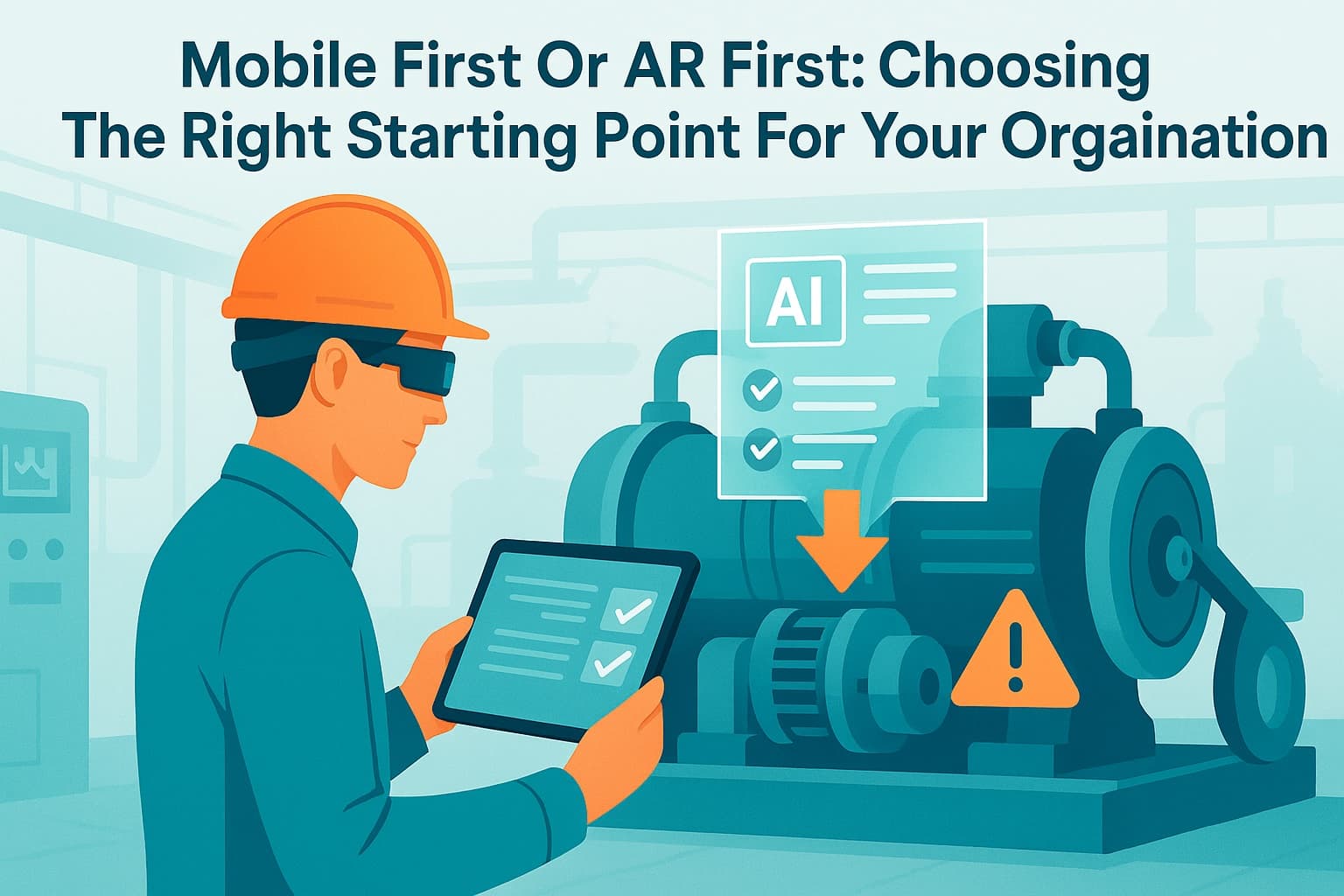
Industrial leaders face a critical decision: Should you digitise your standard operating procedures (SOPs) and work instructions with a mobile-first approach, or invest directly in AI and AR–guided workflows? This choice impacts productivity, safety, training efficiency, and digital maturity. Understanding which starting point fits your organisation can set the pace for measurable improvements in operations.
The context: digital work instructions in industry
Industries from manufacturing to energy and chemicals are under pressure to improve safety, compliance, and workforce productivity. Ageing workforces, increasing complexity, and evolving regulatory demands create a need for robust knowledge capture and transfer. Traditional paper-based SOPs and legacy systems often fall short—leading to errors, delays, and inconsistent outcomes.
Digital work instructions, delivered via mobile devices or augmented reality (AR) headsets, address these challenges by:
- Standardising procedures and reducing human error
- Supporting real-time guidance and documentation
- Enabling faster onboarding and upskilling
- Providing traceable compliance records
But the path to digitalising SOPs is not one-size-fits-all. The decision to start with mobile or AR depends on your current state, priorities, and readiness for change.
Why the choice between mobile first and AR first matters now
Digital transformation is no longer optional for industrial operations. However, the speed and scope of change must balance risk, cost, and business continuity. The choice between mobile first and AR first is about more than technology—it is about setting your teams up for success and scaling digital adoption sustainably.
Key trends driving this decision include:
- Workforce demographics: Many industrial teams are managing knowledge transfer as experienced technicians retire or shift roles. Mobile and AR tools both support skills capture, but differ in usability and impact.
- Regulatory requirements: Increasing documentation and compliance demands push organisations to digitise SOPs and evidence execution.
- Hardware maturity: Mobile devices are ubiquitous and familiar, while AR headsets are rapidly advancing but may require more investment and training.
- IT and change management: Integrations, cybersecurity, and user adoption must be considered for both approaches.
A clear, phased strategy helps avoid common pitfalls—such as stalled pilots, fragmented content, or low engagement.
Comparing mobile first and AR first approaches
What does mobile first mean?
A mobile-first approach digitises work instructions, checklists, and SOPs for use on smartphones and tablets. Teams access step-by-step guidance, capture photos or video as proof, and submit reports—all from familiar devices. Key features include:
- Digital SOPs and checklists
- Barcode scanning and asset tracking
- Photo and video capture for documentation
- Integration with existing maintenance or quality systems
- Offline access for remote sites
Mobile-first solutions are often easier to deploy at scale, with minimal hardware investment and lower training barriers.
What does AR first mean?
An AR-first approach delivers digital work instructions and AI-powered guidance through wearable devices like smart glasses or headsets. Information is overlaid directly onto the work environment, offering hands-free, context-aware support. Capabilities include:
- Step-by-step AR overlays on equipment or assets
- Real-time remote expert assistance (see-what-I-see)
- Automatic recognition of components and tasks using computer vision
- Hands-free operation for safety-critical or complex tasks
- Enhanced data capture (e.g., voice notes, video, sensor data)
AR-first projects often start with targeted use cases where hands-free operation or real-time context is crucial—such as complex assembly, inspections, or hazardous environments.
Side-by-side comparison
| Factor | Mobile First | AR First |
|---|---|---|
| Hardware | Smartphones, tablets (existing devices) | AR headsets, smart glasses (additional hardware) |
| User familiarity | High (minimal training) | Moderate (training required) |
| Hands-free operation | No | Yes |
| Upfront investment | Lower | Higher |
| Content creation | Digital forms, text, images, basic media | 3D overlays, AR content, AI integration |
| Use case fit | Broad, general SOPs, inspections | Complex, safety-critical, remote support |
| Scalability | Fast to deploy across large teams | Scalable, but may require staged rollout |
| Data capture | Photos, video, text, signatures | Video, voice, sensor data, computer vision |
How AI and AR–guided work instructions drive impact
Both mobile and AR approaches move organisations from static, paper-based SOPs to dynamic, data-driven processes. The difference lies in the level of guidance, automation, and user experience.
AI and AR–guided work instructions offer:
- Step-by-step guidance: Reduce cognitive load and standardise task execution.
- Context-aware support: AR overlays and AI-powered prompts adapt to real-world scenarios.
- Real-time documentation: Capture proof of work, compliance data, and operational insights.
- Remote collaboration: Connect field engineers with experts instantly for troubleshooting or approvals.
- Continuous improvement: Analyse execution data to identify bottlenecks, training needs, or safety risks.
For example, a maintenance manager can ensure that every technician follows the same validated process, with automatic documentation for audits. An HSE manager can deploy interactive safety checklists that adapt based on site conditions or previous incidents.
Use cases: when to choose mobile first or AR first
Mobile first: fast digitisation and broad adoption
Mobile-first is often the right choice when:
- Teams are distributed or work in environments where smartphones/tablets are already in use
- The goal is to quickly standardise SOPs, inspections, or training content
- Budget constraints or IT policies limit new hardware deployment
- Change management needs to be gradual, with minimal disruption
Common use cases include:
- Routine inspections and checklists for quality or safety
- Standard maintenance procedures (lubrication, adjustments, basic repairs)
- Digital onboarding for new technicians (e.g., AR onboarding for technicians)
- Evidence collection for compliance (photos, signatures, timestamps)
Example: A chemical plant digitises its safety walks and equipment checks using tablets. Supervisors see a 30% reduction in reporting time and more consistent documentation across shifts.
AR first: unlocking advanced guidance and hands-free workflows
AR-first is the preferred option when:
- Tasks require hands-free operation for safety or efficiency
- Procedures are complex, variable, or require visual confirmation
- Remote support or real-time expert guidance is needed
- The organisation is ready to invest in advanced digital workflows
Typical AR-first scenarios:
- Complex assembly or disassembly with visual overlays
- High-risk inspections in hazardous or confined environments
- Live remote assistance for troubleshooting or regulatory audits
- AI-driven recognition of components, tools, or defects
Example: An energy company equips field engineers with AR headsets for turbine inspections. The result: 40% faster task completion and a measurable reduction in errors, with all steps documented automatically.
Results and proof: measurable benefits from both approaches
Organisations that implement digital work instructions—whether mobile or AR—report improvements in:
- Productivity: Faster task completion and fewer delays
- Quality: Consistent execution, fewer defects or rework
- Safety: Reduced incidents, improved compliance with safety protocols
- Training: Shorter onboarding times, higher retention of procedures
For instance, a global manufacturing firm adopting AR-guided work instructions saw a 25% boost in first-time fix rates and a 50% reduction in training time for new operators.
However, success depends not just on the technology chosen, but also on:
- Clear content governance (who creates, reviews, and updates SOPs)
- Integration with existing IT and maintenance systems
- Strong change management and user involvement
- Ongoing measurement of adoption and impact
What ActARion brings: a pragmatic path to digital SOPs
ActARion supports organisations at every stage of their digital work instruction journey—from initial mobile digitisation to advanced AI and AR–guided workflows.
Our approach:
- Assessment: We help you map current processes, user needs, and readiness for mobile or AR adoption.
- Content strategy: Guidance on structuring SOPs for digital use, including digital work instruction best practices.
- Change management: Support for training, user feedback, and phased rollout.
- Integration: Connect digital SOPs with your maintenance, quality, or EHS systems.
- Scalability: Start with pilots or targeted use cases, then expand based on measurable results.
Note: We work with your teams to ensure the right balance of technology, usability, and ROI—whether you start mobile first, AR first, or plan a hybrid approach.
Explore this for your organisation
Choosing between mobile first or AR first is a strategic decision with real impact on safety, quality, and productivity. If you want to see how digital work instructions could work for your team—whether that means rapid mobile deployment or piloting AR-guided workflows—ActARion can help you explore the best fit, without commitment.
Request a discovery call to discuss your SOP digitisation goals. To see practical examples, review our AI and AR–guided work instruction use cases. For an external perspective on digital transformation in industry, read McKinsey’s insights on digital manufacturing.
Meta description:
Industrial leaders: Should you prioritise mobile digital work instructions or AR-guided workflows? Compare approaches, benefits, and next steps for smarter operations.
URL slug:
mobile-first-or-ar-first
---

## Go deeper

This article is part of our knowledge base on connected worker solutions. For a comprehensive overview, read our whitepaper:

**[Connected worker platforms: enabling knowledge transfer and operational support](/en/whitepapers/connected-worker-platforms)** — Covers the role of AR in connected worker platforms and the limits of mobile-only tools.