
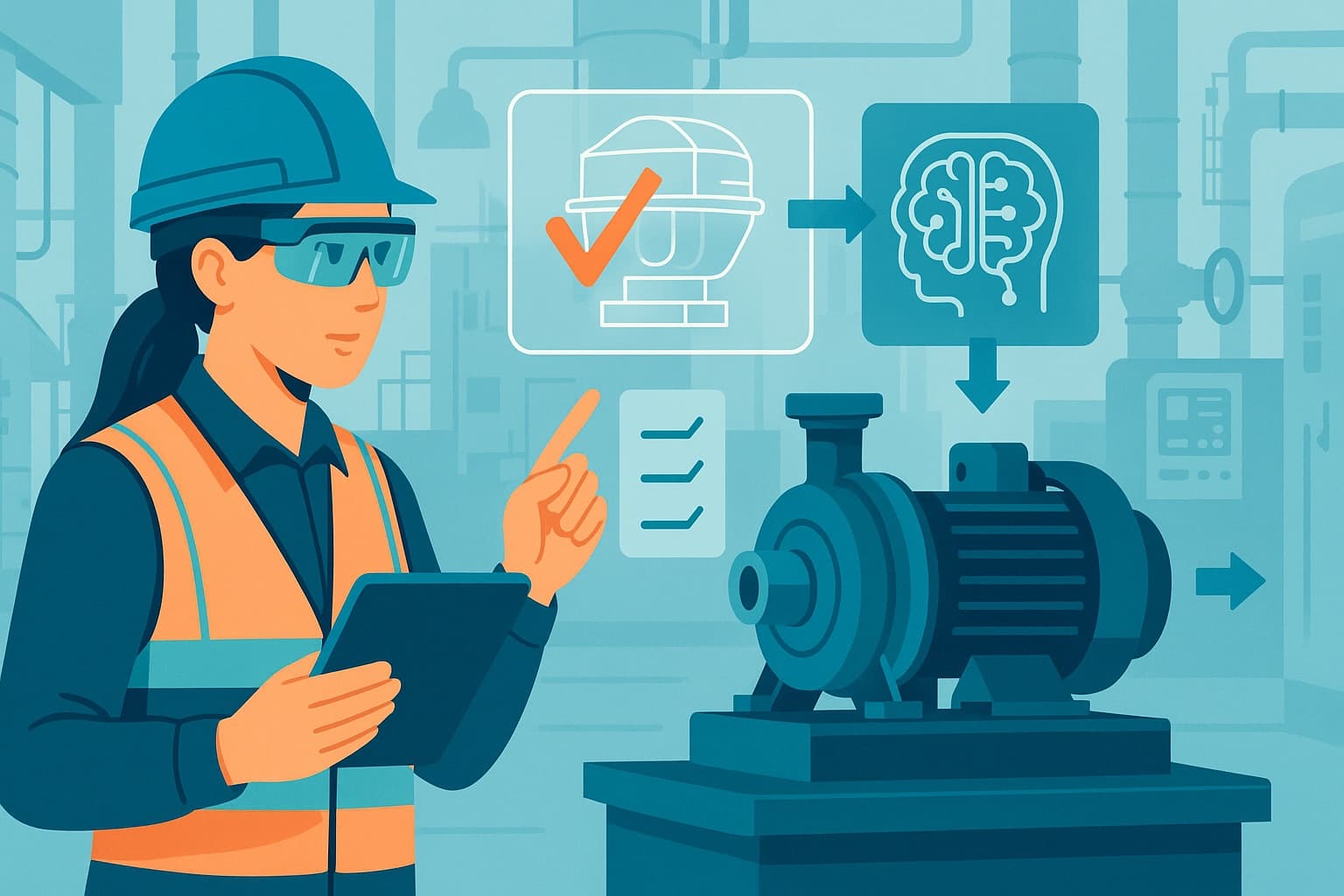
Industrial training is at a turning point. The demands of modern operations—faster onboarding, higher safety standards, and the need for continuous upskilling—are pushing traditional classroom and paper-based methods to their limits. The future of industrial training lies in the convergence of augmented reality (AR), artificial intelligence (AI), and simulation. These technologies, when used together, equip technicians and operators with the tools they need to work smarter, safer, and faster.
Why traditional industrial training models are reaching their limits
Industrial environments are more complex than ever. Equipment is sophisticated, processes are tightly regulated, and mistakes can have significant safety or financial consequences. Yet, many training programs still rely on:
- Classroom theory sessions detached from real equipment
- Paper-based standard operating procedures (SOPs) that quickly become outdated
- Shadowing or buddy systems that are hard to scale and inconsistent in quality
These methods face several challenges:
- Knowledge retention: Studies show that up to 70% of information from traditional training is forgotten within a week (National Training Laboratories, 2023).
- Skills transfer gap: Operators often struggle to apply what they learned in the classroom to real-world scenarios.
- Compliance and safety risks: Inconsistent training increases the risk of errors, non-compliance, and safety incidents.
The result is lost productivity, increased downtime, and higher risk—outcomes no operations manager or HSE leader can afford.
The need for change: new pressures and opportunities
Change isn’t just driven by technology—it’s a response to real business pressures:
- Aging workforce: A large portion of experienced technicians are retiring, taking decades of tacit knowledge with them.
- Rapid technology adoption: New equipment and processes require faster, more flexible training cycles.
- Regulatory scrutiny: Documentation and traceability of training are now baseline requirements for many industries.
- Workforce expectations: New generations expect digital tools and on-demand learning.
At the same time, digital technologies have matured. Cloud infrastructure, mobile devices, and the wide availability of AR headsets and tablets mean that advanced training is no longer confined to high-budget pilot projects. AI and AR–guided work instructions, real-time simulation, and digital SOPs are now within reach for most industrial organizations.
How AI, AR and simulation work together in modern industrial training
The future of industrial training is not about replacing people with machines. It’s about giving teams the tools to learn and perform at a higher level—directly in the flow of work. Here’s how AI, AR, and simulation each play a role:
Augmented reality: bringing instructions and context to the shop floor
AR overlays digital content—such as step-by-step instructions, diagrams, or safety warnings—directly onto the physical environment. For industrial training, this means:
- Technicians see exactly what to do, in real time, on the actual equipment.
- Interactive 3D models help users understand complex assemblies or hidden components.
- Visual cues reduce cognitive load and support faster, more accurate work.
AR SOPs and digital work instructions can be updated instantly, ensuring everyone works from the latest procedures.
Artificial intelligence: adaptive, personalized, and data-driven learning
AI enhances industrial training by:
- Recommending content based on the technician’s role, experience, or past performance.
- Analyzing training data to identify gaps, common errors, or compliance risks.
- Powering real-time feedback and virtual coaching during both training and live operations.
- Supporting natural language queries, so operators can ask questions and get instant, context-aware answers.
AI-driven analytics help managers measure training effectiveness, prove ROI, and continuously improve programs.
Simulation: safe, repeatable, and realistic practice
Simulation allows technicians to practice procedures in a risk-free environment. This includes:
- Virtual replicas of equipment or processes for hands-on learning without downtime or safety risk.
- Scenario-based training for emergency situations, troubleshooting, or infrequent but critical tasks.
- Immediate feedback on actions, helping users build muscle memory and confidence.
Modern simulation platforms often integrate with AR, letting trainees move seamlessly from virtual to physical environments.
The power of convergence: integrated workflows, not siloed tools
The real impact comes when AI, AR, and simulation are combined in a unified workflow:
- A new technician begins with a simulation of a pump overhaul, practicing steps virtually until proficient.
- Next, AR-guided work instructions walk them through the actual procedure on the shop floor, with AI monitoring for errors or missed steps.
- If the technician hesitates or makes a mistake, the AI offers just-in-time microlearning or connects them to a remote expert.
- All actions are logged, creating a digital training record for compliance and improvement.
This approach creates a continuous learning loop—practice, perform, reflect, and improve—embedded directly into daily work.
Use cases: where AI and AR–guided work instructions deliver results
Forward-thinking industrial organizations are already seeing measurable benefits from this approach. Practical use cases include:
Onboarding and upskilling new technicians
- AR onboarding for new technicians reduces time-to-competency by up to 40% (Deloitte Insights, 2022).
- Digital work instructions ensure consistency and reduce the risk of missed steps.
- AI tracks progress and recommends targeted refresher modules.
Safety-critical procedures and compliance
- AR SOPs highlight safety hazards and enforce lockout/tagout steps visually.
- AI-driven checklists prevent skipping critical tasks, reducing incident rates.
- Training records are automatically generated for audits.
Maintenance, repair, and troubleshooting
- AR overlays diagnostic data and repair instructions directly onto equipment.
- Simulation lets teams practice rare fault scenarios with no risk to assets.
- AI provides real-time assistance and flags deviations from best practices.
Remote support and knowledge capture
- Field engineers use AR to connect with remote experts, who can annotate live views.
- AI captures and structures expert interventions, building a knowledge base for future training.
- Simulations are updated with real-world scenarios as they occur.
Results: measurable improvements in safety, productivity, and quality
Organizations adopting integrated AI, AR, and simulation training models report:
- Faster onboarding: Reduced training time by 30–50% for new hires.
- Improved safety: 25% fewer safety incidents linked to procedural errors.
- Higher productivity: 20% reduction in unplanned downtime due to better skills and faster troubleshooting.
- Audit readiness: Digital records and traceability for every training session and procedure.
These results are not theoretical. Companies in automotive, energy, pharma, and heavy manufacturing have documented these gains in published case studies and industry reports (industry research, 2023).
What ActARion brings: expertise, governance, and proven deployment
Implementing AI and AR–guided work instructions in industrial training requires more than just technology. ActARion brings:
- Industrial expertise: Deep understanding of regulated, high-stakes environments and the realities of shop floor operations.
- Governance and change management: Structured rollout plans, stakeholder engagement, and support for content creation.
- Integration: Compatibility with existing learning management systems (LMS), maintenance software, and compliance frameworks.
- Scalability: Solutions that work across multiple sites, languages, and user groups.
- Security and data privacy: Robust controls to protect sensitive operational and training data.
ActARion partners with your team to design pilot programs, measure impact, and scale up with confidence. Our approach ensures that digital work instructions and AR SOPs deliver real, measurable results for your business.
Addressing common concerns: hardware, content, and adoption
Decision makers often ask about practical challenges. Here’s how ActARion addresses them:
- Hardware requirements: Modern AR platforms support a range of devices, from tablets and smartphones to hands-free headsets. We help select the right hardware for your environment and use case.
- Content creation: Our team works with your subject matter experts to digitize SOPs, create AR workflows, and build simulations. Authoring tools make updates fast and easy.
- Change management: We provide training for trainers, clear communication plans, and support to ensure smooth adoption.
- IT integration: Solutions are designed to work with your existing infrastructure, minimizing disruption.
Note: For more on practical deployment, see our FAQ on AR work instructions in industry and implementation guide for digital SOPs.
Explore this in your organisation
If you want to see how AI, AR, and simulation could accelerate training, safety, and productivity for your teams, ActARion can help. Explore what a pilot could look like for your processes—there’s no commitment required.
Schedule a discovery call or request a demo focused on digital work instructions for your team. Or, download our checklist for evaluating AR training solutions.
For an industry-wide perspective, review Gartner’s guide to augmented reality in manufacturing for further insights.
Meta description:
Discover how AI, AR, and simulation shape the future of industrial training for operations, safety, and workforce readiness.
URL slug:
future-industrial-training-ar-ai-simulation
Go deeper
This article is part of our knowledge base on AI and AR–guided work instructions. For a comprehensive overview, read our whitepaper:
AI and AR–guided work instructions: a practical guide for operations teams — A practical guide covering what these technologies are, why they are becoming viable now, and how operations teams can apply them effectively.