
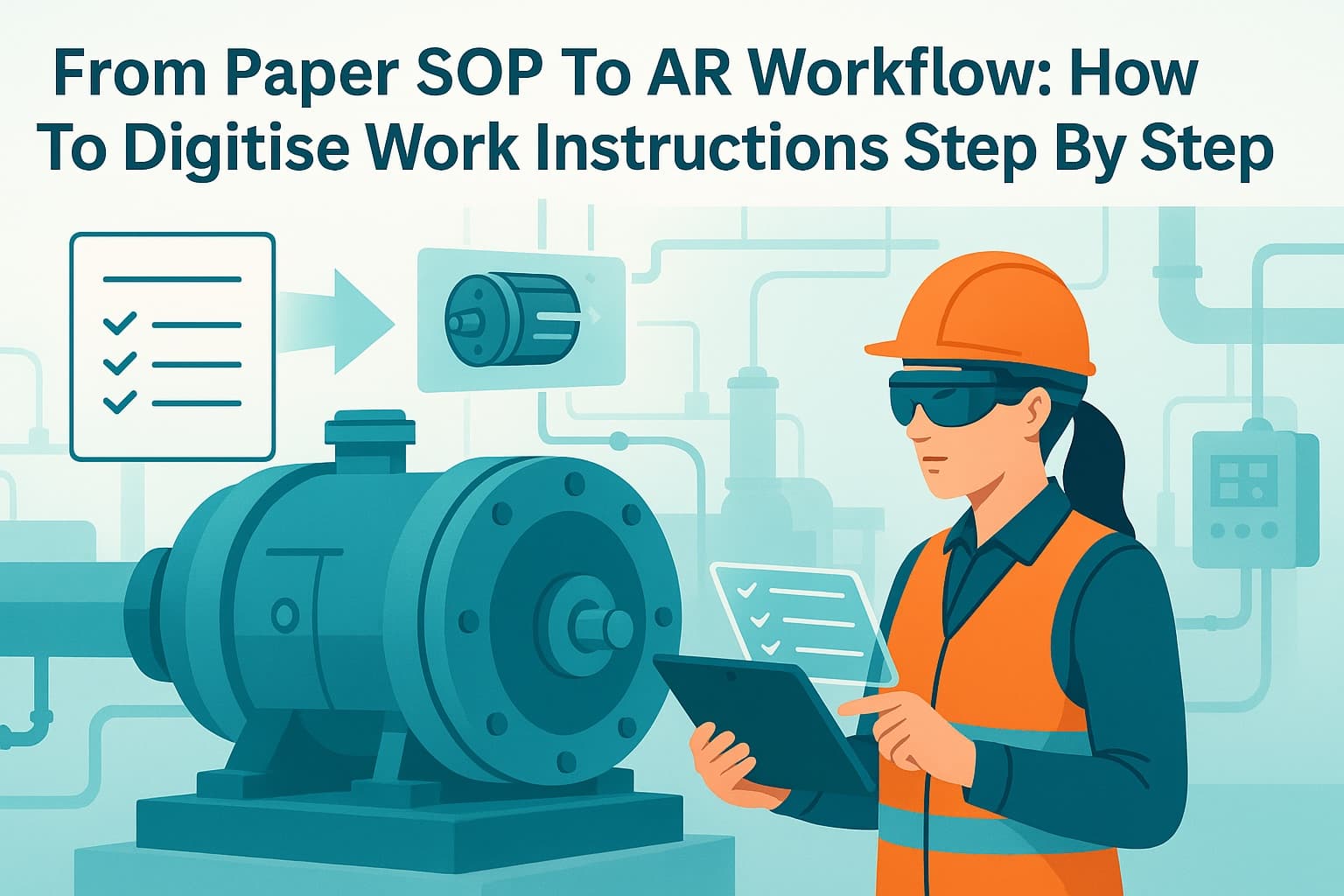
Every industrial operation has tribal knowledge—the unwritten rules, shortcuts and techniques that experienced employees use but rarely document. This knowledge is valuable, but it is also fragile. When key people leave, tribal knowledge disappears. When teams grow, it does not scale. When auditors ask for documentation, it does not exist.
Transforming tribal knowledge into AR SOPs and digital work instructions is one of the highest-impact investments an organisation can make. This article provides a practical roadmap for getting started.
What is tribal knowledge and why does it matter?
Tribal knowledge refers to information that exists only in the minds of certain employees. It includes:
- Best practices developed through years of experience
- Workarounds that compensate for equipment quirks or process limitations
- Diagnostic intuition for identifying and solving problems quickly
- Safety tips that are not written in official procedures
Tribal knowledge is often what separates high-performing teams from average ones. But it is also invisible—until it is gone.
The cost of undocumented tribal knowledge
Relying on tribal knowledge creates real business risk:
- Single points of failure: If the expert is unavailable, no one else knows what to do.
- Inconsistent execution: Different people do the same task differently, leading to variable results.
- Slow onboarding: New hires must learn by osmosis, which takes time and depends on informal mentoring.
- Compliance gaps: Auditors expect documented procedures, not word-of-mouth instructions.
A practical roadmap for converting tribal knowledge to AR SOPs
Transforming tribal knowledge into AR SOPs is not a one-time project—it is an ongoing capability. Here is a practical roadmap:
Step 1: Identify and prioritise
Start by listing the procedures, tasks and skills where tribal knowledge is most critical. Prioritise based on:
- Impact: What happens if this knowledge is lost or executed incorrectly?
- Risk: How likely is it that the knowledge holder will leave or be unavailable?
- Frequency: How often is this task performed?
Focus first on high-impact, high-risk, high-frequency procedures.
Step 2: Engage knowledge holders
Identify the experts who hold the tribal knowledge. Explain the purpose and value of the initiative—this is not about replacing them, but about preserving and sharing their expertise.
Step 3: Capture in the real environment
Equip experts with AR devices and let them perform the task in the real work environment. The AR system captures their actions, images and voice notes as they work. This approach is faster and more accurate than interviewing experts or writing from memory.
Step 4: Structure and validate
Use AI-assisted tools to organise captured content into clear, sequential steps. Review with the expert to fill gaps, add tips and ensure accuracy. Validate with other team members to confirm the procedure is complete and usable.
Step 5: Publish and distribute
Publish the AR SOP to your digital library. Make it accessible on smart glasses, tablets or smartphones. Communicate the availability to teams who need it.
Step 6: Train and reinforce
Introduce the AR SOP to operators and technicians. Provide brief training on how to access and follow it. Monitor usage and gather feedback.
Step 7: Iterate and expand
Use data and feedback to improve the AR SOP over time. Expand to additional procedures, building a growing library of standardised, scalable knowledge.
Overcoming common challenges
Converting tribal knowledge to AR SOPs can encounter resistance. Here are common challenges and how to address them:
- Experts reluctant to share: Emphasise that the goal is to recognise and preserve their expertise, not replace them. Involve them as content owners and reviewers.
- Lack of time: Integrate knowledge capture into normal work activities rather than adding separate documentation projects.
- Perfectionism: Start with "good enough" AR SOPs and improve over time. Perfect is the enemy of done.
- Technology concerns: Provide hands-on training and support. Most operators adapt quickly once they see the value.
Real-world example: standardising a critical troubleshooting routine
A manufacturing plant relied on a senior technician to troubleshoot a complex conveyor system. When the technician was on vacation, troubleshooting calls took three times longer and often escalated unnecessarily.
Using AR work instructions, the technician captured the diagnostic routine step by step, including tips for identifying common faults. The resulting AR SOP was published to the maintenance team.
Within three months, average troubleshooting time dropped by 40%, and escalations fell by 60%—even when the senior technician was unavailable.
Getting started
If your organisation depends on tribal knowledge, the time to act is now—before the experts leave and the knowledge is lost. Start with a focused pilot: one or two high-impact procedures, captured and published as AR SOPs. Demonstrate value, build momentum and expand from there.
Learn more about AR work instructions and SOPs to preserve corporate memory or contact ActARion to discuss your knowledge management challenges.