
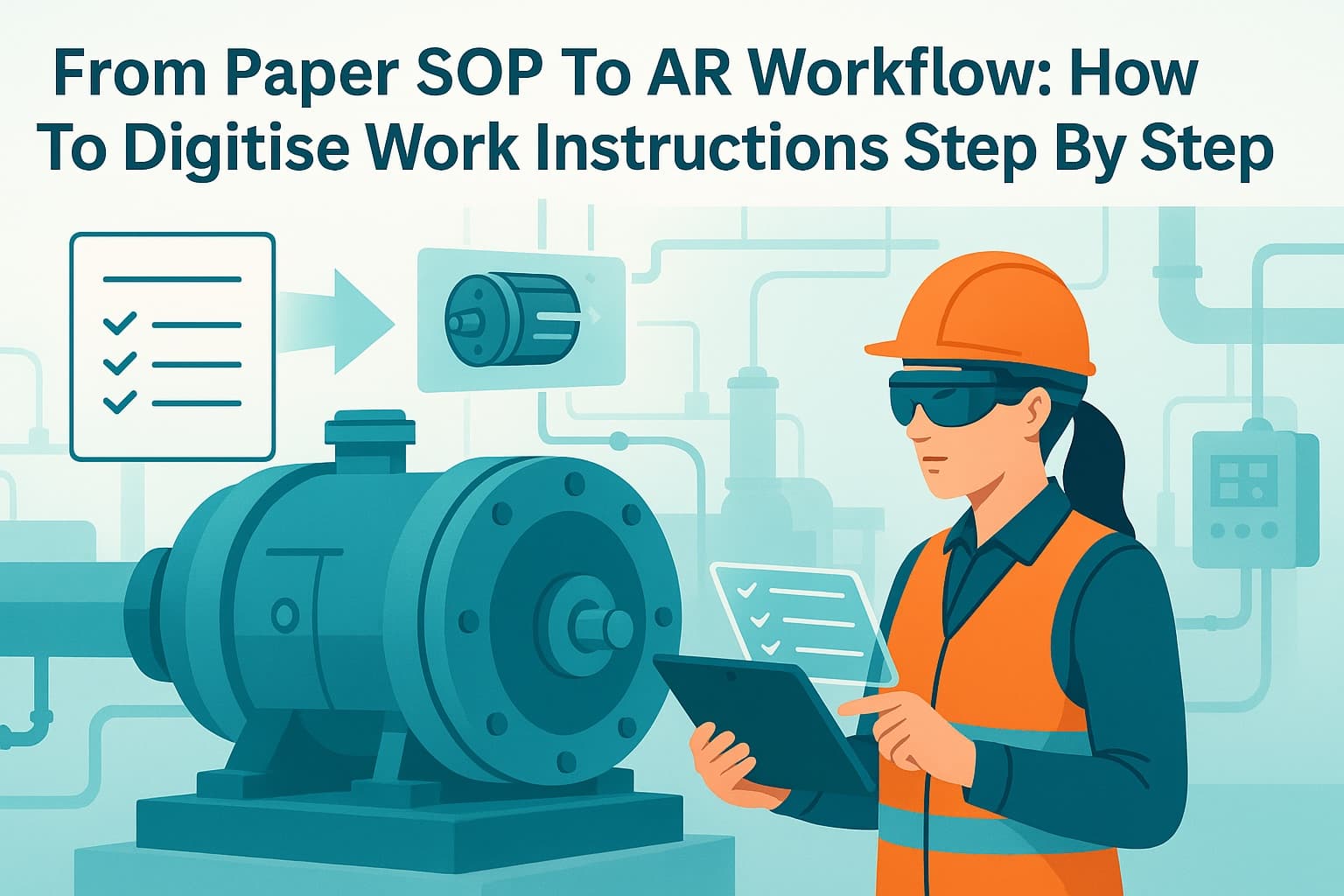
Paper SOPs have been the backbone of assembly line documentation for decades. They are familiar, inexpensive and straightforward to create. But in today's complex manufacturing environments, paper SOPs struggle to keep up. Assembly errors, rework and quality escapes persist—despite best efforts to improve documentation.
AR SOPs offer a fundamentally different approach. By delivering visual, step-by-step guidance directly at the workstation, they reduce ambiguity, prevent errors and create a digital record of every build. This article explores how organisations are making the transition from paper to AR SOPs on assembly lines—and the results they are achieving.
Why paper SOPs fall short on assembly lines
Paper SOPs have inherent limitations that contribute to assembly errors:
Interpretation required
Paper instructions describe what to do, but leave operators to interpret how. Phrases like "attach component A to bracket B" leave room for error—which orientation? Which fastener? Which torque?
Out of context
Paper SOPs are separate from the work. Operators must read the instruction, remember it, then look at the assembly. This mental context-switching introduces errors, especially for complex tasks.
Version control challenges
Keeping paper SOPs current is a constant struggle. Outdated versions circulate, and operators may unknowingly follow obsolete procedures.
No verification
Paper checklists confirm that a step was marked complete—not that it was done correctly. Errors can slip through undetected until final inspection or customer complaints.
How AR SOPs address these limitations
AR SOPs bring instructions directly into the operator's field of view, overlaid on the actual assembly:
Visual, unambiguous guidance
AR overlays show exactly where to place a component, which fastener to use and how to orient it. There is no interpretation required—guidance is visual and precise.
In-context instruction
Operators see what to do while looking at the assembly. There is no context-switching between reading and doing.
Instant updates
When procedures change, AR SOPs are updated centrally and deployed instantly. Every operator sees the current version, every time.
Built-in verification
AR systems can require photo capture, sensor confirmation or operator acknowledgment at each step. Errors are caught in real time, not after the fact.
The migration path: paper to AR SOPs
Migrating from paper to AR SOPs does not need to be a massive project. Here is a practical approach:
1. Prioritise high-impact assembly tasks
Focus first on tasks where errors are most costly, frequent or safety-critical. These are the tasks where AR will deliver the clearest return.
2. Convert existing paper SOPs
Use your paper SOPs as the starting point. Translate steps into AR format, adding visual cues, checkpoints and verification prompts.
3. Validate with experts
Have experienced operators review and test the AR SOPs. They will identify gaps, add tips and ensure the content reflects actual best practice.
4. Pilot before scaling
Roll out AR SOPs on a pilot line or workstation. Measure error rates, cycle times and operator feedback. Refine based on results.
5. Expand and standardise
With pilot success demonstrated, expand AR SOPs to additional tasks and lines. Establish governance for content ownership and updates.
Results: what organisations are achieving
Organisations that have migrated from paper to AR SOPs on assembly lines report significant improvements:
- Error reduction: 40–70% fewer assembly errors compared to paper SOPs
- Rework decrease: 30–50% less rework and scrap from assembly mistakes
- Cycle time improvement: 5–15% faster cycle times as operators spend less time searching for information
- Audit readiness: Instant access to traceable, version-controlled documentation for audits
- Onboarding acceleration: New operators reach competency 30–50% faster with AR guidance
These results are consistent across industries—from aerospace and automotive to electronics and industrial equipment.
Real-world example: electronics assembly
An electronics manufacturer faced persistent rework due to incorrect component orientation and missed solder points. Paper SOPs were detailed, but operators still made errors under production pressure.
By converting to AR SOPs with visual overlays and step-by-step verification, the company achieved:
- 65% reduction in orientation errors
- 45% reduction in rework costs
- 20% faster onboarding for new assemblers
The investment paid back within six months, and AR SOPs are now standard across all assembly lines.
Getting started
If paper SOPs are not delivering the error reduction you need, AR SOPs offer a proven alternative. Start with a focused pilot on your highest-impact assembly tasks, measure results and build from there.
Learn more about AR-guided assembly for error-free production or contact ActARion to discuss your assembly challenges.
Go deeper
This article is part of our knowledge base on digital work instructions and compliance. For a comprehensive overview, read our whitepaper:
Digital work instructions and AR SOPs for standard work and compliance — A practical guide for quality, HSE, and operations leaders on transforming SOPs into executable, auditable AR instructions.