
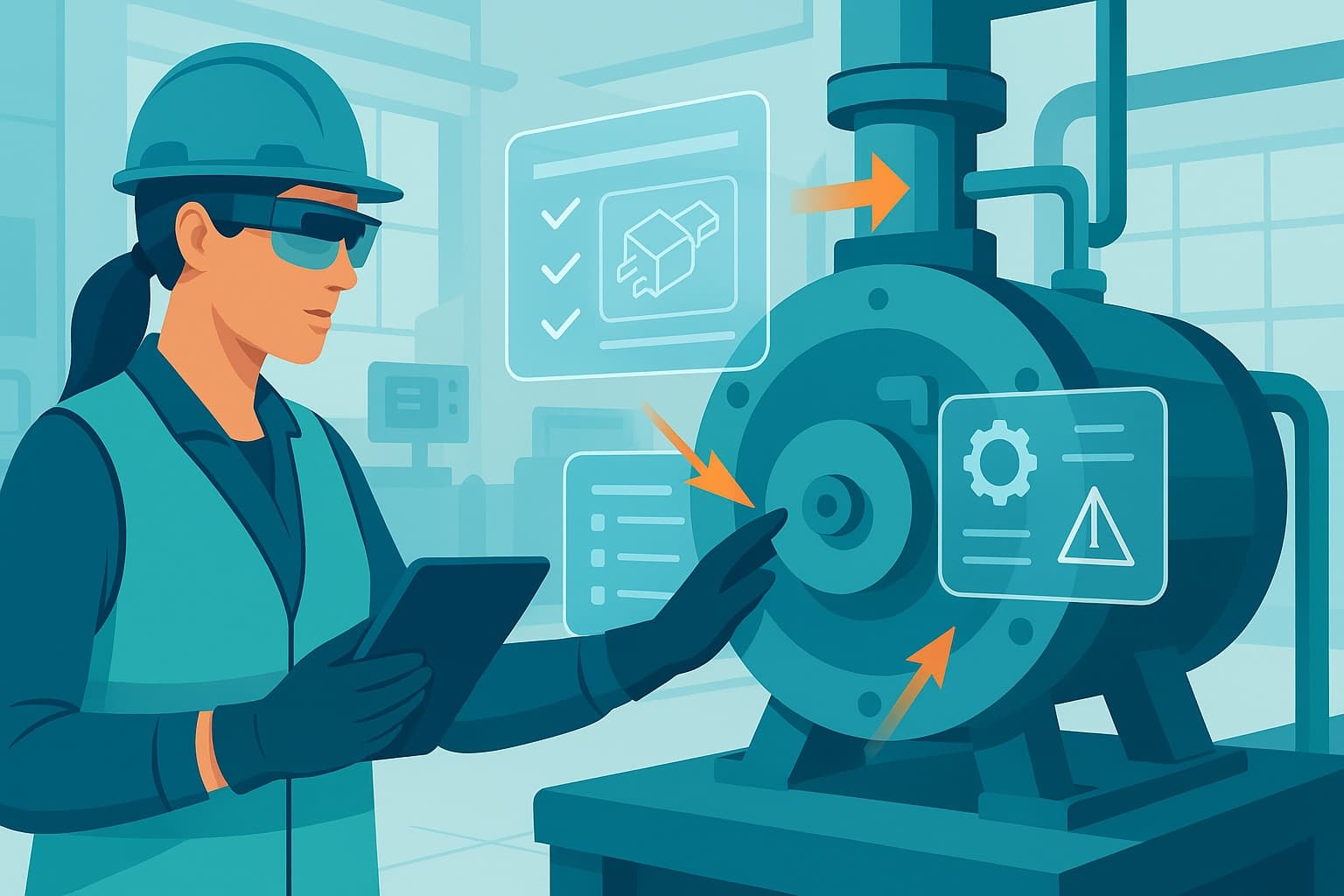
Manufacturing leaders face constant pressure to keep lines running, maintain quality, and ensure safety—even as experienced operators retire and new hires arrive. AR onboarding in manufacturing offers a practical solution: equipping new operators to work safely and productively within days, not weeks, through AI and AR–guided work instructions.
Why manufacturing onboarding needs to change now
The manufacturing sector is experiencing a sharp skills gap. According to a 2023 report by Deloitte and The Manufacturing Institute, over 2.1 million manufacturing jobs could go unfilled by 2030 due to retirements and a lack of qualified candidates. With this turnover, operations and training managers are tasked with onboarding new operators rapidly—without compromising safety, compliance, or throughput.
Traditional onboarding methods present clear challenges:
- Shadowing experienced operators takes weeks, pulling both new hires and mentors away from productive work.
- Paper-based SOPs are often unclear or outdated, leading to errors and inconsistent quality.
- Classroom-based training lacks the hands-on context operators need on the shop floor.
The result is prolonged ramp-up times, increased risk of mistakes, and higher training costs. Production targets are missed, and quality incidents rise as new operators struggle to apply procedures learned in theory.
The cost of slow onboarding in manufacturing
Delayed operator readiness has measurable impacts:
- Lost production hours: Every extra day a new operator is not fully productive reduces output and strains existing teams.
- Increased error rates: Inexperienced operators are more likely to make mistakes, leading to rework, scrap, or safety events.
- Low retention: Frustration due to unclear onboarding increases turnover, perpetuating the cycle.
A recent McKinsey analysis found that manufacturers with slow or inconsistent onboarding face up to 50% higher ramp-up costs per hire compared to those with streamlined, digital approaches.
How AR onboarding in manufacturing accelerates operator readiness
AR onboarding in manufacturing uses augmented reality to deliver step-by-step, visual work instructions directly at the workstation. Combined with AI-driven guidance, these digital work instructions adapt to the operator's progress, ensuring every step is performed correctly and safely. The result: new hires learn on the job, with real-time feedback and support.
Core features of AR onboarding
- Visual SOPs: Procedures are overlaid on real equipment using AR headsets or tablets, showing exactly what to do, where, and how.
- Contextual guidance: AI monitors progress and highlights errors or missed steps before they become issues.
- Hands-free operation: Operators can follow instructions while keeping both hands on the task, boosting safety and efficiency.
- Data capture: Every action is logged, providing traceability for compliance and continuous improvement.
This approach transforms onboarding from a passive, classroom-driven process into active, on-the-job learning—shortening the time to productivity and reducing the risk of mistakes.
Where AR onboarding makes the biggest impact
AR onboarding in manufacturing delivers measurable benefits across several critical use cases:
Assembly and production lines
Operators assembling complex machinery, electronics, or automotive components can follow AR SOPs that show each part's placement and sequence. Instead of memorizing steps or flipping through manuals, new hires see exactly what to do—reducing assembly errors and accelerating learning.
Equipment changeovers
Fast, error-free changeovers are vital in high-mix manufacturing. AR-guided work instructions walk operators through each adjustment, checklist, and parameter in sequence. This reduces downtime, eliminates missed steps, and ensures product quality during transitions.
Safety-critical procedures
Lockout/tagout, machine start-up, and hazardous material handling require strict adherence to protocol. AR onboarding enforces each safety step, with visual confirmation and digital sign-off, minimizing the risk of incidents and regulatory non-compliance.
Quality inspections
New operators often struggle with inspection criteria and documentation. AR onboarding overlays checklists, defect libraries, and "pass/fail" visuals directly on the item, ensuring consistent quality checks and real-time data capture for audits.
Maintenance basics
Routine preventive maintenance can be taught on the job, with AR-guided instructions ensuring correct lubrication, adjustments, and safety checks—reducing equipment failures and unplanned downtime.
Key results: faster, safer, more consistent onboarding
Manufacturers implementing AR onboarding report:
- Onboarding time cut by 40–60%: New operators achieve baseline competency in days, not weeks.
- Quality error reduction: Step-by-step digital work instructions reduce first-time error rates by up to 50% (source: PwC Industry 4.0 survey).
- Improved safety compliance: AR SOPs ensure critical steps are never skipped, with digital sign-offs supporting audits.
- Higher retention: Operators feel more confident and supported, leading to lower early turnover.
For example, a global automotive parts supplier used AR onboarding to train new machine operators. Ramp-up time dropped from 4 weeks to 9 days, with a 30% reduction in quality incidents during the first month.
Addressing challenges: hardware, content, and change management
Adopting AR onboarding in manufacturing requires careful planning. Operations and training leaders should consider:
- Device selection: AR onboarding can run on headsets, tablets, or smartphones. Each has trade-offs in comfort, durability, and hands-free operation.
- Content creation: Existing SOPs must be digitized and enhanced with images, videos, and step-by-step logic. This is a one-time effort, with ongoing updates as processes change.
- Integration: AR solutions should connect with learning management systems (LMS), quality systems, and ERP for seamless reporting and compliance.
- Change management: Teams need clear communication, training, and support to adopt AR onboarding. Early pilot programs and feedback loops help build trust and demonstrate value.
Note: The initial investment in AR onboarding is offset by faster operator readiness, reduced errors, and lower training overhead. ROI is typically realized within the first year, especially in high-turnover or high-mix environments.
What ActARion brings to AR onboarding in manufacturing
ActARion partners with manufacturing operations, HSE, and training leaders to implement AR onboarding tailored to their processes. Key elements include:
- Rapid digitization of SOPs: ActARion's team helps convert existing procedures into AR-ready, visual work instructions.
- AI-driven adaptation: The platform personalizes guidance based on operator performance and learning pace.
- Robust analytics: Detailed dashboards track onboarding progress, compliance, and training effectiveness.
- Scalable deployment: Support for multiple device types and integration with existing systems ensures quick rollout across sites.
- Change management support: ActARion provides templates, communication plans, and hands-on training to drive adoption and measurable results.
ActARion has delivered successful AR onboarding projects in automotive, electronics, and process manufacturing, with proven reductions in ramp-up time and error rates.
Explore AR onboarding in your manufacturing process
See how AR onboarding can get your new operators productive in days—not weeks—while improving safety, quality, and retention. Schedule a discovery call to explore a pilot for your specific workflow.
Learn more about digital work instructions for manufacturing or see how AI and AR–guided SOPs drive results across industries. For broader context on workforce transformation, visit The Manufacturing Institute's workforce resources.
ActARion's approach is exploratory and tailored to your needs—no commitment required.
Go deeper
This article is part of our knowledge base on AI and AR–guided work instructions. For a comprehensive overview, read our whitepaper:
AI and AR–guided work instructions: a practical guide for operations teams — Covers onboarding, maintenance, safety, and adoption of AR work instructions for industrial operations.