
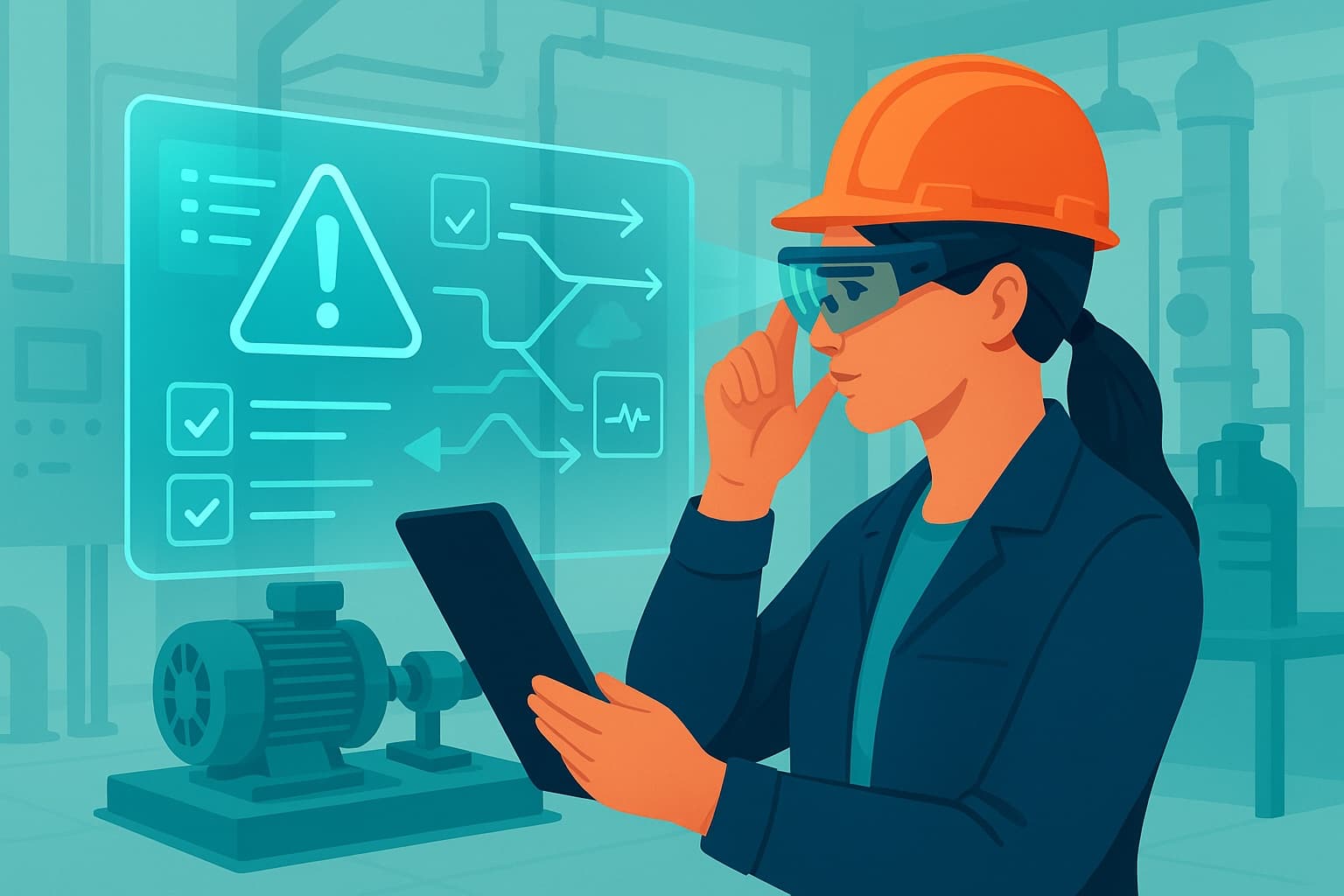
Industrial companies face a critical risk: experienced technicians and engineers are retiring or moving on, taking decades of practical knowledge with them. Capturing this expertise before it walks out of the door is now a top priority for operations, maintenance, and HSE leaders. AI and AR-guided work instructions offer a direct, practical way to digitize expert knowledge, reduce onboarding times, and maintain safety and productivity standards as teams change.
Why expert knowledge loss is an urgent operational risk
Many industrial sectors—manufacturing, energy, chemicals, utilities—are seeing a wave of retirements and turnover. According to the US Bureau of Labor Statistics, almost 25% of the manufacturing workforce is over 55, and the trend is similar in Europe and Asia. As experienced staff leave, the risk isn’t just slower onboarding for new hires. Companies face:
- Increased safety incidents due to gaps in tacit knowledge
- Lower productivity as less experienced teams struggle to troubleshoot
- More downtime from avoidable errors or missed steps
- Reduced compliance with critical procedures (SOPs, quality checks, safety routines)
Verbal handover, paper checklists, and job shadowing are no longer enough. The complexity and variability of industrial operations demand a more robust, scalable approach.
What’s changing: new pressures and expectations
Three trends make knowledge capture more urgent and challenging:
- Higher turnover and skill gaps: Younger technicians have different expectations for learning, and fewer want to spend years “learning by osmosis.”
- More complex assets and processes: Modern equipment and compliance standards require precise, up-to-date procedures.
- Regulatory and customer demands: Auditable, standardized SOPs are now baseline expectations in most regulated industries.
At the same time, digital transformation is no longer optional. Operations managers and L&D leaders are expected to demonstrate measurable improvements in training time, error rates, and compliance.
The limits of traditional knowledge transfer methods
Conventional approaches—mentoring, shadowing, written SOPs—leave critical gaps:
- Tacit knowledge isn’t captured: Experts know the “why” and “how” behind each step, but this rarely makes it into manuals.
- Procedures become outdated: Paper SOPs are hard to update and distribute at scale.
- Learning is slow and inconsistent: New hires must absorb information passively, leading to variable results.
These gaps are visible in onboarding metrics, incident reports, and quality audits. Companies need a way to digitize not just the “what” but also the “how” and “why” of expert work.
How AI and AR help capture and transfer expert knowledge
AI and AR-guided work instructions directly address these challenges. Here’s how:
- Augmented reality (AR) SOPs: Capture expert workflows as step-by-step visual instructions, overlaid directly on equipment or workspaces via smart glasses or tablets. Each step can include photos, videos, or annotations recorded by experts in real time.
- AI-powered content creation: Use AI tools to transcribe, structure, and update SOPs based on expert input, automatically flagging gaps or inconsistencies.
- Contextual guidance: Teams see exactly what to do next, reducing ambiguity and reliance on memory or informal notes.
- Continuous feedback loops: Data from completed work instructions feeds back into AI models, helping refine SOPs and capture new insights from experienced staff.
This approach turns expertise into living, digital assets—available to every technician, on demand.
Example: digitizing a critical maintenance procedure
A chemical plant faces the retirement of its lead compressor technician. Instead of relying on shadowing, the company equips the expert with AR glasses. As the technician performs a complex seal replacement, the system records audio, video, and annotated steps. AI tools transcribe and structure this into a digital SOP, which is reviewed and validated by the expert. The result: a detailed, visual guide available to every team member, reducing onboarding time and errors.
Key benefits of AR and AI–guided work instructions for knowledge capture
AI and AR-guided work instructions provide clear, measurable advantages for industrial teams:
- Faster onboarding: New hires can follow expert-validated, step-by-step AR SOPs, reducing time to competency by 30–50% (source: Deloitte, 2023 Digital Manufacturing Report).
- Fewer errors and incidents: Guided instructions and contextual prompts help teams avoid common mistakes, supporting higher safety and quality standards.
- Up-to-date procedures: AI tools make it easy to update SOPs as equipment or regulations change, ensuring compliance.
- Retention of tacit knowledge: Video, audio, and AR overlays capture the “tricks of the trade” that are lost in written documents.
- Auditability: Digital work instructions create a traceable record of who did what, when, and how—supporting regulatory and customer audits.
Practical use cases across industrial environments
AI and AR-guided work instructions are already delivering results in diverse sectors:
Maintenance and asset reliability
- Capture expert troubleshooting and repair routines for complex equipment
- Standardize PM tasks with visual, step-by-step AR SOPs
- Reduce downtime from avoidable errors as teams change
Health, safety, and environment (HSE)
- Digitize safety-critical procedures, such as lockout/tagout or confined space entry
- Provide real-time guidance and documentation to meet compliance requirements
- Support incident investigations with detailed, time-stamped work records
Quality assurance and audits
- Ensure all operators follow the same validated process for critical quality checks
- Streamline preparation for ISO, FDA, or customer audits with digital SOPs and training records
Training and workforce development
- Create immersive onboarding experiences for new technicians
- Enable “just-in-time” learning with AR overlays in the field
- Reduce reliance on classroom-based or paper-based training
Addressing common challenges: hardware, change management, and content creation
Implementing AI and AR-guided work instructions requires practical planning and governance. Common questions include:
- What hardware is required? Most solutions work with standard tablets or smartphones, and many industrial AR platforms support smart glasses for hands-free use. It’s important to pilot hardware options in real environments.
- How is expert content captured? Experts can record procedures as they work, using video, voice, and photos. AI tools help structure and tag this content, making it searchable and easy to update.
- What about change management? Success depends on involving experienced staff early, demonstrating value, and providing support as teams adapt to new tools. Clear governance and KPIs are critical.
- How secure is the data? Digital work instructions must be stored securely, with access controls and audit trails to protect intellectual property and support compliance.
Note: For a detailed look at AR onboarding, see AR onboarding for technicians.
What ActARion brings to the table
ActARion works with industrial companies to deploy AI and AR-guided work instruction platforms tailored to real operational needs. Our approach includes:
- Industry-specific templates: Pre-built AR SOPs and workflows for maintenance, safety, and quality scenarios
- Expert-driven content capture: Simple tools for recording and structuring expert knowledge, with AI-powered suggestions
- Integration with existing systems: Connect digital work instructions to your EHS, CMMS, or ERP platforms
- Change management support: Proven frameworks to engage teams, measure impact, and ensure adoption
- Data security and compliance: Robust controls to protect sensitive procedures and support audits
We focus on practical, measurable outcomes—shorter onboarding, fewer errors, and preserved expertise as teams change.
Explore what this looks like in your organisation
If you want to see how AI and AR-guided work instructions could help your team capture expert knowledge, reduce onboarding time, and maintain quality as experienced staff retire, schedule an exploratory discovery call. There’s no commitment—just a practical look at what’s possible in your setting.
- Learn more about ActARion’s approach
- See how digital work instructions support compliance
- For more on knowledge management, see Harvard Business Review: Retaining Institutional Knowledge.
Let’s make sure your organisation’s expertise stays where it delivers value—on the shop floor, not walking out the door.
Go deeper
This article is part of our knowledge base on AI and AR–guided work instructions. For a comprehensive overview, read our whitepaper:
AI and AR–guided work instructions: a practical guide for operations teams — Covers what these technologies are, why they are becoming viable now, and how operations teams can apply them to reduce errors, shorten onboarding, and preserve critical know-how.