
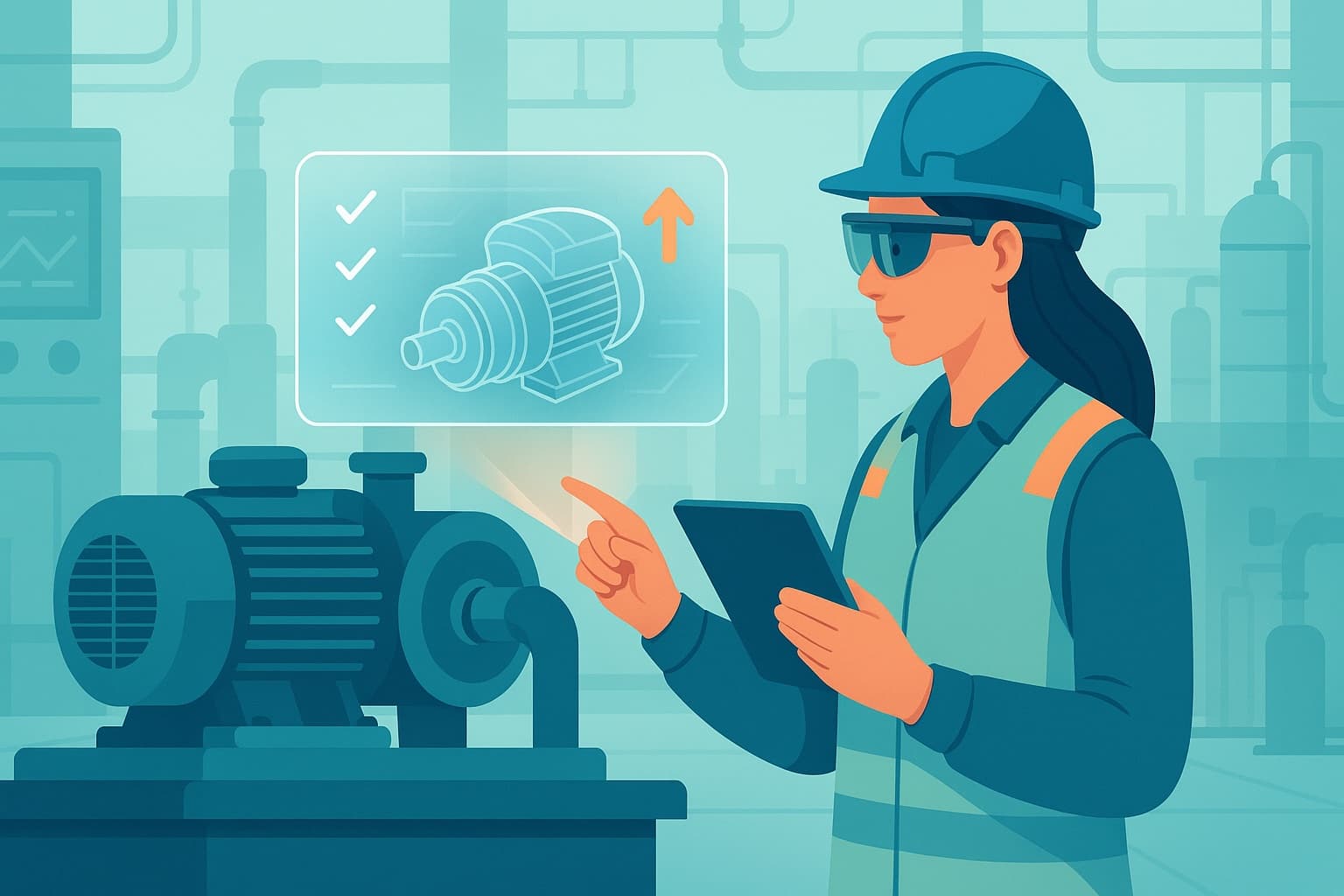
A well-executed AR pilot gives operations, maintenance, and HSE leaders the evidence and confidence to move from experimentation to real, scalable value. Understanding what makes an AR pilot successful—and how to expand it—lets you justify investments, minimise risk, and deliver measurable gains in safety, productivity, and skills transfer.
Why AR pilots matter in industrial operations today
Industrial companies face pressure to improve uptime, maintain safety, and address skills gaps. Traditional methods—paper SOPs, shadowing, classroom training—are slow, error-prone, and struggle to keep up with evolving processes or regulations. Augmented reality (AR) and AI–guided digital work instructions offer a way to:
- Reduce human error by providing step-by-step, context-aware guidance
- Shorten onboarding and upskilling time for technicians and operators
- Standardise procedures and ensure compliance, even in high-stakes environments
- Capture and transfer expert knowledge before it leaves the workforce
Yet, many organisations hesitate to move beyond pilots. Concerns about hardware, integration, content creation, and change management are real. A successful AR pilot addresses these issues head-on, showing clear results and a path to scale.
The current landscape: AR pilots, proof-of-concept fatigue, and the scaling gap
Most industrial teams have tested digital work instructions or AR SOPs in some form. Some see modest wins; others stall at the pilot stage. Common challenges include:
- Narrow focus: Pilots often target a single process or small team, limiting their impact.
- Lack of baseline data: Without clear "before" metrics, it's hard to prove ROI.
- Insufficient stakeholder buy-in: Pilots run by innovation teams may not involve operations, HSE, or L&D decision makers early enough.
- Content bottlenecks: Creating and maintaining AR SOPs requires new skills and workflows.
- Hardware limitations: Early AR devices were bulky or unreliable in industrial settings.
A 2023 survey by PwC found that while 42% of industrial companies have trialed AR/VR, only 13% have scaled beyond pilots (industry research). The gap is not technology—it's governance, measurement, and change management.
Defining a successful AR pilot: measurable criteria
A successful AR pilot in industrial operations does more than "work" technically. It delivers:
- Clear, quantitative improvements in productivity, safety, quality, or training outcomes
- Robust baseline and post-pilot data for comparison
- Stakeholder engagement across operations, HSE, L&D, and IT
- Repeatable content creation and update processes
- Hardware and software fit for real-world environments
- Change management that addresses user adoption and feedback
Key performance indicators (KPIs) might include:
- Reduction in task completion time (e.g., 20% faster equipment setup)
- Fewer safety or quality incidents (e.g., 30% drop in inspection errors)
- Shorter time to competence for new technicians (e.g., onboarding cut from 6 weeks to 4)
- Higher SOP compliance rates (e.g., 95% vs. 80% baseline)
Laying the groundwork: how to plan an AR pilot for impact
Successful AR pilots start with clear intent and strong foundations. Steps include:
- Select a process with high impact and measurable pain points.
- E.g., complex maintenance tasks, safety-critical inspections, or onboarding for new equipment.
- Define baseline metrics.
- Use video, time studies, QA data, or digital logs to quantify the current state.
- Identify stakeholders and champions.
- Involve operations managers, HSE leaders, maintenance leads, L&D, and IT from the outset.
- Choose fit-for-purpose hardware and software.
- Test devices in real environments for comfort, battery life, and connectivity.
- Map out content creation.
- Decide how SOPs, checklists, and training will be digitised and maintained.
- Plan for training and change management.
- Prepare short sessions and feedback loops for technicians and supervisors.
- Set a fixed pilot duration and review cadence.
- Typically 4–12 weeks, with weekly check-ins and a final review meeting.
Note: Pilots that skip baseline measurement or stakeholder engagement often fail to scale, regardless of technical success.
Running the AR pilot: best practices and pitfalls
Effective pilots keep the focus on outcomes, not just technology. Key practices:
Engage users early and often
- Run hands-on demos for technicians, operators, and supervisors before the pilot.
- Collect feedback on usability, comfort, and clarity of digital work instructions.
Monitor and measure
- Track task times, error rates, and user-reported confidence before and after AR introduction.
- Use built-in analytics (if available) to capture usage data.
Iterate content and workflows
- Treat AR SOPs as living documents—update them based on user input and observed gaps.
- Assign a content owner for ongoing updates.
Address technical and environmental issues
- Test AR devices with gloves, PPE, and in varying lighting or noise conditions.
- Ensure Wi-Fi or cellular connectivity is adequate (or plan for offline use).
Communicate progress
- Share interim results with stakeholders—both successes and challenges.
- Use data and stories to build support for scaling.
Common pitfalls to avoid:
- Treating the pilot as a one-off “experiment” with no follow-up plan
- Underestimating the time needed for content creation and user training
- Focusing only on technology, not on process change or ROI
Scaling up: how to move from pilot to enterprise value
A successful pilot is only the beginning. Scaling AR-guided work instructions across operations requires:
Strong sponsorship and governance
- Secure executive backing from operations, HSE, or L&D leadership.
- Form a cross-functional steering group for prioritisation and oversight.
Standardised content workflows
- Establish templates and guidelines for AR SOPs.
- Train process owners (not just IT or innovation teams) to update content.
Integration with existing systems
- Connect AR platforms with asset management, maintenance, or training systems for seamless workflows.
- Ensure data security and compliance with IT policies.
Structured rollout plans
- Prioritise processes or sites with the highest ROI potential.
- Use lessons from the pilot to refine onboarding and support.
Ongoing training and support
- Offer refresher sessions and peer-to-peer learning for technicians and supervisors.
- Provide a feedback channel for continuous improvement.
Metrics and continuous improvement
- Track KPIs at each stage and communicate results to stakeholders.
- Use data to justify further investment and identify new use cases.
Use cases: real-world examples of AR pilots and scaling in industry
Concrete scenarios where AR pilots have delivered value and scaled include:
- Automotive assembly: AR SOPs reduced changeover times by 25% and enabled quick onboarding of new teams during model launches.
- Pharmaceutical manufacturing: Digital work instructions improved batch record accuracy and audit readiness, cutting deviation rates by 40%.
- Oil & Gas maintenance: Field engineers used AR-guided inspections to reduce unplanned downtime and improve safety compliance in remote locations.
- Utilities: AR onboarding for new technicians accelerated time-to-competence and reduced errors during critical maintenance windows.
In each case, pilots succeeded when they delivered measurable results, engaged stakeholders across functions, and established clear processes for content and device management.
What ActARion brings to your AR pilot and scaling journey
ActARion partners with industrial companies to design, execute, and scale AR and AI–guided work instructions that fit real operational needs. Our approach addresses the full lifecycle:
- Process selection: We help identify high-impact use cases with clear pain points and ROI potential.
- Baseline and measurement: Our team works with you to establish robust, auditable metrics from day one.
- Content digitisation: We provide tools and templates for rapid AR SOP creation, and train your teams to maintain them.
- Change management: ActARion supports stakeholder engagement, user training, and feedback loops for sustained adoption.
- Scalable architecture: Our solutions integrate with existing systems and support both pilot and enterprise rollout.
We understand the realities of industrial environments—safety, compliance, and workforce readiness come first. Our clients see measurable improvements in task times, error rates, and skills transfer, with clear data to justify scaling.
Explore what a successful AR pilot looks like in your organisation
Discover how AR and AI–guided work instructions can deliver measurable results for your teams—whether you are focused on safety, productivity, or knowledge transfer. Schedule an exploratory call with ActARion to map out a tailored pilot or download our AR pilot readiness checklist for practical steps.
Explore more about digital work instructions in regulated industries or learn how AR onboarding for technicians can accelerate workforce readiness. For a broader perspective on immersive technologies in industry, see PwC’s latest report.
This is a no-commitment conversation—let’s explore what success could look like for your operations.
Meta description:
What does a successful AR pilot look like and how do you scale it? For operations, HSE, and training leaders, learn the steps, metrics, and best practices for measurable results.
URL slug:
ar-pilot-success-scaling
Go deeper
This article is part of our knowledge base on ROI measurement for AR work instructions. For the complete methodology, read our whitepaper:
ROI Calculator Guide for AI & AR-Guided Work Instructions — Covers how to measure and validate ROI before scaling from pilot to production.