
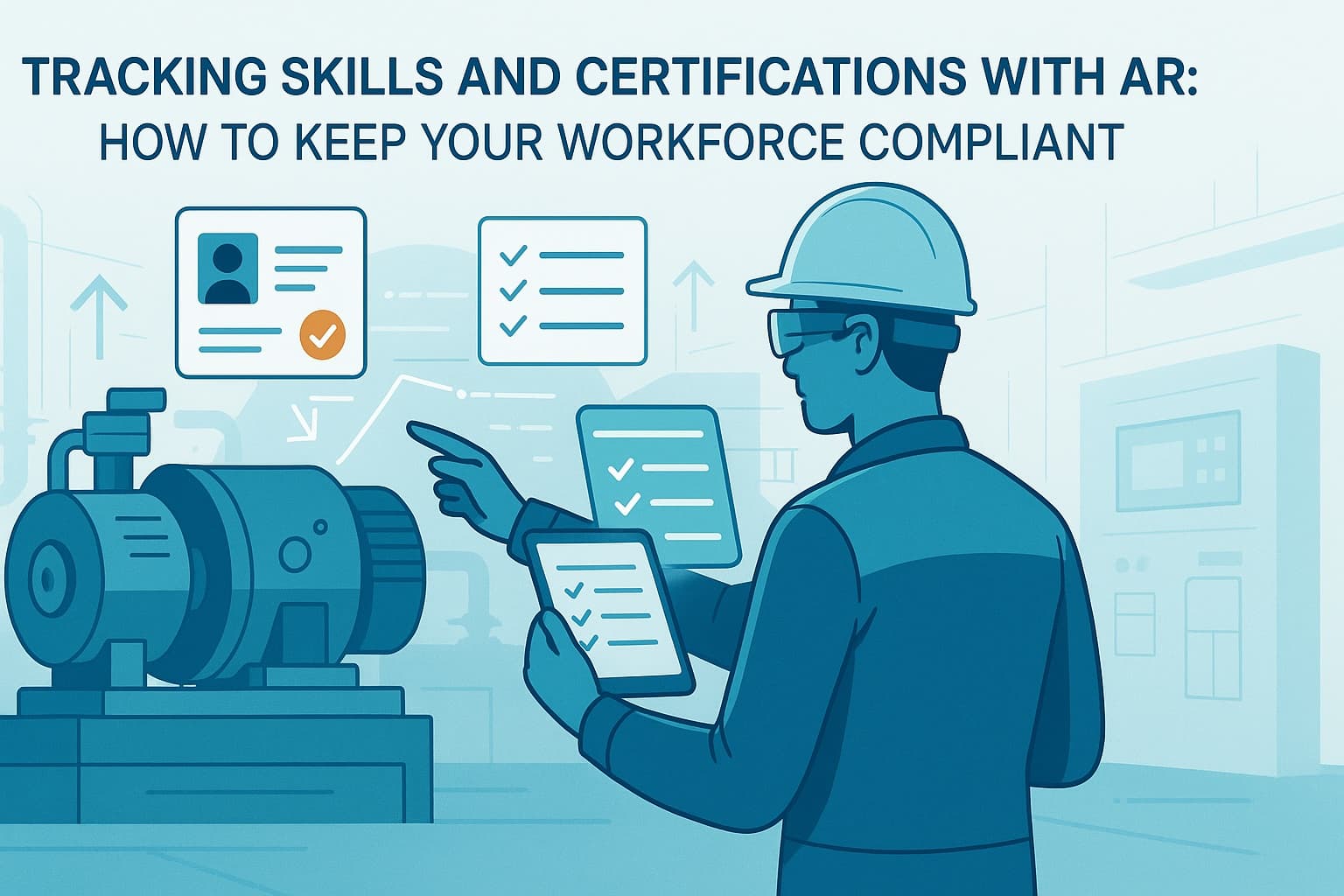
Maintaining a compliant, skilled workforce is non-negotiable in industrial environments. Tracking skills and certifications with AR is changing how operations, HSE, and training managers ensure every technician and operator is qualified, up-to-date, and safe on the job.
Why tracking skills and certifications is critical—and so challenging
Industrial companies rely on strict compliance to keep people safe, avoid downtime, and meet regulatory demands. Every operator, technician, and field engineer must have valid, up-to-date certifications and skills for their assigned tasks. Yet, keeping this data current and actionable is a persistent challenge:
- Paper records and spreadsheets are error-prone and quickly outdated
- Manual tracking creates bottlenecks and missed renewals
- Audits demand instant proof of compliance—often hard to produce
- Skill gaps or expired certifications can risk safety, quality, and reputation
Regulatory bodies like OSHA, ISO, and local authorities require documented evidence of workforce competence. Failing to comply can mean accidents, shutdowns, or costly fines. According to Deloitte's 2023 Manufacturing Industry Outlook, skills shortages and compliance complexity remain top concerns for industrial leaders.
Why change now: compliance and workforce readiness under pressure
Several trends are making skills tracking more urgent:
- Aging workforce: Experienced technicians retire, taking critical knowledge with them.
- High turnover: New hires need rapid onboarding and certification.
- Tightened regulations: Auditors now expect digital records and real-time proof.
- Complex machinery: Advanced equipment demands up-to-date, verified skills.
- Remote and distributed teams: Multiple sites complicate oversight.
Manual or outdated systems can no longer keep pace. Operations, HSE, and L&D managers want tools that make compliance seamless, transparent, and auditable—without draining resources or slowing down work.
How AI and AR–guided work instructions streamline skills tracking and certification
AI and AR–guided work instructions offer a new approach to compliance and workforce management. Instead of relying on static records, these systems connect skills tracking directly to the work itself.
What are AI and AR–guided work instructions?
- AI-driven platforms: Analyze tasks, match them to required skills, and flag gaps
- AR SOPs: Deliver step-by-step procedures, checklists, and compliance prompts in real time through smart glasses or mobile devices
- Digital work instructions: Log who performed each step, when, and with what credentials
This means every time a technician performs a critical maintenance or safety task, the system verifies their current certification status and records their activity for audit trails.
Key features for compliance-focused teams
- Real-time validation: The system checks if the operator has the right certification before allowing task execution.
- Automated tracking: Certifications, renewals, and expirations are tracked and flagged automatically.
- Instant audit trails: Every action is logged, time-stamped, and linked to the individual's digital profile.
- Targeted upskilling: Identifies gaps and suggests just-in-time training or recertification.
- Remote oversight: Managers can view compliance status across teams, sites, and geographies.
Note: AR SOPs and digital work instructions do not replace human oversight—they enhance it with real-time, verifiable data.
Practical use cases: AR for skills and certification tracking in action
1. Maintenance and safety-critical tasks
Before starting a high-voltage electrical inspection, the AR system checks if the technician's electrical safety certification is valid. If expired, access to the work instructions is blocked, and the supervisor is alerted.
- Ensures only qualified personnel perform hazardous work
- Reduces risk of accidental non-compliance
- Creates a digital audit trail for every inspection
2. Onboarding new technicians and operators
New hires receive AR–guided onboarding tailored to their current certifications. The system tracks completed modules, issues digital badges, and notifies managers when onboarding is finished and compliance is met.
- Accelerates time-to-competence
- Eliminates paperwork and manual tracking
- Reduces onboarding errors and missed steps
3. Managing periodic recertification
Operators receive AR reminders and in-context training prompts when recertification is due. The system can even deliver microlearning modules or assessments during routine work, ensuring knowledge stays current.
- Minimizes training downtime
- Increases recertification rates
- Automates compliance documentation
4. Contractor and third-party workforce management
Site supervisors use AR–guided checklists to verify contractor credentials before site access. The system logs entry, tracks work, and alerts if any certification lapses during the contract period.
- Prevents unqualified access
- Simplifies compliance for mixed teams
- Supports legal and client audit requirements
5. Compliance reporting and audits
During an audit, managers access a dashboard showing real-time certification status for all technicians, with digital records linked to every completed task.
- Cuts audit preparation time from days to minutes
- Reduces risk of missing or incomplete records
- Demonstrates proactive compliance management
Results and measurable impact: what leading companies are seeing
Industrial companies using AI and AR–guided work instructions for skills tracking report:
- Reduction in compliance gaps: Automated checks prevent unqualified work, reducing incidents and audit findings.
- Faster onboarding: Digital instructions and automated tracking cut onboarding time by 30–50%.
- Audit readiness: Instant access to digital records shortens audit cycles and improves outcomes.
- Improved safety: Real-time validation ensures only certified personnel perform high-risk tasks.
- Higher training ROI: Targeted upskilling and microlearning improve workforce competence and reduce training waste.
A recent case study showed a global manufacturer reducing certification lapses by 70% after implementing AR–enabled skills tracking.
Addressing practical concerns: hardware, change management, and integration
Hardware and accessibility
Modern AR–guided work instructions are hardware-agnostic. Teams can use smart glasses, rugged tablets, or even standard smartphones. This flexibility ensures adoption without major upfront investment.
Change management and user adoption
Rolling out AR SOPs requires careful change management:
- Involve supervisors and technicians early
- Provide hands-on training and support
- Start with high-impact processes to show value quickly
Resistance is common, but when technicians see how AR simplifies compliance and reduces paperwork, adoption rates increase.
Integration with HR and training systems
AI and AR–guided work instructions can integrate with existing HR, learning management, and maintenance systems. This ensures a single source of truth for skills and certifications, eliminating double data entry and manual updates.
What ActARion brings to skills and certification tracking
ActARion helps operations, HSE, and L&D leaders digitize and automate skills tracking with AI and AR–guided work instructions. Our platform delivers:
- Real-time skills validation at the point of work
- Automated certification tracking and renewal alerts
- Secure, auditable records for every task and operator
- Integration with your HR and training systems
- Flexible deployment on your preferred AR devices
We work closely with your teams to map critical processes, digitize SOPs, and ensure a smooth rollout. Our approach prioritizes safety, compliance, and measurable ROI.
For more on our approach, see how AI and AR–guided work instructions support compliance and digital SOPs for maintenance processes.
Explore skills and certification tracking in your organisation
See how tracking skills and certifications with AR can reduce compliance risk and improve workforce readiness in your operations. Schedule a discovery call to discuss a pilot or request a demo focused on your critical processes. This is an exploratory step—no commitment required.
Learn more about ActARion's approach to digital work instructions or see how AR onboarding for technicians works in practice. For further reading, explore Deloitte's Connected Worker case study.
Go deeper
This article is part of our knowledge base on digital work instructions and compliance. For a comprehensive overview, read our whitepaper:
Digital work instructions and AR SOPs for standard work and compliance — A practical guide on transforming SOPs into executable, auditable AR instructions for compliance and quality.