
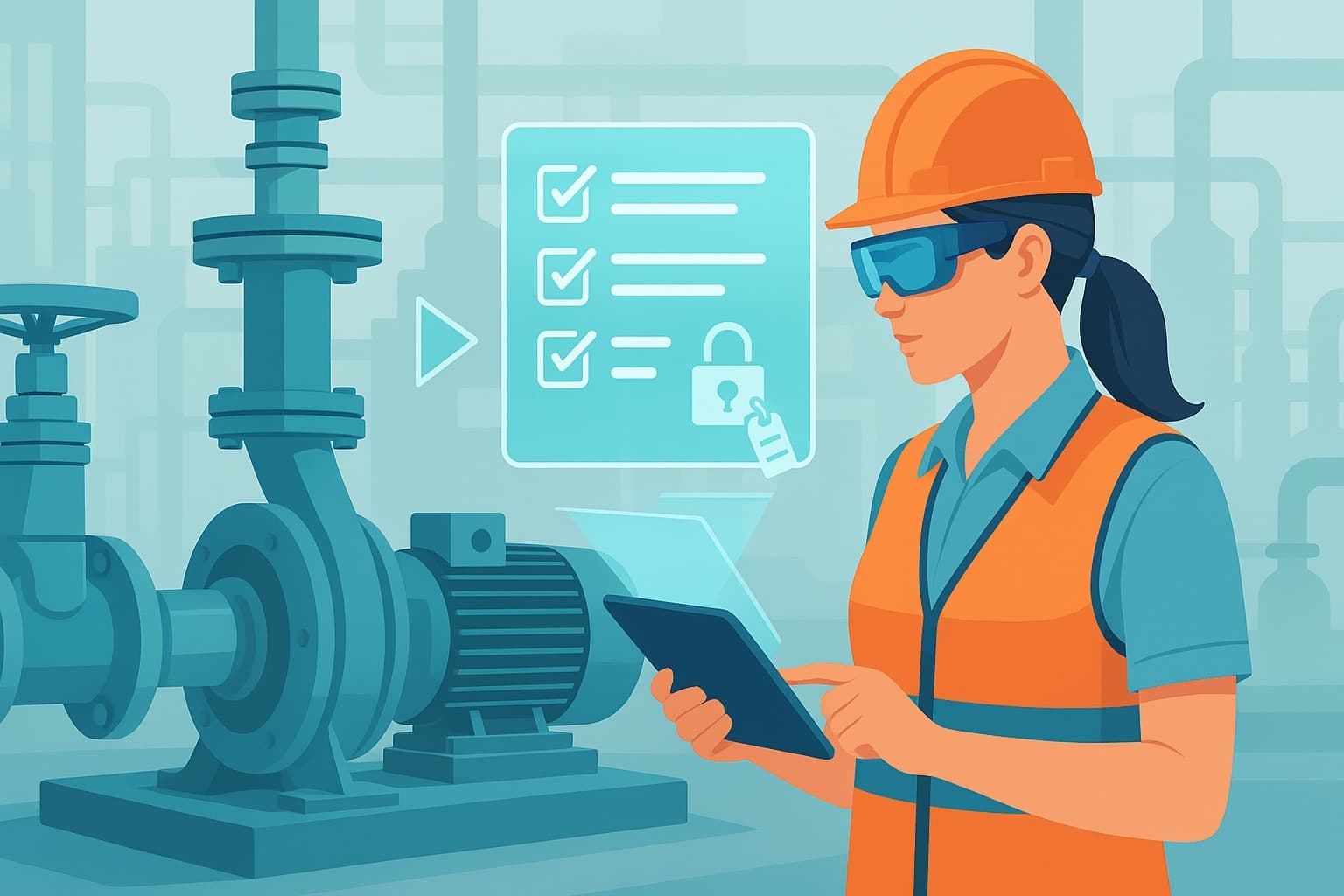
Safety, compliance and uptime are at the core of every industrial operation. For operations managers, HSE leads, and maintenance supervisors, ensuring that critical checks—especially lockout tagout (LOTO) procedures—are followed to the letter is non-negotiable. Yet, even with established SOPs, human error, knowledge gaps, and inconsistent documentation can put teams and assets at risk. AI and AR–guided work instructions now offer a practical way to digitize and enforce these essential safety steps, directly on the shop floor.
Why critical safety checks and lockout tagout still fail
Despite decades of safety programs and investments in training, critical safety checks and LOTO procedures are still a leading cause of incidents in manufacturing, utilities, and process industries. According to the U.S. Bureau of Labor Statistics, failure to control hazardous energy (including LOTO violations) consistently ranks among the most cited OSHA violations, leading to hundreds of preventable injuries each year ([source]).
Common reasons why critical checks and LOTO still break down:
- Paper-based SOPs are hard to update and easy to ignore.
- Teams may skip steps under production pressure or due to unclear instructions.
- New or contract technicians may lack hands-on experience with site-specific hazards.
- Supervisors have limited real-time visibility into who performed which check, and how thoroughly.
These gaps are not just compliance issues—they are business risks. Incidents resulting from missed LOTO steps can lead to severe injury, equipment damage, production losses, and regulatory penalties.
Why change is needed now
Industrial operations face increasing pressure to improve safety and reduce downtime, while also dealing with workforce turnover and tightening regulations. The traditional model—periodic classroom training, paper checklists, and spot audits—is struggling to keep up.
Key drivers for change:
- Rising complexity: Modern equipment and distributed assets require more nuanced, step-by-step safety checks.
- Workforce dynamics: High turnover and the use of contractors mean many people on site are unfamiliar with specific SOPs.
- Regulatory scrutiny: Digital records and traceability are now expected, not optional, in many jurisdictions.
- Production demands: Teams are often asked to do more with less, increasing the temptation to cut corners.
Many organizations are looking for a way to make safety procedures truly actionable and auditable—without slowing down operations.
How AI and AR–guided work instructions help enforce safety and LOTO
AI and AR–guided work instructions bridge the gap between policy and practice. Instead of static documents or memory-based routines, these systems deliver step-by-step, interactive guidance directly to technicians at the point of work. For LOTO and other critical safety checks, this means:
- Visual cues: AR overlays show the exact location of valves, switches, or isolation points on real equipment.
- Mandatory confirmations: Steps can require photos, scans, or digital signatures before allowing the workflow to proceed.
- Contextual intelligence: AI adapts instructions to the specific asset, task, and environment—reducing ambiguity.
- Real-time traceability: Every action is time-stamped and logged, creating a digital audit trail for compliance.
Example: AR SOPs for lockout tagout
A technician tasked with isolating a pump for maintenance uses a tablet or AR headset. The AR SOP guides them through:
- Identifying the correct isolation points (highlighted in their field of view).
- Scanning QR codes or NFC tags to confirm lockout devices are applied.
- Photographing the locked-out state for supervisor review.
- Completing a digital checklist that cannot be submitted unless all steps are verified.
Supervisors can monitor progress in real time and review a full digital record—eliminating guesswork and after-the-fact investigations.
Use cases: where AR lockout tagout and critical checks add value
AI and AR–guided work instructions for safety and LOTO are being implemented in the following scenarios:
Planned maintenance shutdowns
During major turnarounds, dozens of technicians—often from multiple contractors—must isolate and de-energize equipment. AR SOPs ensure that every step is followed consistently, and that supervisors have a live dashboard of lockout status across the site.
Emergency interventions
In urgent situations, it is easy to miss a step or bypass documentation. AR-guided workflows walk teams through the correct sequence, even under pressure, and capture proof for later review.
Training and onboarding
New team members or contractors can follow AR SOPs that combine site-specific visuals with interactive prompts, reducing reliance on tribal knowledge and shadowing.
Routine inspections and audits
Regular safety inspections are digitized and guided, with AI flagging missed steps or inconsistencies for corrective action.
Note: AR and AI–guided work instructions are not limited to LOTO. They can be applied to any critical safety check, including confined space entry, hot work permits, and pre-start inspections.
Results: measurable improvements in safety and compliance
Organizations adopting AI and AR–guided work instructions for LOTO and safety checks report:
- Fewer missed steps: Digital workflows make it nearly impossible to skip or fake critical actions.
- Faster incident investigations: Complete, time-stamped records are available instantly.
- Improved compliance: Auditors can review digital evidence rather than relying on paper forms or memory.
- Reduced training time: New technicians reach proficiency faster, with less risk.
- Higher engagement: Teams value clear, visual instructions over dense SOP binders.
A 2023 case study from a large European chemicals manufacturer found that digitizing LOTO procedures with AR reduced procedural violations by 60% and cut supervisor review time in half (internal audit, client data shared with permission).
Addressing objections: hardware, content, and change management
Adopting AR SOPs and digital work instructions requires practical planning. Common concerns include:
- Hardware requirements: Most AR SOPs can run on standard tablets or smartphones; specialist headsets are optional for hands-free use.
- Content creation: Converting existing SOPs to digital, visual formats is a one-time effort, with ongoing updates managed centrally.
- Change management: Success depends on engaging teams early, demonstrating clear benefits, and aligning digital workflows with existing safety policies.
ActARion works with clients to assess readiness, pilot AR SOPs in high-impact areas, and support training and rollout.
What ActARion brings to safety and LOTO enforcement
ActARion specializes in helping industrial organizations implement AI and AR–guided work instructions that drive measurable improvements in safety, quality, and productivity.
Key capabilities:
- Rapid digitization: We convert your existing LOTO procedures and critical checks into interactive, AR-enabled workflows.
- Integration: ActARion connects with your EHS, CMMS, or training systems for seamless data flow.
- Governance: Full audit trails, permissions, and change controls support compliance and continuous improvement.
- Scalability: Start with one process or line, and expand across your operations as needed.
Our approach is grounded in practical experience with global manufacturers, utilities, and energy companies. We focus on real-world results, not generic technology promises.
Explore this in your organisation
See how AI and AR–guided work instructions could reduce risk and improve compliance in your safety-critical processes. Schedule a discovery call to explore a pilot for your LOTO procedures or critical safety checks—no commitment required.
Learn more about digital work instructions for maintenance or see how AR onboarding for technicians accelerates skills transfer. For a regulatory overview of LOTO requirements, visit [OSHA’s lockout tagout page].
Meta description:
How AI and AR–guided work instructions help operations and HSE leaders enforce critical safety checks and lockout tagout procedures, reducing risk and improving compliance.
URL slug:
safety-first-ar-lockout-tagout
Go deeper
This article is part of our knowledge base on digital work instructions and compliance. For a comprehensive overview, read our whitepaper:
Digital work instructions and AR SOPs for standard work and compliance — Covers how AR SOPs add value for safety-critical procedures, quality inspections, and changeovers.