
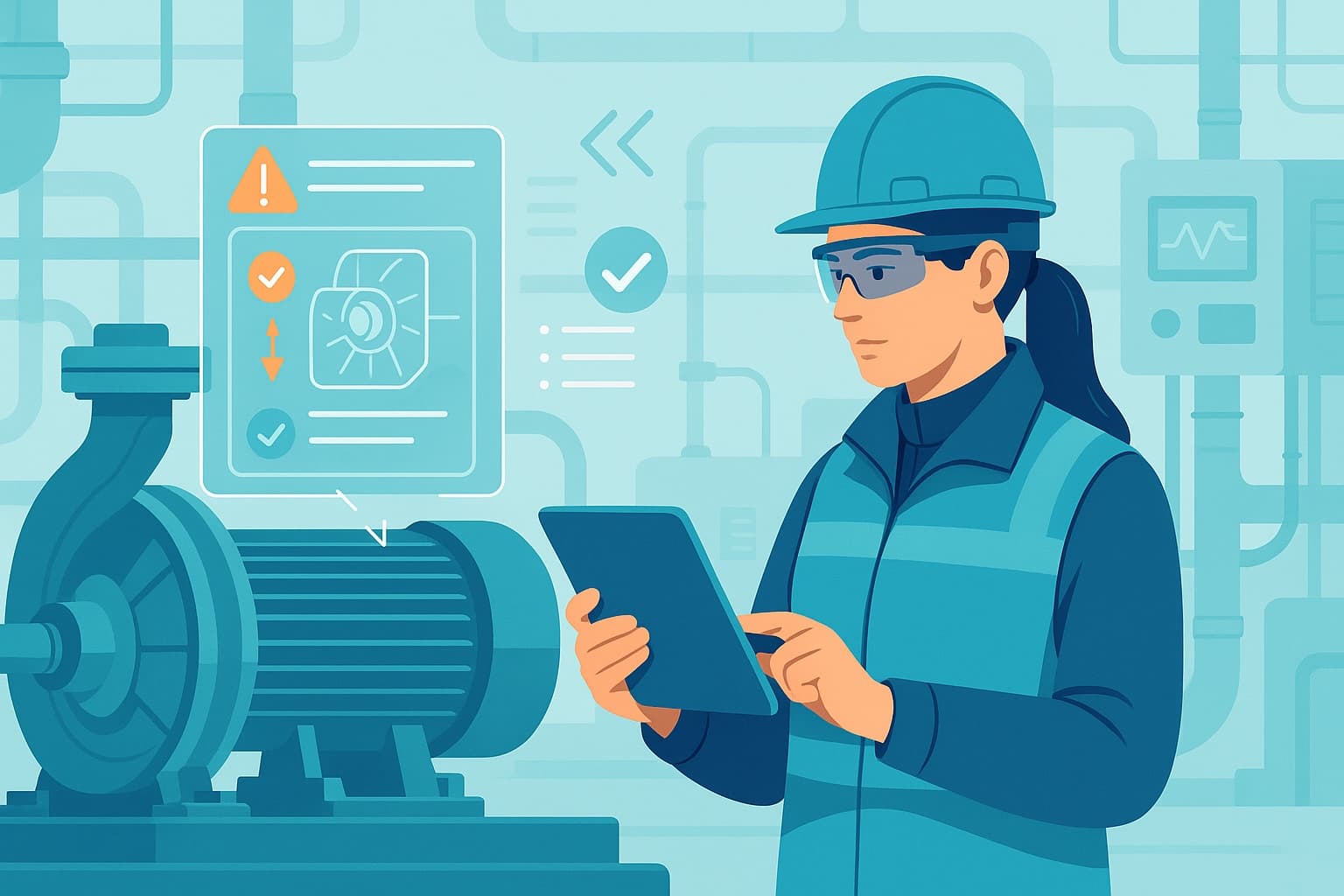
Unplanned downtime is a critical challenge for industrial operations. When systems fail or complex maintenance is required, the fastest path to resolution often means bringing in an external specialist—at significant cost, delay, and risk to productivity. Remote expert support with AR (augmented reality) is changing that equation. By enabling real-time, on-site guidance from experts anywhere in the world, AI and AR–guided work instructions help your teams resolve downtime faster, maintain quality and safety, and avoid the need to fly in specialists.
Downtime and specialist dependence: why change is urgent
Industrial sites—whether manufacturing plants, energy facilities, or logistics hubs—rely on the smooth, uninterrupted operation of complex equipment. When something goes wrong, the consequences are immediate:
- Production lines stop, causing loss of output and revenue.
- Safety risks increase, especially when unfamiliar teams attempt urgent repairs.
- Compliance and quality can be compromised if unqualified interventions are made.
Traditionally, the solution has been to call in a vendor or technical specialist. According to a 2023 ARC Advisory Group report, unplanned downtime costs manufacturers an estimated $50 billion per year globally, with up to 42% of incidents requiring external intervention. Travel delays, visa processes, and specialist availability can easily stretch downtime from hours to days.
This approach is increasingly unsustainable:
- Rising travel costs and supply chain disruptions make flying in experts more expensive and less reliable.
- Skills shortages mean fewer specialists are available, especially for legacy or bespoke equipment.
- Environmental and ESG goals push companies to minimize unnecessary travel.
- Teams need to upskill and become more self-reliant to maintain uptime and safety.
The gap: why on-site teams struggle with complex issues
Even with strong in-house maintenance and operations teams, several barriers prevent rapid resolution of complex problems:
- OEM manuals and SOPs are often static, generic, and hard to follow under pressure.
- Knowledge transfer is inconsistent, especially with staff turnover and retirements.
- Remote support calls via phone or video lack the context and clarity needed for precise troubleshooting.
- Language barriers and miscommunication lead to errors and rework.
For decision makers, the result is a difficult trade-off: accept costly downtime, or accept the risks of incomplete or incorrect repairs.
How remote expert support with AR works
Remote expert support with AR bridges these gaps by combining live, real-time communication with digital overlays, step-by-step AR SOPs, and AI-powered guidance. Here’s how it works in practice:
- On-site technicians use AR-enabled devices (smart glasses, tablets, or phones) to connect with remote experts.
- The expert sees exactly what the technician sees, in real time, through a secure video feed.
- Using AR, the expert can annotate the technician’s field of view—highlighting components, drawing arrows, or overlaying instructions directly onto the equipment.
- AI and AR–guided work instructions provide relevant SOPs, checklists, and troubleshooting steps, customized for the specific asset and scenario.
- Documentation and session recording ensure compliance and knowledge capture for future reference.
This setup transforms remote support from a passive phone call to an interactive, context-rich collaboration.
Key benefits of remote expert support with AR
Organizations adopting AR-based remote support realize measurable improvements in several areas:
- Faster resolution of downtime: Teams can begin troubleshooting immediately, without waiting for travel or scheduling.
- Improved safety and compliance: Step-by-step AR SOPs reduce risk of error and ensure adherence to procedures.
- Reduced costs: Eliminating travel and reducing repeat site visits saves direct and indirect costs.
- Workforce upskilling: On-site teams gain confidence and expertise by working through issues under expert guidance.
- Better documentation: Every session can be captured for audit, training, and continuous improvement.
A 2022 Capgemini study found that companies using AR remote assistance reduced machine downtime by 30–50%, with a similar reduction in travel-related costs.
Practical use cases in industrial environments
Remote expert support with AR is already delivering results in sectors such as manufacturing, energy, utilities, and logistics. Here are some concrete scenarios:
Complex equipment troubleshooting
A packaging line in a food processing plant goes down due to a sensor fault. The maintenance team connects with a remote OEM specialist using AR smart glasses. The expert guides the team through diagnostics, highlights wiring and sensor locations in the technician’s field of view, and confirms the fix—all without leaving their office.
Commissioning and calibration
A new automated inspection system must be calibrated to meet regulatory standards. Instead of waiting for a vendor representative, the plant’s quality engineer uses AR-enabled instructions and connects with a remote calibration expert. Live AR overlays reduce ambiguity, ensure accuracy, and minimize the risk of non-compliance.
Emergency response and safety incidents
A chemical plant experiences an alarm on a critical valve. The HSE manager initiates a remote support session with a process safety expert, who walks the on-site team through isolation procedures using AR overlays and digital checklists. The incident is resolved safely, with full documentation for follow-up.
Training and onboarding
New technicians join a wind farm maintenance team with limited hands-on experience. By pairing AI and AR–guided work instructions with remote mentoring, the team accelerates onboarding and ensures that every step is performed correctly—even during their first solo intervention.
What’s needed for effective remote expert support
To realize the benefits of AR remote support, organizations should address several practical considerations:
- Device compatibility: Ensure AR solutions work with existing devices (smart glasses, tablets, rugged smartphones) and can operate in challenging environments (gloves, PPE, variable lighting).
- Network reliability: Industrial sites must provide secure, stable connectivity—ideally with offline fallback for critical instructions.
- Content readiness: Digital SOPs and AI–guided instructions must be accurate, up-to-date, and tailored to assets and processes.
- Data security: All remote sessions and data transfers should comply with company and regulatory standards for privacy and cybersecurity.
- Change management: Teams need training, support, and clear governance to adopt new workflows and maximize ROI.
Note: While AR remote support reduces the need for specialist travel, it does not eliminate the need for on-site expertise in all cases. Some interventions (e.g., high-voltage work, hazardous materials) may still require certified specialists on site.
How ActARion enables remote expert support with AR
ActARion partners with industrial organizations to deploy remote expert support that is robust, scalable, and tailored to operational realities. Our approach combines:
- AI and AR–guided work instructions: We digitize your SOPs and asset-specific procedures for real-time use in the field.
- Seamless remote session management: Secure video, annotation, and documentation tools integrate with your existing systems.
- Governance and compliance: We help you manage access, recordkeeping, and audit trails for every support session.
- Change enablement: Our experts support your teams through onboarding, training, and continuous improvement.
This means your teams are empowered to resolve downtime and complex issues, safely and efficiently—without waiting for external specialists to arrive on site.
Results: measurable impact on productivity and cost
Organizations using ActARion’s remote expert support with AR report:
- 30–60% reduction in average downtime per incident
- 40% drop in travel-related support costs
- Improved first-time fix rates and reduced repeat visits
- Higher technician engagement and skills retention
- Enhanced compliance and traceability for critical interventions
These outcomes are supported by real-world deployments across manufacturing, energy, and logistics sectors. For more details, see our case studies and use cases.
Explore remote expert support for your organisation
Remote expert support with AR enables your teams to resolve downtime quickly, maintain quality, and reduce costs—without flying in specialists. To explore how this looks for your specific assets, sites, and teams, schedule a discovery call with ActARion. This is an exploratory conversation, not a commitment.
Learn more about AI and AR–guided work instructions, or see how AR onboarding for technicians accelerates skills transfer. For industry trends and best practices, see the World Economic Forum on AR in industry.
Go deeper
This article is part of our knowledge base on connected worker solutions. For a comprehensive overview, read our whitepaper:
Connected worker platforms: enabling knowledge transfer and operational support — Covers remote expert support and other key use cases enabled by connected worker platforms.