
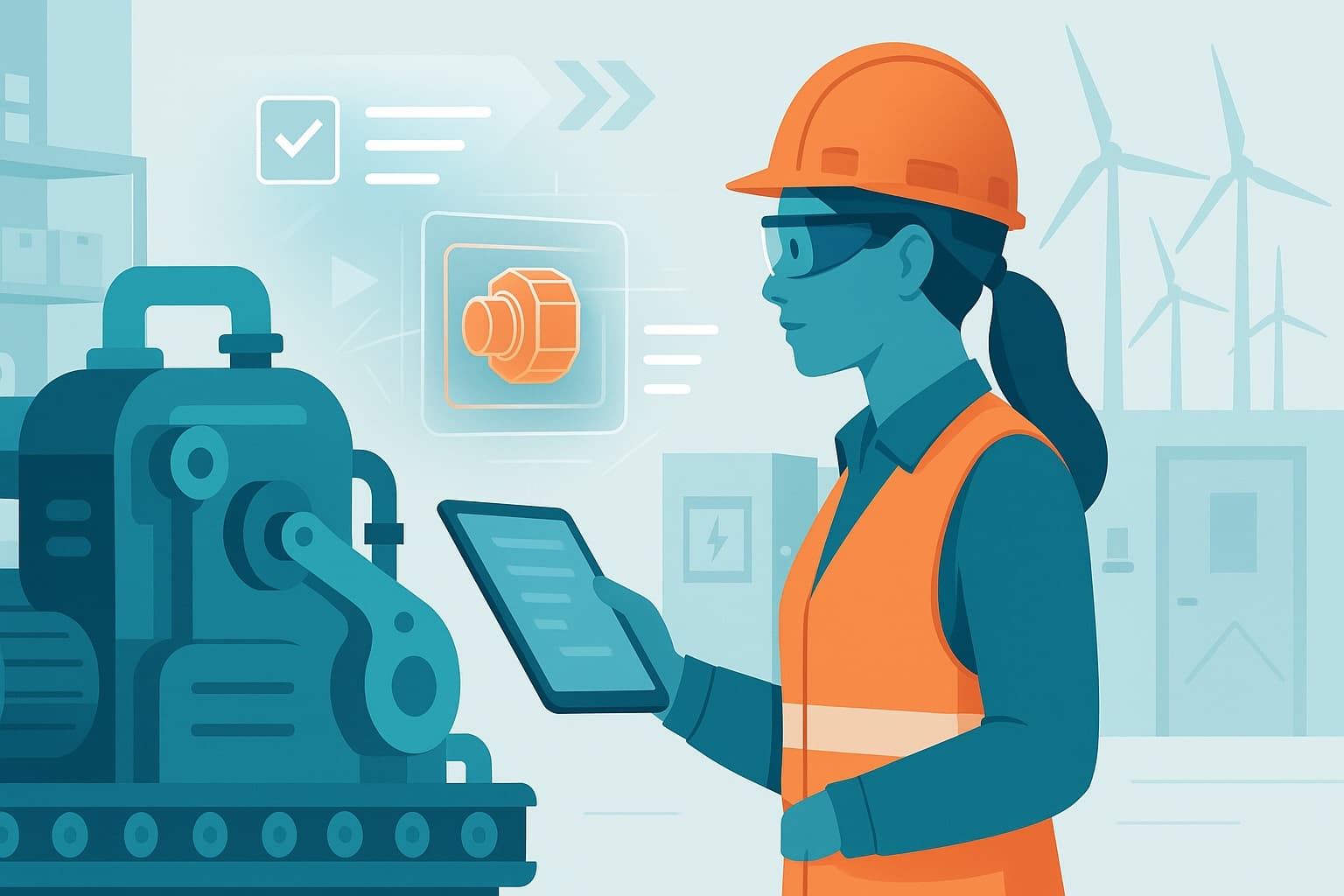
Augmented reality (AR) is no longer just a pilot project in industrial environments. Operations managers, HSE leads, and training specialists are using AI and AR–guided work instructions to improve safety, quality, and productivity across manufacturing, logistics, and energy sectors. The lessons learned from real-life AR use cases are clear: digital work instructions and AR SOPs help teams work smarter, safer, and faster.
Why industrial teams are turning to AR now
The pressure to maintain uptime, assure safety, and transfer skills efficiently is increasing. Many sectors face an ageing workforce, skills shortages, and stricter compliance demands. Traditional paper-based SOPs and manual training are not keeping pace.
Several trends are driving AR adoption in industry:
- Complexity of tasks: Equipment and processes are more advanced, requiring precise execution and real-time guidance.
- Workforce turnover: New technicians and operators need to reach proficiency quickly, without compromising safety or quality.
- Remote work and distributed expertise: Global operations require knowledge sharing across locations, often with limited on-site support.
- Regulatory scrutiny: Documentation and traceability requirements are rising, especially in safety-critical environments.
In this context, AI and AR–guided work instructions are becoming essential tools.
What makes AR work instructions effective in industry
AR work instructions overlay digital guidance directly onto the technician’s field of view—using smart glasses, tablets, or head-mounted displays. Combined with AI, these systems can:
- Guide step-by-step procedures: Visual cues, checklists, and contextual data reduce errors and omissions.
- Validate actions in real time: AI-powered recognition ensures correct parts, tools, or sequences.
- Capture evidence and compliance data: Photos, videos, and digital logs support traceability and audits.
- Enable remote support: Experts can see what the operator sees and provide live guidance.
The result is a measurable improvement in safety, productivity, and quality.
Manufacturing: AR SOPs for quality assurance and maintenance
Problem: Standardization and error-proofing in complex assembly
In automotive and electronics manufacturing, even small deviations from SOPs can lead to costly defects or recalls. Traditional paper-based instructions are hard to update and often ignored on the shop floor.
Use case: Guided assembly and inspection
A global automotive supplier implemented AR SOPs for complex wiring harness assembly. Technicians wore smart glasses displaying step-by-step overlays, with AI verifying part placement and torque values.
Observed results:
- 35% reduction in assembly errors (internal QA data, 2023)
- 25% faster onboarding for new operators
- Digital audit trails for every unit assembled
Lessons learned
- Content accuracy is critical: AR instructions must be kept up to date with process changes.
- Change management is key: Teams need hands-on training to trust and use the new system.
- Integration with MES/ERP: Linking AR work instructions to production systems streamlines reporting and compliance.
Problem: Unplanned downtime from maintenance errors
Reactive maintenance and inconsistent procedures lead to avoidable downtime and safety risks.
Use case: AR-guided preventive maintenance
A chemical manufacturer equipped maintenance technicians with AR-enabled tablets. Step-by-step digital work instructions guided lubrication, inspection, and calibration tasks. AI-based checklists ensured nothing was missed.
Observed results:
- 40% reduction in unplanned downtime (internal maintenance logs, 2022–2023)
- Improved safety compliance, with automated documentation for every intervention
Lessons learned
- Visual guidance reduces cognitive load: Technicians follow complex procedures more reliably with AR.
- Evidence capture: Photos and digital sign-off support root cause analysis and regulatory audits.
Logistics: Optimizing picking, packing, and inventory with AR
Problem: Inefficient picking and error-prone inventory management
Distribution centers face pressure to process more orders with fewer errors. Manual picking processes are slow and prone to mistakes, especially with high SKU variety.
Use case: AR-assisted order picking
A major logistics provider deployed AR headsets for order pickers. The system highlighted picking paths, shelf locations, and item details directly in the picker's view. AI confirmed correct item selection with barcode scanning.
Observed results:
- 20% increase in picking speed (pilot project, 2023)
- 50% reduction in picking errors
- Higher job satisfaction reported by operators
Lessons learned
- Hardware ergonomics matter: Lightweight, comfortable devices see higher adoption.
- Content localization: Instructions should be available in multiple languages for diverse teams.
- Integration with WMS: Real-time data exchange with warehouse management systems is essential for accuracy.
Problem: Onboarding new staff during seasonal peaks
High staff turnover and seasonal peaks require rapid onboarding without compromising accuracy.
Use case: AR onboarding for new warehouse technicians
A European e-commerce warehouse used AR SOPs to train new hires. Interactive, visual instructions walked trainees through picking, packing, and safety procedures.
Observed results:
- 30% faster onboarding (L&D team data, 2023)
- Fewer onboarding-related errors in the first 30 days
Lessons learned
- Self-paced learning: AR allows trainees to practice at their own speed, reducing supervision needs.
- Retention improves: Visual, hands-on guidance leads to better long-term recall.
Energy: Safety-critical procedures and remote support
Problem: High-consequence tasks and remote locations
Energy sector teams often work in hazardous, remote environments—where mistakes can have serious consequences. Access to expertise is limited, and documentation must be flawless.
Use case: AR-guided lockout/tagout (LOTO) procedures
A power generation company introduced AR SOPs for LOTO procedures on turbines. Technicians received visual step-by-step guidance, with AI verifying correct switch positions and lock placements.
Observed results:
- Zero LOTO violations in 12 months (HSE audit, 2023)
- 15% reduction in procedure time
- Digital evidence for every step, supporting compliance
Lessons learned
- Procedural rigor: AR SOPs enforce correct sequencing, which is critical for safety.
- Audit-ready records: Automated evidence capture simplifies HSE audits.
Problem: Limited access to expert support
When issues arise at remote sites, delays in getting expert help can extend downtime.
Use case: Remote AR support for field engineers
An oil and gas operator equipped field engineers with AR headsets. Experts at headquarters could see the engineer’s view and provide live, step-by-step guidance.
Observed results:
- 60% reduction in time to resolve complex faults (pilot program, 2023)
- Fewer site visits required by central experts
Lessons learned
- Bandwidth and connectivity: Reliable network access is essential; offline modes may be needed.
- Privacy and security: Clear governance around video/audio capture and data storage is required.
Addressing common challenges: hardware, content, and change management
Rolling out AI and AR–guided work instructions is not without hurdles. Industrial decision makers report several recurring challenges:
- Hardware selection: Choose devices that fit your environment—considering durability, battery life, and comfort.
- Content creation: Developing accurate, visual SOPs takes effort. Involve process experts and update content regularly.
- Integration: AR systems should connect with existing MES, ERP, or WMS platforms for seamless workflows.
- Change management: Teams need training, support, and clear communication to adopt new tools.
- Governance: Address data privacy, security, and compliance from day one.
Successful projects invest in pilot phases, gather feedback from technicians, and iterate before scaling up. For further details on change management, see governance for AR and AI in industry.
How ActARion supports your AR journey
ActARion brings deep industrial expertise to every AR deployment. Our approach focuses on measurable results, safety, and sustainable adoption:
- Process mapping: We work with your teams to digitize SOPs and identify high-impact use cases.
- Custom AR SOPs: We create and maintain digital work instructions tailored to your processes and equipment.
- Integration: Our solutions connect with your existing IT and OT systems to ensure data consistency.
- Change management: We provide onboarding, training, and support to drive adoption and ROI.
- Governance: We help you establish clear data, privacy, and compliance frameworks.
Our track record spans manufacturing, logistics, and energy—delivering real improvements in uptime, quality, safety, and training effectiveness. For a closer look at our approach, see how ActARion works with industrial teams.
Explore this in your organisation
If you want to see how AI and AR–guided work instructions could address your team's safety, quality, or productivity challenges, schedule an exploratory call with ActARion. We'll review your current processes and identify practical AR use cases—no obligation required.
Explore more about digital work instructions in manufacturing or AR onboarding for technicians. For additional industry insights, see the World Economic Forum’s report on AR in industry.
Meta description:
Explore real-life AR use cases in manufacturing, logistics, and energy. Learn how AI and AR–guided work instructions deliver measurable safety, quality, and productivity gains for industrial teams.
URL slug:
lessons-learned-ar-use-cases