
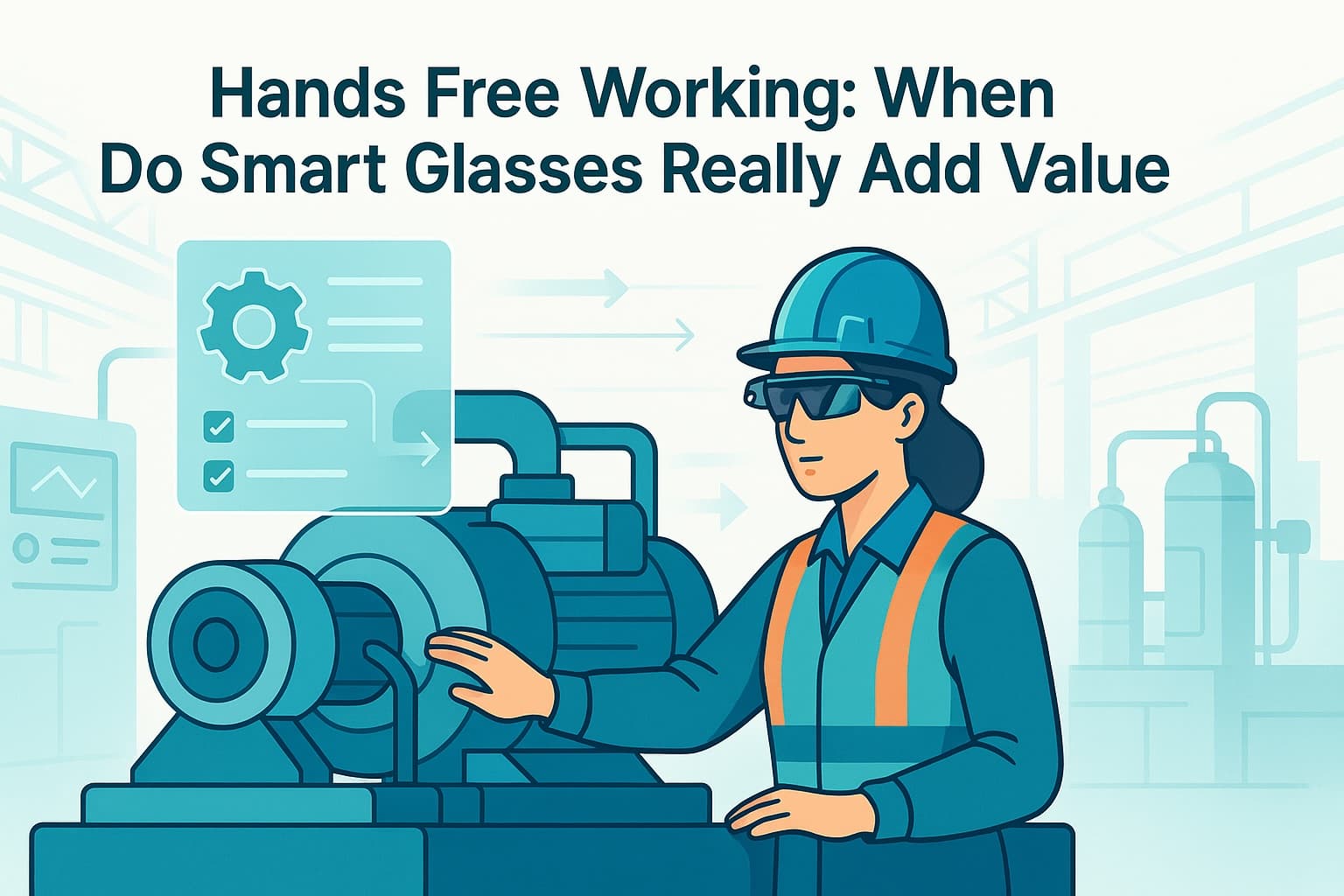
Hands free working is a growing priority in industrial operations. Smart glasses promise to keep technicians’ hands on the task—improving safety, quality, and speed. But the real question for operations, HSE, and maintenance leaders is: when do smart glasses move beyond novelty to deliver measurable value?
This article explores the concrete scenarios where hands free working with smart glasses—powered by AI and AR–guided work instructions—makes a difference. We cover key use cases, operational results, and what to consider before investing.
Why hands free working matters now
Industrial teams face rising complexity, workforce turnover, and regulatory scrutiny. At the same time, pressure mounts to reduce downtime, ensure compliance, and close skills gaps. Traditional methods—paper-based SOPs, tablets, or memory—often fall short in dynamic environments where speed and precision are critical.
Key challenges include:
- Technicians juggling tools, parts, and documentation at once
- Distraction or errors from switching between screens and tasks
- Increased risk of contamination in clean or hazardous areas
- Difficulties onboarding new staff to complex procedures
These pain points are not theoretical. For example, a 2022 survey by the Manufacturing Institute found that 74% of manufacturers cited skills gaps as a top challenge, with onboarding and knowledge transfer lagging behind operational needs (source). In regulated sectors, compliance audits frequently cite incomplete documentation and procedural deviations as root causes for incidents.
The limitations of “traditional” digital tools
Many plants and field teams have already moved from paper to tablets or mobile devices. While this digitization step is positive, it introduces new friction:
- Tablets and phones require at least one hand, often both, to operate
- Gloved or dirty hands make touch screens difficult or hazardous
- Devices are easily dropped or contaminated
- Switching between device and task slows work, especially for complex or risky jobs
For processes where uninterrupted focus and physical control are essential—heavy equipment maintenance, live electrical work, or sterile environments—these limitations create real bottlenecks and safety concerns.
What hands free working with smart glasses can do
Smart glasses, when paired with AI and AR–guided work instructions, enable hands free working by projecting digital SOPs, checklists, diagrams, or real-time data directly into a technician’s field of view. Voice commands, gestures, or eye tracking let users navigate instructions without putting down tools or removing PPE.
Key benefits include:
- Both hands remain available for work, tools, and safety equipment
- Instructions are always visible, reducing context switching and errors
- Photos, videos, and data can be captured instantly for documentation
- Remote experts can “see what I see” for live support or approvals
- AR overlays highlight specific parts, hazards, or next steps directly on equipment
This approach is not about replacing people. It’s about augmenting teams with just-in-time knowledge, improving compliance, and making complex or hazardous work safer and more efficient.
When do smart glasses really add value?
The value of hands free working depends on the context. Based on field experience and customer deployments, smart glasses deliver the strongest ROI in scenarios where:
1. Work requires both hands for safety or precision
- Electrical panel work, where one hand must remain on a safety bar
- Tight spaces or working at height, where holding a device is unsafe
- Tasks involving tools, chemicals, or PPE that limit device use
2. Environments are hazardous, sterile, or regulated
- Cleanrooms in pharma, biotech, or food processing
- Explosive atmospheres (ATEX zones) where device handling is restricted
- Maintenance in high-voltage or arc flash risk areas
3. Procedures are complex, variable, or high-stakes
- Equipment changeovers with dozens of steps and tight tolerances
- Emergency repair tasks where speed and accuracy are critical
- Quality inspections requiring photo evidence or step-by-step checks
4. Onboarding and training need to be accelerated
- New hires or contractors performing unfamiliar tasks
- Reskilling experienced staff for new equipment or processes
- Cross-shift consistency when teams rotate frequently
5. Remote support or validation is required
- Field service in remote or offshore locations
- Regulatory audits needing live walkthroughs
- Expert sign-off on completed work without travel
In these contexts, smart glasses shift the balance from “nice to have” to “must have” by directly supporting safety, productivity, and compliance.
Use cases: hands free working in action
To illustrate where smart glasses and AR SOPs deliver measurable results, consider these scenarios:
Digital maintenance instructions for complex assemblies
A maintenance team at a chemical plant needs to overhaul a pump. The procedure includes over 40 steps, each with critical tolerances and safety checks. Wearing smart glasses, the technician sees each step overlaid on the equipment, uses voice to confirm completion, and captures photos for the maintenance record—without ever removing gloves or juggling paper.
Result: 30% reduction in errors, 20% faster job completion, full digital traceability.
Quality inspections in regulated manufacturing
In a medical device facility, quality inspectors use smart glasses to follow digital work instructions and capture real-time evidence. AR overlays guide them to each inspection point, and voice commands log findings. This hands free approach maintains sterile conditions and ensures every checkpoint is documented for audit.
Result: 100% inspection coverage, reduced contamination risk, automatic compliance documentation.
Remote expert support for field service
A field engineer servicing a wind turbine encounters an unexpected fault. Using smart glasses, they share a live feed with a remote specialist, who guides troubleshooting and confirms repairs. The engineer keeps both hands on the task, and the fix is completed safely on the first visit.
Result: Reduced downtime, eliminated travel costs, improved first-time fix rates.
Onboarding new technicians with AR SOPs
A manufacturing site faces high turnover among technicians. Instead of shadowing or lengthy classroom training, new hires use smart glasses to follow AR–guided procedures on the production line. Each step is visualized on real equipment, and common errors are flagged in real time.
Result: 40% reduction in onboarding time, higher confidence, and fewer early-stage incidents.
What to consider before deploying smart glasses
While the benefits of hands free working are clear in the right contexts, successful adoption requires careful planning. Decision makers should address:
- Hardware suitability: Not all smart glasses are equal. Evaluate comfort, battery life, field of view, and compatibility with PPE. ATEX-certified models may be needed for hazardous areas.
- Content readiness: Digital work instructions must be clear, visual, and up-to-date. Investing in content creation and maintenance is critical.
- Connectivity: Live remote support and data sync may require reliable Wi-Fi or 5G, especially in remote or shielded sites.
- Change management: Teams need training and support to build confidence in new workflows. Early involvement of end users and clear governance help drive adoption.
- Integration: Ensure AR SOPs connect to existing systems (CMMS, QMS, LMS) for seamless documentation and reporting.
Note: For a detailed checklist on evaluating smart glasses for industrial use, see How to choose AR hardware for industrial environments.
What ActARion brings to hands free working
ActARion enables industrial teams to realize the full potential of hands free working with a proven platform for AI and AR–guided work instructions. Our approach focuses on:
- Fast digitization of SOPs and checklists for hands free use
- Integration with leading smart glasses and industrial wearables
- Built-in support for compliance, documentation, and remote assistance
- Governance frameworks for safe, scalable adoption
- Change management and user training tailored to your context
We work with operations, HSE, maintenance, and L&D leaders to identify high-impact use cases, measure outcomes, and build a sustainable roadmap for digital work instructions.
Explore hands free working in your organisation
Ready to see where hands free working with smart glasses could deliver measurable value for your teams? Schedule an exploratory call to review your processes, challenges, and priorities—no commitment required.
- See how AI and AR–guided work instructions drive safety and productivity
- Explore use cases in maintenance and inspections
- For industry trends and standards, visit The Manufacturing Institute
Discover how ActARion can help your organisation work smarter, safer, and faster with hands free digital work instructions.
Meta description:
Hands free working with smart glasses: when do they add real value? For industrial managers seeking safer, more productive, and compliant operations.
URL slug:
hands-free-working-smart-glasses
Go deeper
This article is part of our knowledge base on connected worker solutions. For a comprehensive overview, read our whitepaper:
Connected worker platforms: enabling knowledge transfer and operational support — Covers the role of AR in connected worker platforms and the limits of mobile-only tools.