
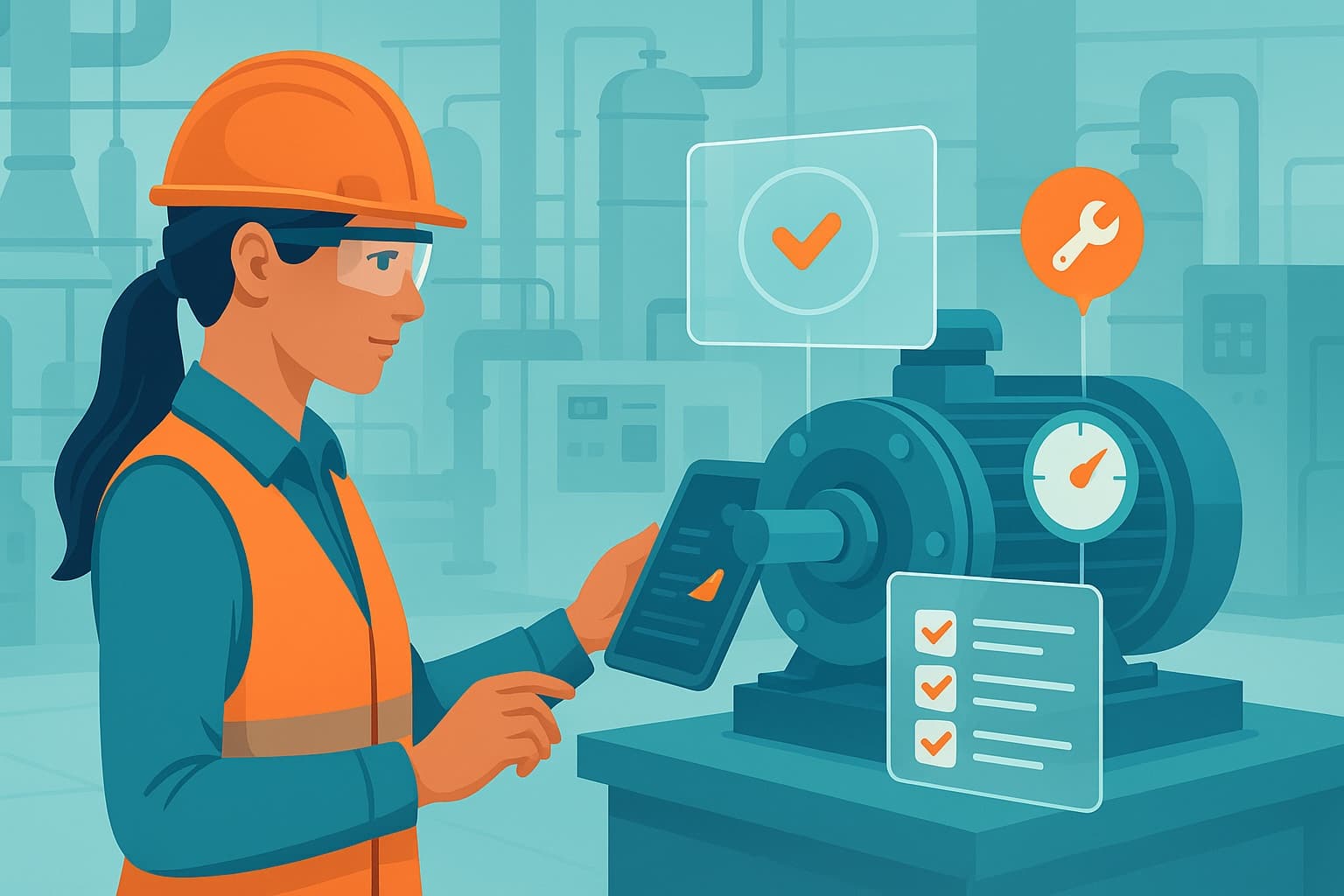
Industrial training is at a turning point. In a sector where safety, uptime, and compliance are non-negotiable, the future of work depends on evolving the way teams learn and apply critical skills. AI and AR–guided work instructions are enabling a new standard: safer, faster, and smarter industrial training that directly impacts productivity and risk reduction.
Industrial training today: context and challenges
Operations managers, HSE leads, and training specialists know the realities of industrial training. Most organisations still rely heavily on classroom sessions, paper-based SOPs, and shadowing experienced technicians. This approach is resource-intensive and often inconsistent, leading to:
- Variability in how procedures are understood and applied
- High risk of errors during complex or infrequent tasks
- Slow ramp-up times for new technicians and operators
- Difficulty capturing and transferring expert knowledge before retirement or turnover
According to the European Agency for Safety and Health at Work, human factors remain a leading cause of industrial incidents, often linked to insufficient or inconsistent training (source). The pressure to maintain uptime, comply with regulations, and onboard new staff quickly is only increasing.
Why change is needed now: trends shaping the future of work
Several trends are converging to make the case for new training models in industrial environments:
- Aging workforce: Many senior technicians are retiring, risking the loss of decades of tacit knowledge.
- Increased complexity: Equipment and processes are more sophisticated, requiring deeper and more precise skills.
- Regulatory demands: Authorities are raising expectations for traceable, auditable training and compliance.
- Digital transformation: Companies are digitising operations to improve efficiency, but legacy training lags behind.
The COVID-19 pandemic accelerated remote work and digital adoption, but in-person, hands-on learning remains essential for many tasks. The challenge is to blend digital tools with real-world practice, ensuring that teams are not just trained, but truly ready.
How AI and AR–guided work instructions enable safer, faster, smarter training
AI and AR–guided work instructions, sometimes called digital work instructions or AR SOPs, are addressing these challenges head-on. These solutions overlay step-by-step procedures, contextual information, and real-time guidance onto the technician’s field of view—using tablets, smart glasses, or mobile devices.
How it works in practice
- AI-driven content: Automatically adapts instructions based on equipment, skill level, or previous errors.
- AR overlays: Visual cues guide technicians through each step, reducing ambiguity and reliance on memory.
- Real-time feedback: Prompts and alerts help prevent errors before they occur.
- Performance tracking: Digital records show who completed which steps, when, and how, supporting compliance.
This approach turns every task into a learning opportunity and every technician into a contributor to continuous improvement.
Use cases: real-world impact of AI and AR in industrial training
The benefits of safer, faster, smarter industrial training become concrete in specific scenarios:
Digital onboarding for new technicians
Traditional onboarding can take weeks or months, as new hires shadow experienced colleagues and work through manuals. With AI and AR–guided work instructions, new technicians can:
- Follow step-by-step AR SOPs for routine and complex tasks
- Receive instant feedback on each action
- Access embedded safety reminders and compliance checks
This reduces onboarding times by up to 40% in some industrial organisations (), while maintaining safety and quality standards.
Upskilling and cross-training
As operations change, teams need to learn new equipment or processes quickly. Digital work instructions enable targeted, on-the-job upskilling:
- Operators can switch between tasks with guided support, reducing dependence on paper manuals
- Maintenance leads can standardise best practices across shifts and sites
- HSE managers can embed the latest safety requirements directly into work instructions
This approach also supports compliance with ISO 9001 and ISO 45001, which require documented training and traceability.
Knowledge retention and transfer
When senior technicians retire or move roles, their know-how can be lost. AI and AR–guided work instructions help capture expert workflows:
- Video or photo capture of best practices during live tasks
- Step-by-step breakdowns that can be updated as processes evolve
- Centralised, searchable repositories accessible to all team members
This preserves institutional knowledge and ensures consistent application across teams.
Remote support and validation
When problems arise, field engineers can use AR to connect with remote experts:
- Live video with AR markup for troubleshooting and validation
- Real-time coaching and sign-off for critical procedures
- Reduced travel and faster resolution of complex issues
This is especially valuable for geographically distributed sites or during travel restrictions.
Results: measurable improvements in safety, productivity, and quality
Organisations implementing AI and AR–guided work instructions in industrial training report:
- Fewer incidents: Up to 30% reduction in procedural errors and near misses (Deloitte, 2022)
- Faster onboarding: 25–40% reduction in time to competence for new hires
- Higher compliance: Digital records make audits faster and more accurate
- Improved quality: Consistent application of SOPs leads to fewer defects and rework
For decision makers, these outcomes translate into lower risk, higher uptime, and greater agility—all critical in today’s industrial landscape.
Addressing objections: hardware, content, and change management
While the benefits are clear, implementing AI and AR–guided work instructions requires careful planning.
Hardware selection
- Fit for environment: Devices must be rugged, easy to disinfect, and safe for use in hazardous areas.
- User comfort: Smart glasses and tablets must not impede movement or safety gear.
Content creation and updates
- Initial effort: Converting legacy SOPs to digital, interactive formats takes time.
- Ongoing maintenance: Processes and regulations change; instructions must be kept current.
- Governance: Clear ownership for content quality and version control is essential.
Change management and adoption
- Training: Teams need hands-on exposure to new tools, with support from supervisors.
- Buy-in: Involving technicians in content creation increases acceptance and relevance.
- Integration: Digital work instructions should fit into existing workflows and IT systems.
Note: Successful pilots often start with high-impact, high-frequency tasks before scaling up. This allows organisations to prove value, refine processes, and build internal champions.
What ActARion brings to the future of industrial training
ActARion partners with industrial organisations to implement AI and AR–guided work instructions that deliver measurable results. Our approach is grounded in real-world experience with maintenance, HSE, and operations teams. We help you:
- Assess training and process gaps with a structured discovery phase
- Select appropriate hardware and integration points
- Digitise and optimise SOPs for AR delivery
- Support change management and upskilling for teams and supervisors
- Ensure ongoing content governance and compliance
We do not promise overnight transformation. Instead, we focus on practical, incremental improvements that can be measured and scaled—so you can justify investment and prove ROI.
Explore this in your organisation
If you are responsible for safety, productivity, or workforce readiness, the future of work in industrial training is already here. AI and AR–guided work instructions can help your teams work smarter, safer, and faster—while preserving knowledge and meeting compliance requirements.
To see what this could look like in your environment, schedule a non-committal discovery call or request a demo focused on a specific process. Explore how digital work instructions for maintenance and AR onboarding for technicians are already delivering results in similar settings. For broader industry trends, see the European Agency for Safety and Health at Work.