
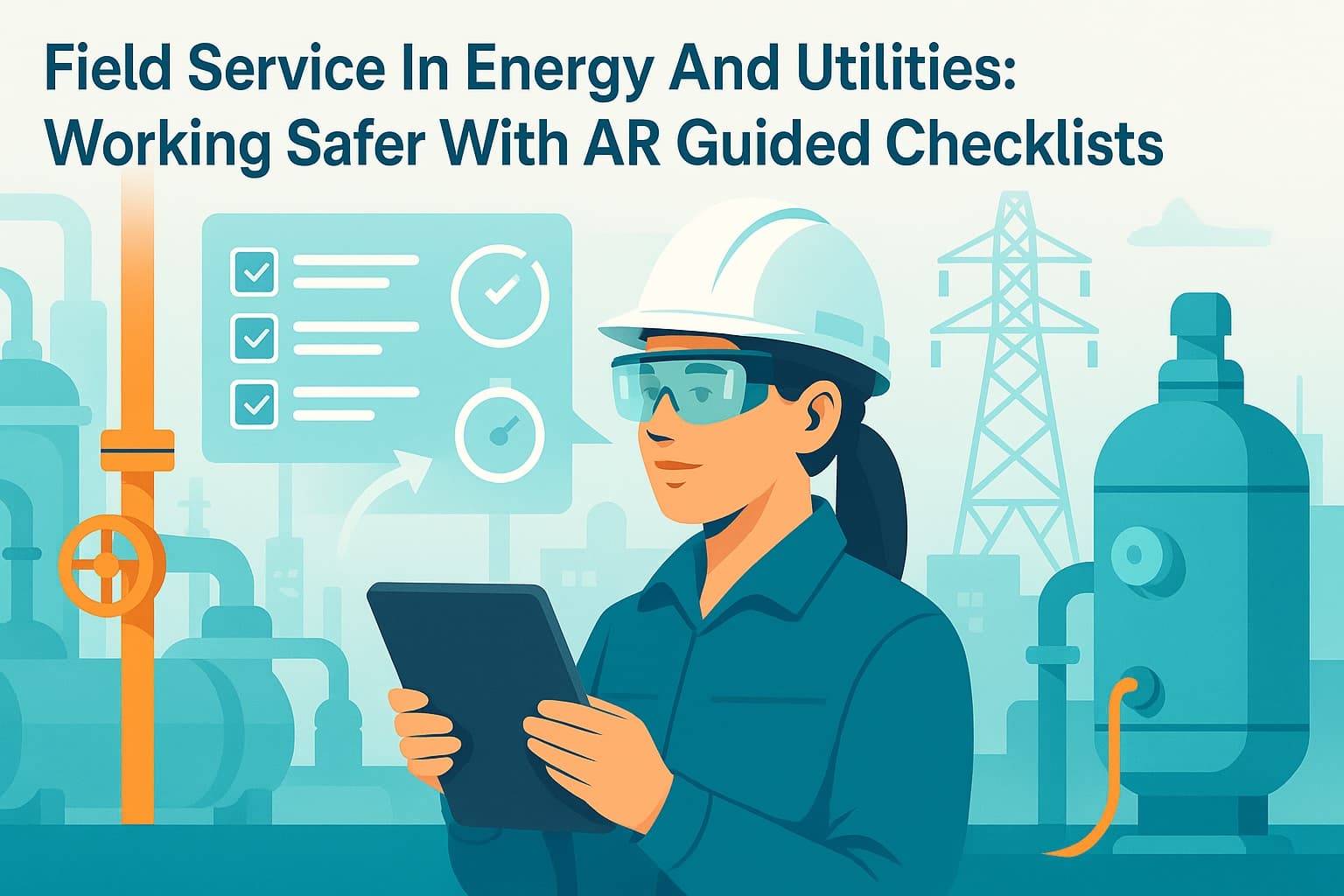
Field service in the energy and utilities sector involves high-risk tasks, complex assets, and strict compliance demands. Many operations managers, HSE leads, and maintenance supervisors face a recurring challenge: ensuring every technician follows safety-critical steps—every time, in every environment. AR guided checklists are now enabling safer, more reliable field service, reducing errors and downtime while supporting workforce readiness.
Why energy and utilities field service needs a new approach to safety
Field service work in energy and utilities is unforgiving. Whether managing electrical substations, gas pipelines, or water treatment sites, teams operate under pressure—often in hazardous, remote, or weather-exposed locations. Mistakes can put safety, compliance, and uptime at risk.
Key challenges for field service leaders:
- High incident risk: Electrical, chemical, and mechanical hazards are routine.
- Complex, evolving assets: Equipment varies by site and age; documentation is often out of date.
- Workforce turnover: New technicians need rapid onboarding and reliable guidance.
- Regulatory scrutiny: Auditable proof of compliance is essential.
- Unplanned downtime: Errors or missed steps can halt operations.
Traditional paper-based SOPs and static digital manuals do not reflect real-time conditions or ensure procedural consistency. Technicians may skip steps, misinterpret instructions, or lack situational awareness. This puts both safety and productivity at risk.
Why now: digitization, workforce shifts, and regulatory drivers
Several trends make it urgent for energy and utilities leaders to modernize field service operations:
- Aging workforce and skills gap: Experienced technicians are retiring, and new hires need faster, more effective onboarding and upskilling.
- Remote and distributed assets: Field teams are spread across wide geographies, often without direct supervision.
- Regulatory and ESG pressure: Authorities demand traceability for every intervention, and incident reporting is under greater scrutiny.
- Digital transformation mandates: Boards and regulators are pushing for real-time data, process digitization, and measurable improvements in safety and compliance.
According to the International Energy Agency, digital solutions—including AR and AI—are recognized as key to increasing reliability and safety in the sector (IEA Digitalization in Energy). AR guided checklists fit directly into this agenda, bridging the gap between policy and field-level execution.
How AR guided checklists make field service safer
AR guided checklists combine augmented reality (AR) and AI-driven digital work instructions to provide step-by-step, context-aware guidance—right where the work happens. Technicians access these checklists through smart glasses, tablets, or mobile devices, overlaying instructions, diagrams, and safety alerts onto real-world equipment.
Core safety benefits:
- Procedural compliance: Technicians follow validated SOPs in real time, with mandatory steps and digital sign-offs.
- Hazard identification: AR overlays highlight risk zones, PPE requirements, and lockout/tagout points directly on equipment.
- Error prevention: AI-driven prompts flag skipped steps or potential mistakes before they escalate.
- Remote expert support: Supervisors or engineers can join live via AR to guide field teams, resolving uncertainties on the spot.
- Incident documentation: Every checklist run generates a timestamped, auditable digital record.
This approach reduces reliance on memory or outdated paper instructions. It standardizes safe work practices across sites and shifts, even with less experienced staff.
Note: A 2022 study by the Electric Power Research Institute found that AR-guided maintenance reduced procedural errors by over 40% compared to paper-based SOPs.
Practical use cases for AR guided checklists in the field
AR guided checklists deliver measurable safety and quality gains across a range of field service scenarios in energy and utilities. Examples include:
Substation inspection and maintenance
- Step-by-step inspection flows with visual overlays for breaker, relay, and transformer checks
- Automated photo capture and annotation for asset condition
- Built-in safety prompts for arc flash and isolation procedures
Gas pipeline leak detection
- Guided walk-through for leak survey, including sensor placement and calibration
- Hazard zone visualization and PPE checks before entry
- Real-time documentation for regulatory reporting
Wind turbine servicing
- Visualized lockout/tagout steps and safe access routes
- Torque and lubrication instructions overlaid on component location
- Remote support for troubleshooting rare faults
Water treatment plant sampling
- Checklist for sampling points, container labeling, and contamination prevention
- AR cues for safe chemical handling and disposal
- Digital logs for traceability and compliance audits
Each use case benefits from reduced error rates, faster onboarding, and more consistent compliance—regardless of technician experience.
Overcoming barriers: hardware, change management, and content
Adopting AR guided checklists in energy and utilities field service is not without challenges. Leaders must address:
- Hardware selection: Smart glasses, tablets, or ruggedized phones all have pros and cons. Field conditions and PPE compatibility must be assessed.
- Connectivity: AR solutions can work offline, but syncing data in remote areas requires planning.
- Content creation: Existing SOPs must be digitized and validated for AR delivery. This is a one-time lift, but requires input from technical and safety teams.
- Change management: Technician buy-in is essential. Early pilots, hands-on training, and clear communication about safety and productivity benefits help build trust.
- Governance: Ongoing review and update of digital work instructions ensures relevance and regulatory alignment.
ActARion works with field service leaders to address these barriers through structured pilots, hardware evaluations, and stepwise rollout plans.
Results: measurable safety, productivity, and compliance gains
Organizations using AR guided checklists in field service report:
- Fewer safety incidents: Standardized procedures reduce skipped steps and near-misses.
- Improved compliance: Digital audit trails simplify regulatory reporting and internal reviews.
- Faster onboarding: New technicians reach proficiency in weeks, not months.
- Reduced downtime: Quicker troubleshooting and fewer errors minimize asset outages.
- Higher workforce confidence: Teams report greater clarity and less stress in high-risk tasks.
For example, a European utility deploying ActARion's AR SOPs for transformer maintenance saw a 30% drop in procedural deviations and cut onboarding time by 40%. These are the kinds of tangible results that matter when justifying investment to executive teams and regulators.
What ActARion brings to energy and utilities field service
ActARion specializes in deploying AI and AR–guided work instructions for complex, safety-critical environments. For energy and utilities field service, we provide:
- Industry-specific templates: Pre-built AR SOPs for inspection, maintenance, and emergency response
- Integration with asset management systems: Seamless checklist assignment, data sync, and reporting
- Expert support: Guidance on hardware selection, content digitization, and change management
- Scalable pilots: Structured rollout plans, from proof-of-concept to enterprise deployment
We understand the operational, safety, and compliance realities faced by field service leaders. Our approach is practical, transparent, and focused on measurable improvement.
Explore AR guided checklists in your field service operations
If you want to improve safety, compliance, and workforce readiness in your field service teams, AR guided checklists are a proven, practical step forward. Schedule a discovery call to see how this approach can fit your specific sites, assets, and regulatory needs. No commitment—just a chance to explore the impact in your context.
Learn more about AI and AR–guided work instructions and see AR onboarding for technicians. For broader industry insights, see the IEA’s Digitalisation in Energy report.