
Assembly errors drive up costs and risk in complex manufacturing. High-value sectors—such as aerospace, automotive, electronics, and industrial equipment—face pressure to deliver flawless products, on time and within budget. Yet, even experienced teams struggle to eliminate mistakes during intricate assembly tasks. As product complexity grows, so do risks of rework, scrap, and quality escapes.
AI and AR–guided work instructions now offer a concrete path to error free assembly. By digitizing and visualizing each step, these technologies help technicians work smarter, safer, and faster—cutting rework and scrap in even the most demanding production environments.
Complex assembly: where errors start and why they multiply
Assembly operations in advanced manufacturing are never simple. Components are diverse, tolerances are tight, and the sequence of operations is critical. Small mistakes—misaligned parts, missed fasteners, or incorrect torque—can cascade into expensive failures.
Key drivers of error and waste in complex assembly include:
- Manual process variation: Even skilled technicians interpret paper SOPs differently, leading to inconsistent results.
- Change management gaps: Engineering changes, updated work instructions, or new materials are not always communicated or adopted in real time.
- Training limitations: Ramp-up for new hires or transfers is slow, and tribal knowledge is hard to transfer.
- Verification bottlenecks: Manual checks are prone to oversight and do not always catch subtle deviations.
These pain points are well documented. The International Journal of Advanced Manufacturing Technology found that human error accounts for over 20% of assembly-related defects in high-mix, low-volume production (). For every error detected late, the cost to rework or scrap the assembly rises exponentially.
Why traditional approaches fall short in today’s production
Most manufacturers rely on a mix of paper SOPs, static digital documents, and peer-to-peer training. While these methods are familiar, they have clear limitations:
- Paper-based SOPs: Prone to wear, misplacement, and misinterpretation. Updates are slow and adoption is inconsistent.
- Digital PDFs and checklists: Reduce some errors, but lack contextual guidance and real-time feedback.
- Shadowing and mentoring: Useful for onboarding, but hard to scale and dependent on individual trainers.
For decision makers, the result is persistent rework rates (often 5–10% in complex lines), unpredictable scrap, and high costs for quality assurance. As product variants multiply and regulatory demands tighten, these legacy approaches cannot keep up.
How AI and AR–guided work instructions enable error free assembly
AI and AR–guided work instructions tackle the root causes of assembly errors by making procedures digital, interactive, and context-aware. Here’s how:
Visualizing each step, eliminating ambiguity
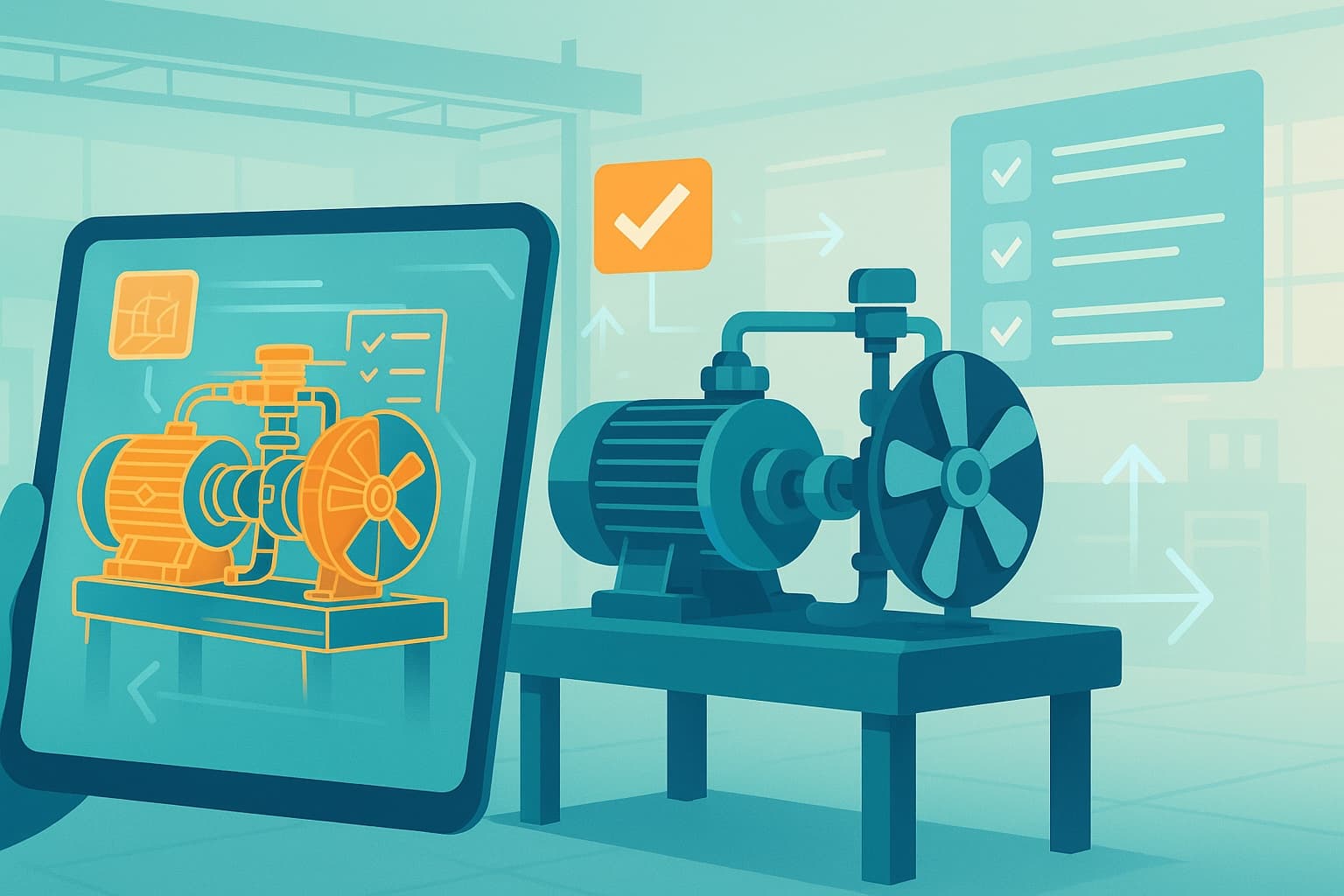
With AR SOPs, technicians see work instructions overlaid directly onto the physical workspace—via smart glasses or tablets. Instead of flipping through manuals, they follow clear, visual cues showing:
- Exact part placement and orientation
- Correct tool selection and usage
- Real-time prompts for torque, sequencing, and inspection points
This removes guesswork and ensures every operator follows the same best practice, every time.
Real-time validation and error prevention
AI-powered systems can monitor progress and verify critical steps. For example:
- Computer vision checks for correct component fit before allowing the next step
- Sensors confirm torque or fastener engagement
- The system blocks advancement if a key process is skipped
This approach prevents errors at the source, not just after the fact.
Dynamic updates and instant change management
Engineering changes are pushed instantly to all workstations. AR SOPs ensure that everyone—regardless of shift or role—uses the latest, validated process. This is essential for regulatory compliance and for rapid response to quality issues.
Accelerated onboarding and skills transfer
New technicians can reach proficiency faster with step-by-step AR guidance. AI and AR–guided work instructions break down complex tasks and reduce reliance on peer shadowing. This supports workforce flexibility and reduces the impact of turnover.
Use cases: error free assembly in action
AI and AR–guided work instructions are delivering results in real production. Here are concrete scenarios:
Aerospace subassembly: eliminating FOD and torque errors
An aerospace supplier digitized its SOPs for composite subassemblies. AR overlays now guide technicians through each fastener, highlight torque specs, and flag foreign object debris (FOD) risks. Quality escapes dropped by 40%, and torque-related rework was nearly eliminated.
Automotive powertrain: reducing variant confusion
A powertrain manufacturer deploys AR SOPs to handle dozens of engine variants. The system detects the specific model, loads the correct sequence, and uses visual cues for critical differences. Scrap from misbuilds fell by 60%, and new hires reached full productivity in half the usual time.
Electronics assembly: supporting high-mix lines
In electronics, rapid product changeovers make errors likely. With AI and AR–guided work instructions, teams receive real-time prompts for each unique configuration. Visual checks confirm component orientation and solder points. Rework rates dropped from 8% to 2% within three months.
For more examples, see digital SOPs for assembly quality.
Results: measurable impact on rework, scrap, and quality
The shift to AI and AR–guided work instructions delivers tangible benefits for manufacturers focused on error free assembly:
- Reduced rework: Companies report 30–60% fewer rework incidents on complex lines (internal case studies; see also Deloitte’s analysis).
- Lower scrap rates: Scrap from assembly errors drops as root causes are eliminated at the source.
- Faster onboarding: New technicians achieve full proficiency in 30–50% less time.
- Higher first-pass yield: Consistent adherence to SOPs boosts right-first-time rates.
- Improved compliance: Automated traceability and validation support audits and regulatory demands.
These results are not hypothetical. They are being realized in factories that have prioritized digital work instructions and invested in modernizing their assembly processes.
Addressing objections: hardware, change management, and content
Adopting AI and AR–guided work instructions does involve change. Here’s how leading manufacturers address common concerns:
- Hardware readiness: Modern AR devices (smart glasses, tablets) are ruggedized and suitable for industrial use. Many organizations start with pilot lines or high-value stations to build the business case.
- Change management: Success depends on clear communication, operator involvement, and support from supervisors. Early wins—such as reduced rework or faster onboarding—help drive adoption.
- Content creation: Converting SOPs to digital, visual formats can be streamlined with template-based tools and support from experienced partners like ActARion. Start with high-impact processes, then expand.
For more on implementation, read AR onboarding for new technicians.
What ActARion brings to error free assembly
ActARion partners with manufacturers to enable error free assembly using AI and AR–guided work instructions. Our approach combines:
- Process analysis: Identifying where errors and waste occur, and which SOPs to digitize first.
- Content digitization: Rapidly converting paper or PDF instructions into interactive AR SOPs.
- Technology integration: Deploying AR devices and connecting with existing MES or quality systems.
- Change management: Supporting teams, supervisors, and trainers to ensure smooth adoption.
- Continuous improvement: Measuring impact and refining instructions based on real-world feedback.
Our experience covers aerospace, automotive, electronics, and other high-mix, high-value manufacturing. We focus on safety, quality, and measurable ROI.
To learn more, see our about page or explore how AR SOPs improve assembly quality.
Explore error free assembly in your organisation
Error free assembly with AI and AR–guided work instructions is now practical and proven. If you want to reduce rework, cut scrap, and ensure quality in complex production, ActARion can help you explore what this looks like for your lines and teams.
Schedule an exploratory discovery call to discuss your assembly challenges and see how digital work instructions could fit your processes. There’s no commitment—just a practical look at the benefits, steps, and ROI in your context.
Start by visiting our contact page or download our assembly quality checklist. For an external perspective, see Deloitte’s analysis of AR in manufacturing.