
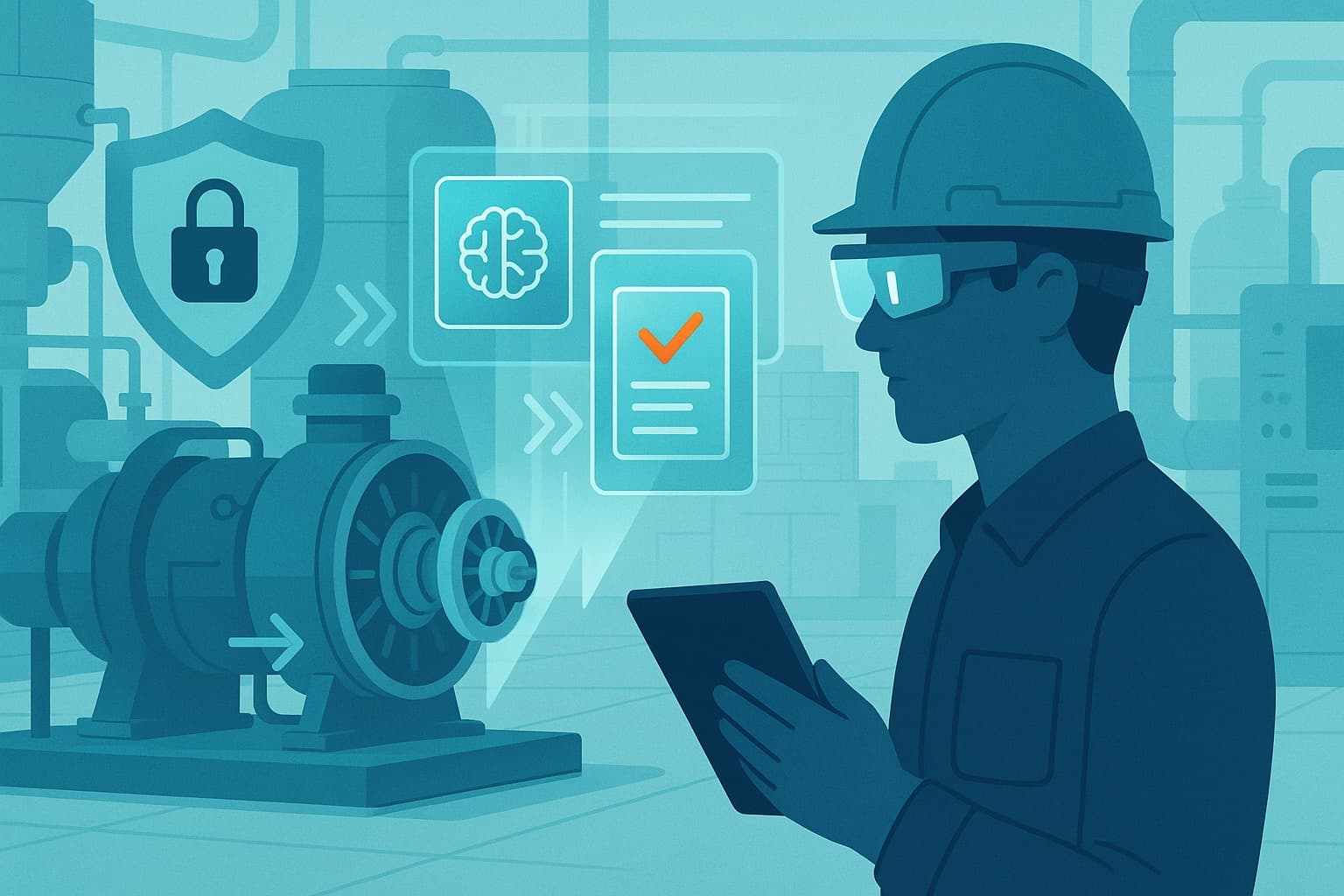
Augmented reality (AR) and artificial intelligence (AI) are transforming industrial operations. Companies use AR and AI–guided work instructions to digitize inspections, standardize procedures, and accelerate training. But as these tools connect devices, data, and teams, new risks emerge around cybersecurity and data privacy. For operations, HSE, and IT leaders, ensuring that AR and AI deployments are secure is now a non-negotiable part of digital transformation.
Rising adoption of AR and AI in industrial environments
Industrial organizations are under pressure to optimize productivity, maintain high safety standards, and transfer knowledge efficiently. AR and AI–guided work instructions address these needs:
- Field engineers use AR headsets to follow digital SOPs hands-free.
- Maintenance leads leverage AI to flag anomalies during inspections.
- Training managers accelerate onboarding with interactive, real-time guidance.
According to industry research, over 70% of industrial companies plan to increase their investment in AI by 2025. AR adoption is also accelerating as hardware becomes more practical and content creation tools mature.
But as these technologies move from pilots to production, the attack surface expands. Devices with cameras and microphones, cloud-connected analytics, and real-time data sharing all present new entry points for cyber threats and privacy breaches.
Why cybersecurity and data privacy demand urgent attention
Industrial operations handle sensitive information: production parameters, equipment status, safety incidents, and sometimes personal data about technicians. When AR and AI platforms are introduced, the following risks become more pressing:
- Unauthorized access: AR devices and connected platforms may be targeted for credential theft or unauthorized access attempts.
- Data interception: Real-time video, sensor data, and work logs transmitted over networks can be intercepted if not properly encrypted.
- Privacy breaches: Devices often collect audio, video, and location data that may be subject to GDPR or other privacy regulations.
- Malware and ransomware: AI algorithms and AR devices are potential vectors for malware if not secured and updated regularly.
- Loss of operational integrity: Compromised digital work instructions can lead to unsafe procedures or quality escapes.
A 2023 SANS report found that 40% of industrial organizations experienced a cybersecurity incident impacting operational technology (OT) in the past year. The cost of a breach goes beyond downtime—regulatory fines, reputational damage, and loss of intellectual property are real risks.
How AR and AI–guided work instructions introduce new security challenges
Traditional IT and OT systems in industrial environments are often siloed, with clear boundaries and controls. AR and AI change this in several ways:
- Device proliferation: AR headsets, tablets, and mobile devices multiply the number of endpoints needing protection.
- Cloud connectivity: Many AR and AI platforms rely on cloud-based analytics and storage, raising questions about data residency and third-party access.
- User-generated content: Teams may upload photos, videos, or notes to digital work instructions, increasing the volume and sensitivity of stored data.
- Integration complexity: Connecting AR SOPs to legacy systems, asset databases, or ERP tools introduces integration points that must also be secured.
Each new interface or integration is a potential vulnerability. Without robust governance, these risks can quickly outpace the benefits of digitization.
Key requirements for secure and compliant AR and AI deployments
Operations and IT leaders must work together to ensure that AR and AI–guided work instructions meet strict security and privacy standards. Key requirements include:
Device and network security
- Require strong authentication (e.g., multi-factor authentication) for all AR and AI devices.
- Enforce regular software updates and device patching.
- Use secure Wi-Fi, VPN, or private 5G networks for on-site connectivity.
- Segment AR and AI traffic from critical OT networks where possible.
Data protection and privacy
- Encrypt all data at rest and in transit, especially video, audio, and sensor streams.
- Store sensitive data in secure, compliant cloud environments or on-premises as needed.
- Implement access controls and audit logs to track who accessed or modified digital work instructions.
- Minimize data collection to what is necessary for operations or compliance.
- Anonymize or pseudonymize personal data wherever feasible.
Governance and compliance
- Map data flows and storage locations for all AR and AI–enabled processes.
- Conduct privacy impact assessments, especially if handling personal data or data subject to GDPR, CCPA, or local laws.
- Maintain clear policies on data retention, deletion, and subject access requests.
- Train teams on secure device use and reporting suspicious activity.
Vendor due diligence
- Evaluate AR and AI platform vendors for security certifications (e.g., ISO 27001, SOC 2).
- Review third-party subprocessor lists and data protection agreements.
- Require regular penetration testing and vulnerability disclosures.
Practical use cases: Secure AR and AI in action
To illustrate what secure deployment looks like, consider these real-world scenarios:
Digitizing safety inspections with AR SOPs
A European chemical manufacturer equips operators with AR glasses to conduct daily safety inspections. The AR SOPs guide each step, capture photos, and log results directly to a secure cloud. Only authorized supervisors can review inspection data, and all transmissions are encrypted. Device access is restricted to company-issued credentials, and logs are retained per regulatory requirements.
AI-powered quality control with privacy safeguards
An automotive plant uses AI to analyze video feeds from AR-equipped technicians performing assembly checks. The AI flags deviations in real time, but all video is anonymized to remove faces and personal identifiers before storage. Only summary data is shared with quality teams, and footage is deleted after 30 days unless needed for incident investigation.
Remote assistance with strict access controls
A maintenance lead in the energy sector uses AR to connect field engineers with remote experts. Live video feeds are end-to-end encrypted, and session logs are kept for audit. Remote experts can only access the feed during scheduled support windows and cannot record or download footage without explicit consent.
In each case, robust cybersecurity and privacy measures are built into both the technology stack and the operating procedures.
Addressing common objections and limitations
Decision makers often raise valid concerns when evaluating AR and AI deployments:
-
“We can’t risk exposing our production network.”
Network segmentation, device hardening, and secure gateways allow AR and AI traffic without compromising core OT systems. -
“How do we ensure GDPR or CCPA compliance?”
Data minimization, transparent consent processes, and clear data flow mapping are essential. Choose vendors with strong track records in industrial compliance. -
“What about content created by technicians?”
Implement automatic content classification, access controls, and retention policies for user-generated photos, videos, and notes. -
“Are AR devices themselves a weak link?”
Standardize on approved devices, enforce regular updates, and restrict installation of unauthorized apps. -
“Change management is a challenge.”
Involve IT, operations, and HSE teams early. Provide targeted training and clear escalation paths for security incidents.
What ActARion brings to secure AR and AI deployment
ActARion works with industrial organizations to deliver AI and AR–guided work instructions that meet the highest standards for cybersecurity and data privacy. Our approach includes:
- End-to-end encryption: All data, from device to cloud, is encrypted using industry best practices.
- Role-based access controls: Only authorized personnel can create, edit, or review digital work instructions and associated data.
- Comprehensive audit trails: Every access and change is logged for compliance and forensic analysis.
- Flexible deployment: Choose secure cloud or on-premises hosting to meet your security and data residency needs.
- Privacy by design: Personal data is minimized, anonymized, or excluded wherever possible; privacy impact assessments are standard.
- Integration with existing IT/OT security: We align with your network policies, device management, and incident response procedures.
- Change management support: We support your teams with training, documentation, and secure onboarding processes.
By partnering with ActARion, you gain a credible, experienced provider who understands the realities of industrial cybersecurity and compliance.
Explore secure AR and AI work instructions in your operations
Securing AR and AI–guided work instructions is essential for safe, productive, and compliant industrial operations. To see how this could work in your environment, schedule an exploratory discovery call with ActARion. Discuss your specific security requirements and learn how our approach can help you digitize processes without compromising safety or privacy.
To learn more, see our detailed FAQ on AR data security and read about AR onboarding for technicians. For an industry perspective on cybersecurity best practices, visit the ENISA guidelines for securing industrial IoT.
This is a risk-free, exploratory conversation—no commitment required.
Meta description:
Cybersecurity and data privacy when deploying AR and AI in operations: What operations, HSE, and IT leaders must know to protect data and ensure compliance.
URL slug:
cybersecurity-data-privacy-ar-ai-operations