
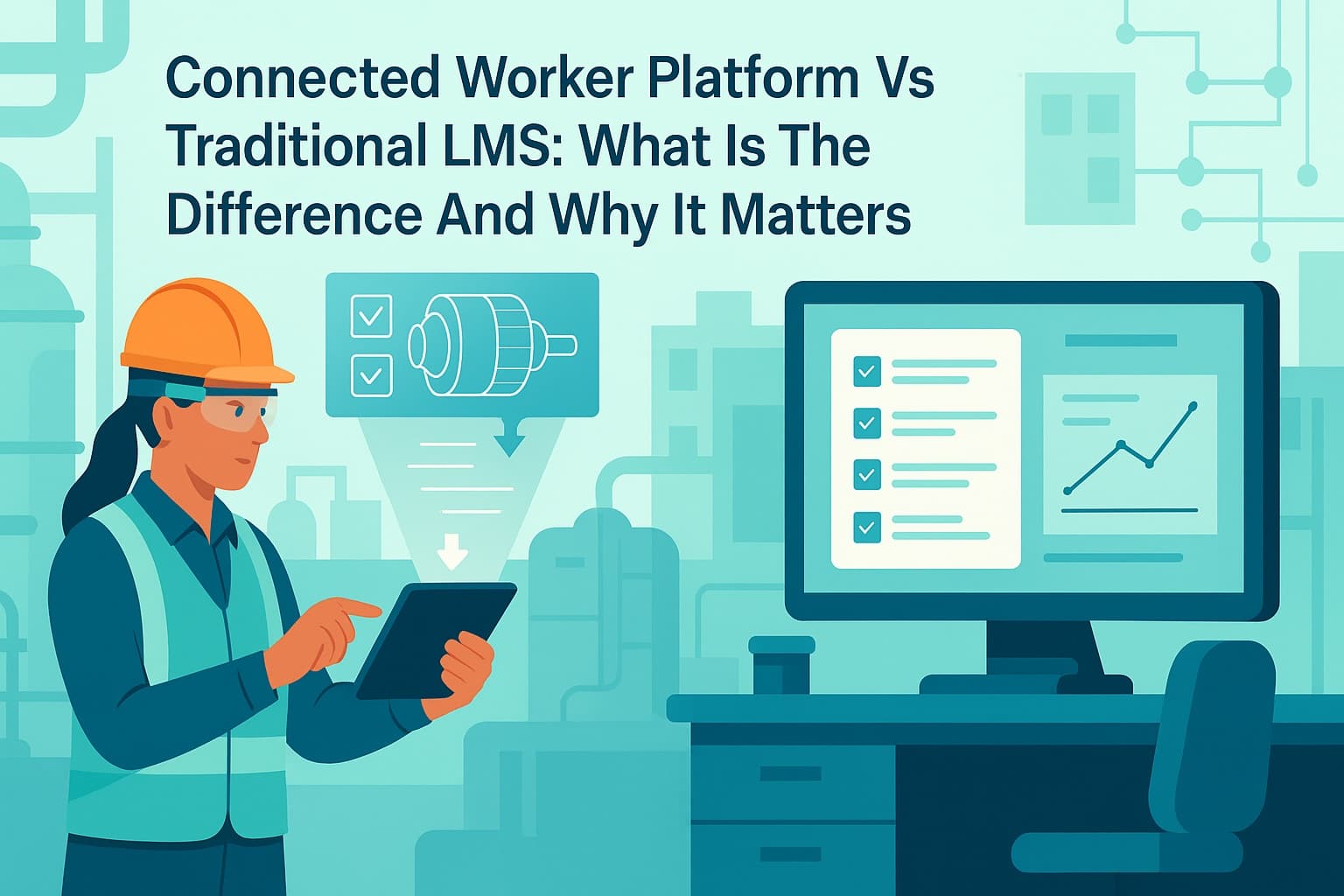
Modern industrial operations demand more than static training modules and compliance checklists. Operations managers, HSE leaders, and maintenance supervisors are under pressure to keep teams safe, skilled, and productive while supporting rapid change. The choice between a connected worker platform and a traditional Learning Management System (LMS) is no longer academic—it directly impacts safety, quality, and uptime.
Industrial training and knowledge transfer: what's changing?
Industrial environments have unique challenges: skills gaps, high turnover, complex procedures, and strict regulatory requirements. Traditionally, organizations have relied on LMS platforms to deliver training and track compliance. These systems work for classroom content, but they often fall short where it matters most—on the plant floor, in the field, or during live maintenance.
Several trends are driving the need for a new approach:
- Workforce turnover: The average tenure of skilled technicians is shrinking, putting pressure on onboarding and upskilling processes (source: Deloitte, 2023 Manufacturing Industry Outlook).
- Complexity of equipment and procedures: SOPs are evolving faster than static documents can be updated.
- Regulatory scrutiny: Auditors expect not just records of training, but proof of competency and adherence to procedures in real time.
- Digital transformation: AI, AR, and IoT are changing how work is performed, documented, and improved.
A traditional LMS was not designed for these realities. The connected worker platform, powered by AI and AR–guided work instructions, addresses these gaps with tools made for dynamic, high-risk environments.
Why traditional LMS platforms fall short in industrial operations
Learning Management Systems (LMS) have long been the backbone of corporate training, especially for compliance and onboarding. In industries like oil & gas, utilities, chemicals, and manufacturing, they provide:
- Centralized training content (videos, documents, quizzes)
- Tracking of course completions and certifications
- Audit trails for compliance
However, several limitations become clear in the context of industrial work:
Training is disconnected from the job
LMS platforms focus on knowledge delivery, not skills application. Technicians may pass a course but still make mistakes when performing a complex lockout/tagout or calibration task. Training is often completed in a classroom or on a computer, then separated from real-world work.
Static content struggles with change
Updating SOPs or work instructions in an LMS is slow. By the time a new procedure is published, teams may already be using outdated steps. This lag increases risk and reduces the impact of training.
Poor support for in-the-moment guidance
LMS platforms do not deliver live, contextual guidance. If a technician forgets a step or encounters an unexpected situation, there is no support beyond static reference material.
Limited insight into real performance
While LMS systems track course completions, they rarely capture what happens on the job. Managers see who passed a test, but not who followed the right steps during a critical inspection or repair.
Note: A 2022 survey by IndustryWeek found that 58% of manufacturers report "skills application gaps" after traditional training, with errors persisting even after LMS-based onboarding.
What is a connected worker platform?
A connected worker platform combines digital work instructions, real-time support, and performance insights in a unified environment. It leverages AI and AR to guide technicians through complex tasks, capture data as work happens, and ensure compliance with SOPs.
Key features include:
- AI and AR–guided work instructions: Interactive, step-by-step procedures delivered via smart glasses, tablets, or mobile devices.
- Live support and remote expert access: Technicians can request guidance or escalate issues instantly.
- Real-time data capture: Every step, check, and measurement is recorded for traceability and analytics.
- Continuous feedback loops: Supervisors see not just what was trained, but what was done, by whom, and how well.
- Integration with EHS, quality, and maintenance systems: Data flows across operations, supporting audits and continuous improvement.
In contrast to the LMS, the connected worker platform is built around the reality of field work—dynamic, unpredictable, and safety-critical.
Connected worker platform vs traditional LMS: key differences
| Feature/Capability | Traditional LMS | Connected Worker Platform |
|---|---|---|
| Training delivery | Off-the-job (classroom, e-learning) | On-the-job (in-context, AR-guided) |
| Content type | Static (slides, videos, documents) | Interactive, step-by-step, multimedia |
| SOP updates | Manual, slow, version control issues | Instantly updated, always current |
| Real-time guidance | None | Yes (AI/AR, remote expert support) |
| Performance tracking | Course completion, quiz scores | Task execution, error rates, compliance logs |
| Regulatory documentation | Training records | Training + execution traceability |
| Skills transfer effectiveness | Variable, hard to measure | High, directly observable |
| Integration with operations | Siloed | Embedded in daily workflow |
What this means for operations, safety, and compliance
- Safety: AR SOPs and digital work instructions reduce procedural errors and ensure critical steps are never skipped.
- Productivity: Teams spend less time searching for information and more time executing tasks correctly the first time.
- Quality: Real-time data capture supports root cause analysis and continuous improvement.
- Workforce readiness: New hires reach proficiency faster with in-context guidance and less reliance on classroom training.
How AI and AR–guided work instructions change the game
The core advantage of a connected worker platform is its ability to bring knowledge and support to the point of work. Here's how it works in practice:
Digital SOPs, always up to date
With a connected worker platform, procedures are digital, version-controlled, and instantly distributed. When a process changes, every technician receives the update on their device—no more outdated binders or old PDFs.
AR-guided execution
Using smart glasses or tablets, technicians see step-by-step instructions overlaid on equipment, with visuals, checklists, and contextual warnings. AI can verify that steps are completed in the correct sequence, flag missing data, or prompt for photos as proof.
Real-time escalation and support
If a technician encounters an unfamiliar fault, they can connect with a remote expert via video, sharing their view in real time. This reduces downtime and prevents unsafe improvisation.
Automated compliance and traceability
Every action is logged: who did what, when, where, and how. This data supports regulatory audits, quality investigations, and continuous improvement efforts—without extra paperwork.
Closing the skills gap
By guiding less experienced technicians through complex tasks, the platform accelerates onboarding and reduces reliance on "tribal knowledge." This is critical as experienced workers retire and younger teams come onboard.
Note: McKinsey reports that digital work instructions can reduce training time by up to 50% and cut procedural errors by 40% (McKinsey, Digital Manufacturing).
Use cases: where connected worker platforms outperform LMS
Maintenance and inspections
A traditional LMS can teach the theory of preventive maintenance, but only a connected worker platform can guide a technician through a live turbine inspection, capturing every torque value and checklist item for compliance.
Safety-critical procedures
In chemical plants or refineries, missing a lockout/tagout step can have catastrophic consequences. AR SOPs delivered via a connected worker platform ensure each step is followed and documented, with AI flagging deviations in real time.
Rapid onboarding and upskilling
When onboarding new hires or contractors, digital work instructions allow them to shadow experienced technicians virtually, accelerating skills transfer and reducing the risk of costly errors.
Audits and compliance
Instead of sifting through training records, auditors can see exactly how procedures were executed, with timestamps and evidence captured automatically. This level of traceability is not feasible with a traditional LMS.
Continuous improvement
By analyzing execution data, quality and operations leaders can spot patterns, identify bottlenecks, and update SOPs based on real-world feedback. This creates a closed loop between training, execution, and improvement.
Overcoming challenges: content creation, hardware, and change management
Adopting a connected worker platform is not without hurdles. Decision makers should consider:
- Content creation: Digital SOPs and AR instructions require upfront investment in authoring and validation. However, modern platforms include templates and tools to speed up the process.
- Device strategy: Tablets, smartphones, and smart glasses each have pros and cons. Selection depends on environment, PPE requirements, and use case.
- IT and data security: Integration with existing systems (EHS, CMMS, ERP) and ensuring data privacy is essential.
- Change management: Success depends on clear communication, pilot programs, and support for both supervisors and technicians.
Note: Early adopters report that involving teams in SOP digitization and piloting AR-guided tasks builds trust and accelerates adoption.
What ActARion brings to industrial teams
ActARion partners with operations, HSE, and training leaders to deploy connected worker platforms that deliver measurable results. Our approach includes:
- Rapid digitization of SOPs: We help convert critical procedures into AI and AR–guided work instructions tailored to your environment.
- Pilot programs: Start with a high-impact use case (such as AR onboarding for technicians or digital inspections), measure results, and scale with confidence.
- Change management support: We provide training, stakeholder engagement, and governance frameworks to ensure adoption and ROI.
- Integration expertise: ActARion connects digital work instructions with your existing EHS, quality, and maintenance platforms.
Our focus is on safety, productivity, and compliance—helping you build a workforce that is ready for today's and tomorrow's challenges.
Explore connected worker platforms in your organisation
If you want to see how a connected worker platform can improve safety, productivity, and skills transfer in your operations, schedule an exploratory discovery call. We'll map your current processes and identify high-value opportunities for AI and AR–guided work instructions. There's no commitment—just a chance to see what's possible with ActARion.
- Learn more about AI and AR–guided work instructions.
- Explore use cases for digital SOPs.
- For an overview of connected worker trends, see Deloitte's 2023 Manufacturing Industry Outlook.
Take the next step—request a discovery session and see how connected worker platforms can deliver real results for your teams.
Go deeper
This article is part of our knowledge base on connected worker solutions. For a comprehensive overview, read our whitepaper:
Connected worker platforms: enabling knowledge transfer and operational support — Learn what to look for when evaluating platforms and where AR adds value beyond mobile-only tools.