
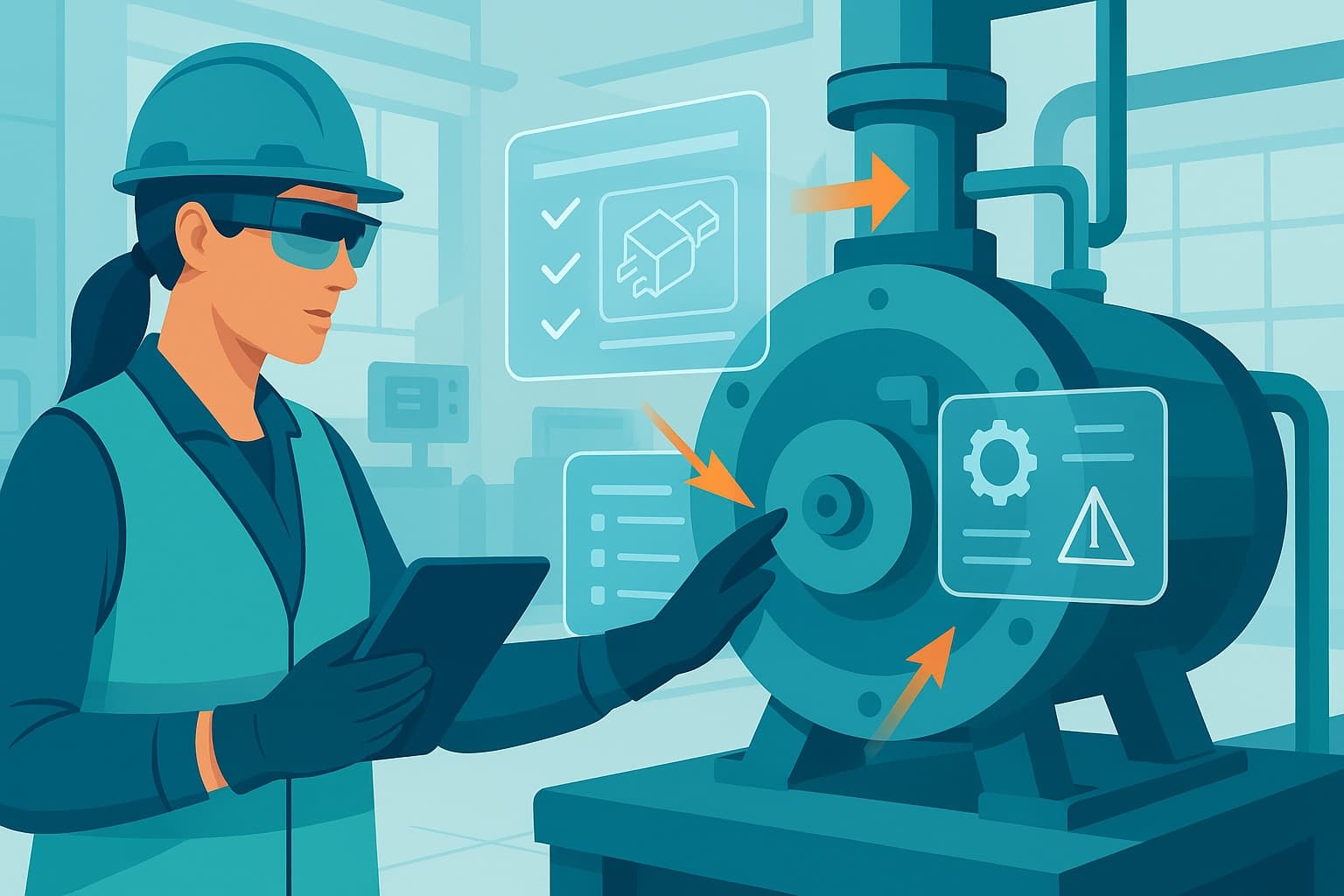
When organisations consider AR-guided onboarding, a common question is: how does it actually compare to traditional PDF-based training? The answer lies in real-world data from pilot programmes across manufacturing, logistics and field service.
This article shares concrete numbers from industrial onboarding pilots, comparing AR work instructions to PDF manuals and traditional training methods.
The baseline: traditional onboarding challenges
Before exploring AR results, it is worth understanding the typical challenges with PDF-based onboarding:
- Time to competency: New hires often take 4–8 weeks of shadowing and self-study to reach full productivity on complex tasks.
- Error rates: During the learning phase, error rates are significantly higher than for experienced operators—often 2–3x the baseline.
- Trainer workload: Experienced staff spend substantial time coaching and supervising new hires, reducing their own productivity.
- Consistency: Training quality varies by trainer, shift and site, leading to inconsistent skill levels.
These challenges are costly. They slow hiring, increase errors and burden your best people.
AR onboarding pilot results: what the numbers show
Multiple industrial pilots have compared AR-guided onboarding to PDF-based methods. Here are typical results:
Time to competency
- PDF baseline: 4–8 weeks to reach full productivity
- AR-guided: 2–4 weeks to reach full productivity
- Improvement: 30–50% reduction in time to competency
AR work instructions accelerate learning by guiding new hires through tasks step by step, in context, with immediate feedback. They do not need to interpret static documents or wait for a trainer to become available.
Error rates during onboarding
- PDF baseline: 8–15% error rate during learning phase
- AR-guided: 3–6% error rate during learning phase
- Improvement: 40–60% reduction in errors
AR overlays and prompts reduce ambiguity and catch mistakes before they happen. New hires complete tasks First Time Right more often, even in their first days.
Trainer and supervisor workload
- PDF baseline: Trainers spend 60–80% of their time coaching and supervising during onboarding periods
- AR-guided: Trainers spend 20–40% of their time on coaching, focusing on exceptions and complex scenarios
- Improvement: 50% or more reduction in trainer burden
AR work instructions handle routine procedural guidance, freeing trainers to focus on higher-value coaching and support.
Consistency across shifts and sites
- PDF baseline: Significant variation in training quality and outcomes by trainer, shift and location
- AR-guided: Consistent training experience regardless of who is training or where
AR-guided onboarding delivers the same high-quality instruction to every new hire, reducing variability and ensuring standardised skills.
What drives the improvement?
Several factors explain why AR onboarding outperforms PDF-based methods:
- Contextual guidance: AR overlays are displayed on the real work environment, making instructions immediately relevant and easy to follow.
- Step-by-step pacing: New hires cannot skip steps or rush ahead; the system ensures each step is completed before moving on.
- Instant feedback: Errors are caught and corrected in real time, preventing bad habits from forming.
- Reduced cognitive load: New hires do not need to remember sequences or interpret abstract diagrams—guidance is always visible.
- Trainer independence: New hires can learn and practice without constant supervision, speeding up the process.
Real-world example: manufacturing onboarding pilot
A manufacturing facility piloted AR-guided onboarding for new assembly operators. The pilot group used AR work instructions on tablets; the control group used PDF manuals and traditional shadowing.
Results after 6 weeks:
| Metric | PDF Group | AR Group | Improvement |
|---|---|---|---|
| Time to competency | 6 weeks | 3.5 weeks | 42% faster |
| Error rate (week 1–2) | 12% | 5% | 58% fewer errors |
| Trainer hours per new hire | 40 hours | 18 hours | 55% reduction |
| New hire confidence (survey) | 3.2/5 | 4.4/5 | +38% |
The AR group reached full productivity faster, made fewer errors and felt more confident—while requiring less trainer time.
Is AR onboarding right for your organisation?
AR-guided onboarding delivers the strongest results in environments where:
- Tasks are procedural and repeatable
- Visual guidance adds value (e.g. equipment operation, assembly, inspections)
- Trainer time is scarce or expensive
- Consistency across shifts and sites matters
If your onboarding process matches these criteria, AR work instructions are worth piloting.
Getting started
To see what AR onboarding could deliver for your organisation, consider a focused pilot on a specific role or task. Measure time to competency, error rates and trainer workload—then compare to your PDF baseline.
Learn more about AR training and onboarding for industrial teams or contact ActARion to discuss an onboarding pilot.
Go deeper
This article is part of our knowledge base on ROI measurement for AR work instructions. For the complete methodology, read our whitepaper:
ROI Calculator Guide for AI & AR-Guided Work Instructions — Covers the methodology behind calculating training time reduction and other ROI metrics.