
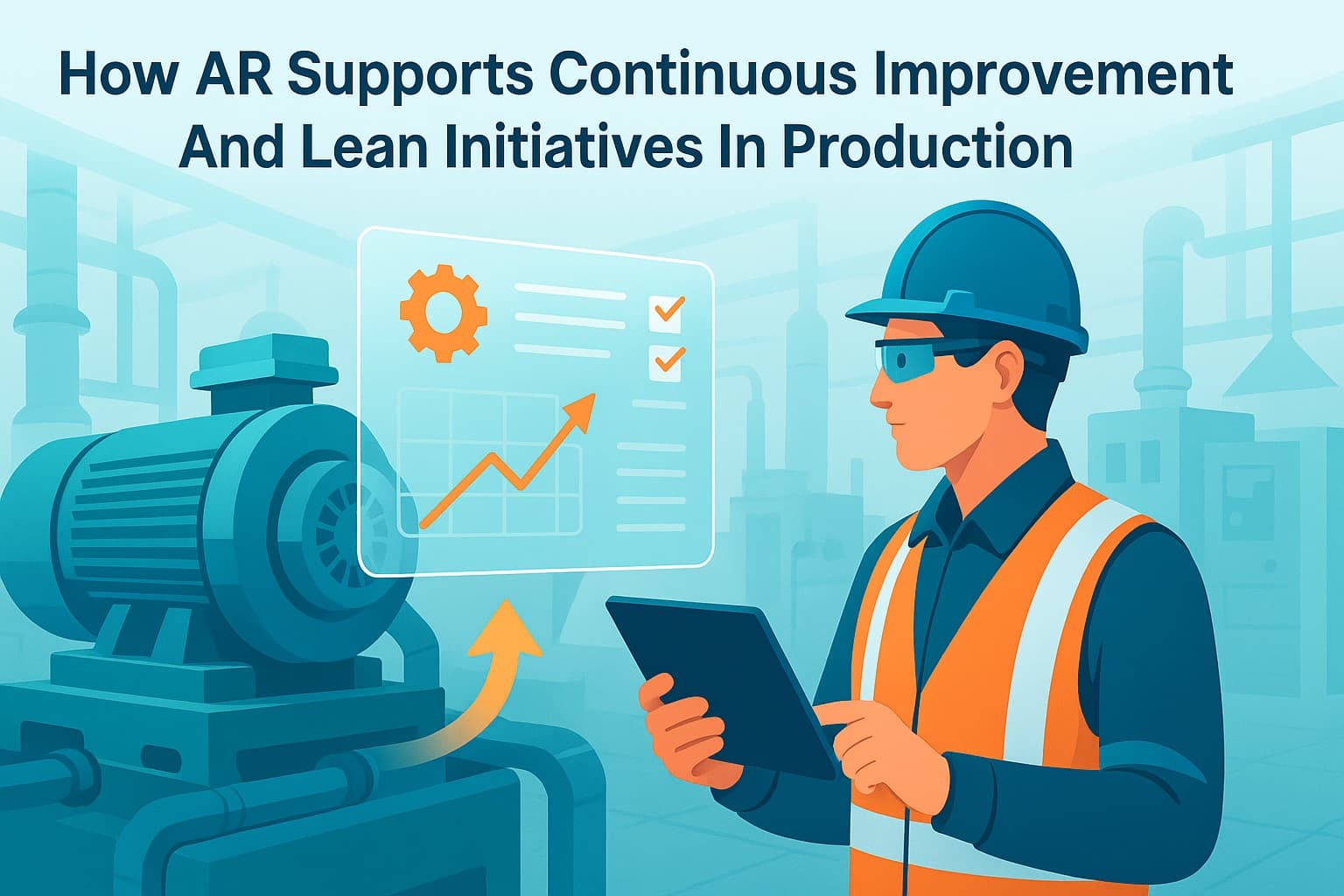
Augmented reality (AR) is changing how production teams approach continuous improvement and lean manufacturing. For operations managers, HSE leaders, and training professionals, the need for safer, smarter, and more reliable processes is constant. AR supports continuous improvement and lean initiatives in production by making standardized work and real-time problem-solving more accessible and measurable—directly on the shop floor.
Why lean and continuous improvement need better support
Lean manufacturing and continuous improvement have been industry standards for decades. Yet, even in advanced production environments, challenges remain:
- Standard operating procedures (SOPs) are often paper-based, hard to update, or not followed consistently.
- Kaizen events and improvement cycles depend on accurate data and engaged teams, which can be difficult to maintain.
- Skills gaps and operator turnover slow down the adoption of new best practices.
- Safety, quality, and productivity targets are harder to reach when information is siloed or outdated.
The stakes are high. According to McKinsey, manufacturers that excel at lean and digitalization can see productivity gains of 30–50%.[^1] But many factories still struggle to connect lean theory to everyday actions.
Why change now: trends driving AR adoption in production
Several trends are accelerating the adoption of AR in continuous improvement and lean initiatives:
- Workforce change: Experienced operators are retiring, and new hires expect digital tools and real-time guidance.
- Complexity: Product variants, shorter cycles, and stricter compliance make manual documentation unsustainable.
- Data requirements: Lean relies on accurate, timely data—yet manual reporting is inconsistent and error-prone.
- Remote collaboration: Global teams need to share best practices and support problem-solving without travel.
In this context, AI and AR–guided work instructions offer a practical way to close the gap between lean goals and day-to-day execution.
How AR supports continuous improvement and lean initiatives
AR enhances continuous improvement and lean initiatives by embedding digital work instructions, real-time feedback, and standardized processes directly into the production environment. Here’s how:
Standardizing work instructions with AR SOPs
- AR SOPs present step-by-step instructions as overlays on real equipment, reducing ambiguity and ensuring adherence to best practices.
- Updates to procedures can be deployed instantly, so teams always have the latest version.
- Visual cues, 3D models, and contextual information help operators understand complex tasks—especially when tolerances are tight or safety is critical.
Enabling real-time problem-solving and kaizen
- Operators can flag process deviations or suggest improvements on the spot using AR devices, feeding directly into continuous improvement cycles.
- AI-powered analytics provide supervisors with real-time dashboards on adherence, bottlenecks, and common errors.
- Remote experts can join live AR sessions to support troubleshooting, reducing downtime and empowering teams to solve problems faster.
Accelerating skills transfer and onboarding
- New technicians can follow AR-guided training modules, learning standardized work as they perform real tasks.
- AR reduces the dependency on shadowing senior operators, speeding up onboarding and reducing errors from inexperience.
- Skills assessments and checklists can be built into AR workflows, providing objective data on proficiency and compliance.
Supporting 5S, TPM, and other lean pillars
- Visual management is simpler with AR overlays—teams see what “good” looks like, and non-compliance is easy to spot.
- Preventive maintenance tasks are guided step by step, reducing missed checks and equipment failures.
- Waste (muda) is easier to identify and eliminate when real-time data and visual cues are integrated into daily routines.
Use cases: AR in continuous improvement and lean production
Decision makers in manufacturing are already applying AR to support continuous improvement and lean initiatives in concrete ways:
Digital work instructions for complex assembly
A European automotive supplier reduced assembly errors by 42% by deploying AR SOPs at key stations. Operators received guided instructions and alerts if steps were missed, ensuring process stability even with high product variability.
Visual 5S audits and workplace organization
A food processing plant uses AR checklists for 5S audits. Supervisors and operators see clean/dirty zones highlighted on live video feeds, making audits faster and more objective. Audit results feed directly into the plant’s CI dashboard.
Kaizen event documentation and follow-up
During kaizen events, improvement ideas and quick wins are captured with AR photos and voice notes, tagged to specific machines or lines. Follow-up actions are assigned and tracked through the AR platform, closing the loop between idea and execution.
Remote guidance for troubleshooting and training
A packaging manufacturer uses AR to connect remote maintenance experts with line operators. Experts can see what the operator sees, draw annotations, and guide corrective actions without travel delays—reducing mean time to repair by 35%.
For more examples, see AI and AR–guided work instructions for manufacturing.
Results: measurable impact on lean goals
Companies deploying AR in support of lean and continuous improvement report:
- Fewer process deviations and quality escapes, as AR SOPs drive consistent execution.
- Shorter downtime and faster changeovers, thanks to on-demand expert guidance and clear instructions.
- Increased engagement in kaizen and improvement events, since operators can contribute ideas directly and see tangible results.
- More accurate training and skills tracking, reducing the risk of human error and non-compliance.
A 2023 Capgemini survey found that 63% of industrial companies using AR for work instructions achieved measurable improvements in productivity and quality within 12 months.1
What ActARion brings to your continuous improvement journey
ActARion works with manufacturing leaders to embed AI and AR–guided work instructions into existing lean and CI programs. Our approach focuses on:
- Mapping current SOPs and CI processes to identify high-impact AR use cases.
- Co-creating digital work instructions and AR SOPs tailored to your equipment, compliance needs, and workforce.
- Supporting change management, training, and governance to ensure adoption and measurable ROI.
- Integrating with your MES, EHS, or quality systems for seamless data flow and reporting.
ActARion is a trusted partner for operations, HSE, and L&D leaders who need to justify technology investments with real-world results. Learn more about our approach to digital work instructions and real-world deployments.
Explore AR for continuous improvement in your production environment
Discover how AR supports continuous improvement and lean initiatives in your own context. See how AI and AR–guided work instructions can help your teams achieve safer, more efficient, and more consistent production—while making lean and CI programs easier to sustain.
Schedule a no-commitment discovery call or request a demo for your SOP process. Download our AR implementation checklist for manufacturing to get started. For more on industry trends, see McKinsey’s digital manufacturing insights.
Meta description:
How AR supports continuous improvement and lean initiatives in production: actionable ways for manufacturing leaders to improve safety, quality and productivity.
URL slug:
ar-supports-continuous-improvement-lean-production