
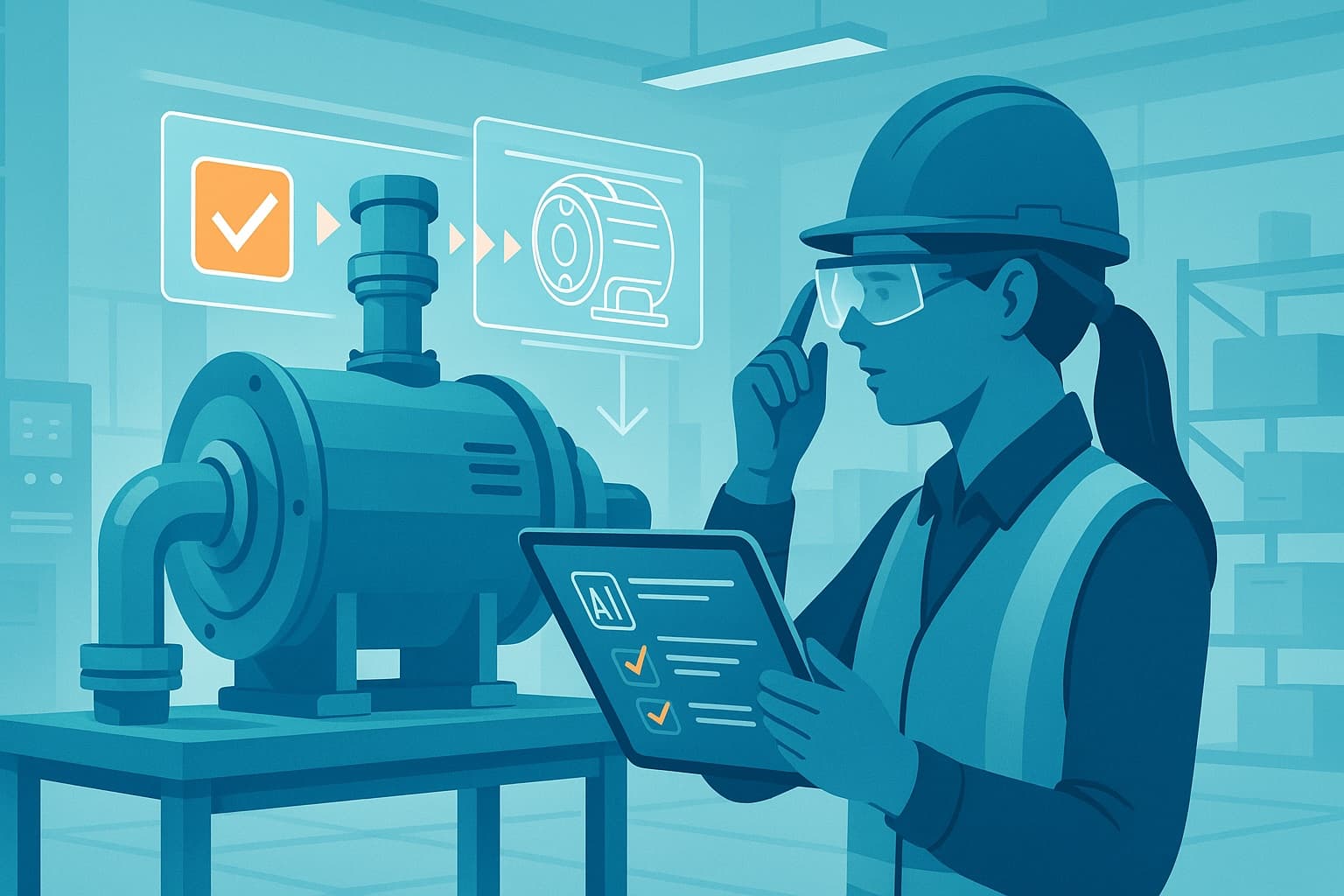
Augmented reality (AR) supported work is changing the way industrial teams operate. For team leaders and trainers, this shift is not just about adopting new tools—it fundamentally changes their roles, responsibilities, and the way they deliver value. When safety, quality, and workforce readiness are on the line, understanding these changes is critical.
Why industrial leaders need to rethink team leadership and training now
Industrial operations face increasing pressure to improve productivity while maintaining high standards for safety and compliance. Skills gaps are widening as experienced technicians retire and new hires require faster, more effective onboarding. Traditional paper-based standard operating procedures (SOPs) and classroom training often fall short, leaving team leaders and trainers to bridge the gap through hands-on supervision and informal coaching.
This approach is increasingly unsustainable:
- Teams must adapt quickly to changing regulations, new equipment, and evolving processes.
- Mistakes or knowledge gaps can result in costly downtime, rework, or safety incidents.
- Trainers and team leaders spend excessive time shadowing or correcting work, reducing their capacity for strategic improvement.
At the same time, digital transformation initiatives are accelerating. According to a 2023 McKinsey survey, over 70% of manufacturing and energy companies are prioritizing investments in digital work instructions and advanced training tools to address these challenges (McKinsey research). AR supported work is at the forefront of this trend.
The limitations of traditional work instructions and on-the-job training
Team leaders and trainers have long relied on printed SOPs, binders, and classroom sessions to impart knowledge. While effective for routine, unchanging tasks, these methods fall short when:
- Procedures are complex or frequently updated.
- Teams are distributed across multiple sites or shifts.
- Language barriers or literacy differences exist.
- There is high turnover or a need for rapid upskilling.
In these scenarios, even small misunderstandings can lead to safety risks, quality escapes, or compliance failures. Team leaders and trainers become reactive—spending more time correcting errors than driving improvement.
How AR supported work changes the landscape for team leaders and trainers
AI and AR–guided work instructions fundamentally shift the focus from manual supervision to digital enablement. Here’s what changes for team leaders and trainers:
1. From reactive oversight to proactive coaching
With AR SOPs and digital work instructions, technicians and operators receive step-by-step visual guidance, hands-free, directly at the point of work. This reduces the need for constant supervision and allows team leaders to:
- Focus on coaching higher-level skills.
- Identify and support individuals who need extra help, using real-time performance data.
- Spend more time on process improvement, less on firefighting.
2. Real-time visibility and data-driven insights
AR supported work generates rich data on how procedures are executed. Team leaders and trainers can:
- Monitor task completion rates, error frequencies, and compliance in real time.
- Identify bottlenecks, skill gaps, or recurring issues.
- Use this data to tailor training programs and improve SOPs.
3. Continuous improvement and rapid SOP updates
Instead of waiting for annual SOP reviews, trainers can quickly update digital work instructions as processes change. AR platforms allow instant distribution of new content to every user, minimizing lag and reducing the risk of outdated instructions in the field.
4. Enhanced onboarding and cross-training
AR onboarding for new technicians accelerates learning curves by providing just-in-time, context-aware instructions. Trainers can scale their impact, supporting more new hires with less direct contact while maintaining safety and quality standards.
5. Redefining the trainer’s role
Trainers shift from being the sole source of knowledge to facilitators and curators of digital content. They focus on:
- Developing and maintaining high-quality AR SOPs.
- Using AI-driven analytics to target interventions.
- Supporting a culture of continuous learning and digital literacy.
Practical use cases for AR supported work in leadership and training
Industrial companies are already seeing the benefits of AR supported work in several key areas:
Digital inspections and compliance
Team leaders use AR-guided checklists to ensure that critical inspections are performed correctly every time, with automatic documentation for audits. This reduces paperwork and speeds up compliance reporting.
Assembly and maintenance procedures
Complex assembly or maintenance tasks are broken down into visual, interactive steps. Trainers can update instructions as equipment changes, ensuring that teams are always following the latest best practices.
Remote support and expert guidance
When a technician encounters an unfamiliar problem, AR platforms enable live remote support from a trainer or subject matter expert. This minimizes downtime and reduces travel costs for trainers.
Skills assessment and targeted retraining
With data from AR supported work, team leaders can identify who consistently struggles with certain tasks and assign targeted retraining, either in-person or through additional digital modules.
Note: In a 2022 pilot at a European chemical plant, introducing AR SOPs for line changeovers reduced average changeover time by 25% and cut training time for new operators by 40%. Error rates fell significantly, and trainers reported spending 30% more time on process improvement rather than direct supervision (source: industry pilot data).
Addressing common concerns: hardware, change management, and content
While the benefits of AR supported work are clear, decision makers often raise practical questions:
Hardware requirements
Modern AR solutions support a range of devices, from tablets and smartphones to wearable headsets. Many organizations start with ruggedized tablets before scaling to head-mounted displays as needed. Considerations include:
- Durability and safety certification for industrial environments.
- Battery life for shift-long operation.
- Hygiene protocols for shared devices.
Change management
Introducing AR SOPs and digital work instructions requires thoughtful change management:
- Involve team leaders and trainers early in content creation and pilot programs.
- Provide hands-on training to build confidence and digital skills.
- Communicate the benefits clearly—emphasizing safety, efficiency, and professional development.
Content creation and maintenance
Developing high-quality AR SOPs is a collaborative process. Trainers and subject matter experts work together to capture best practices in clear, visual steps. Ongoing review ensures that instructions stay current as processes evolve.
What ActARion brings to industrial team leaders and trainers
ActARion partners with industrial companies to deliver practical, scalable AR supported work solutions tailored to real operational needs. Our approach is grounded in industry expertise and a deep understanding of safety, quality, and training requirements.
Key benefits ActARion delivers
- Faster onboarding and skills transfer: AR onboarding for technicians reduces time-to-competence while maintaining safety and quality.
- Consistent compliance and documentation: Digital work instructions and AR SOPs ensure procedures are followed and automatically documented.
- Empowered team leaders and trainers: Shift from manual oversight to data-driven coaching and process improvement.
- Adaptable technology: Support for a range of devices and easy integration with existing systems.
Our team supports every stage—from pilot design and content creation to rollout and ongoing governance. We ensure that team leaders and trainers are equipped to lead in a digital-first environment.
Explore AR supported work in your organization
If you want to see how AR supported work can empower your team leaders and trainers—improving productivity, safety, and training outcomes—schedule a discovery call with ActARion. This is an exploratory conversation, not a commitment.
Learn more about AI and AR–guided work instructions and see AR onboarding for new technicians in practice. For a broader industry perspective, read the McKinsey report on digital transformation in manufacturing.
Meta description:
How AR supported work changes the role of team leaders and trainers. For industrial managers: learn how AR SOPs and digital work instructions drive safety, productivity, and skills transfer.
URL slug:
ar-supported-work-team-leaders-trainers