
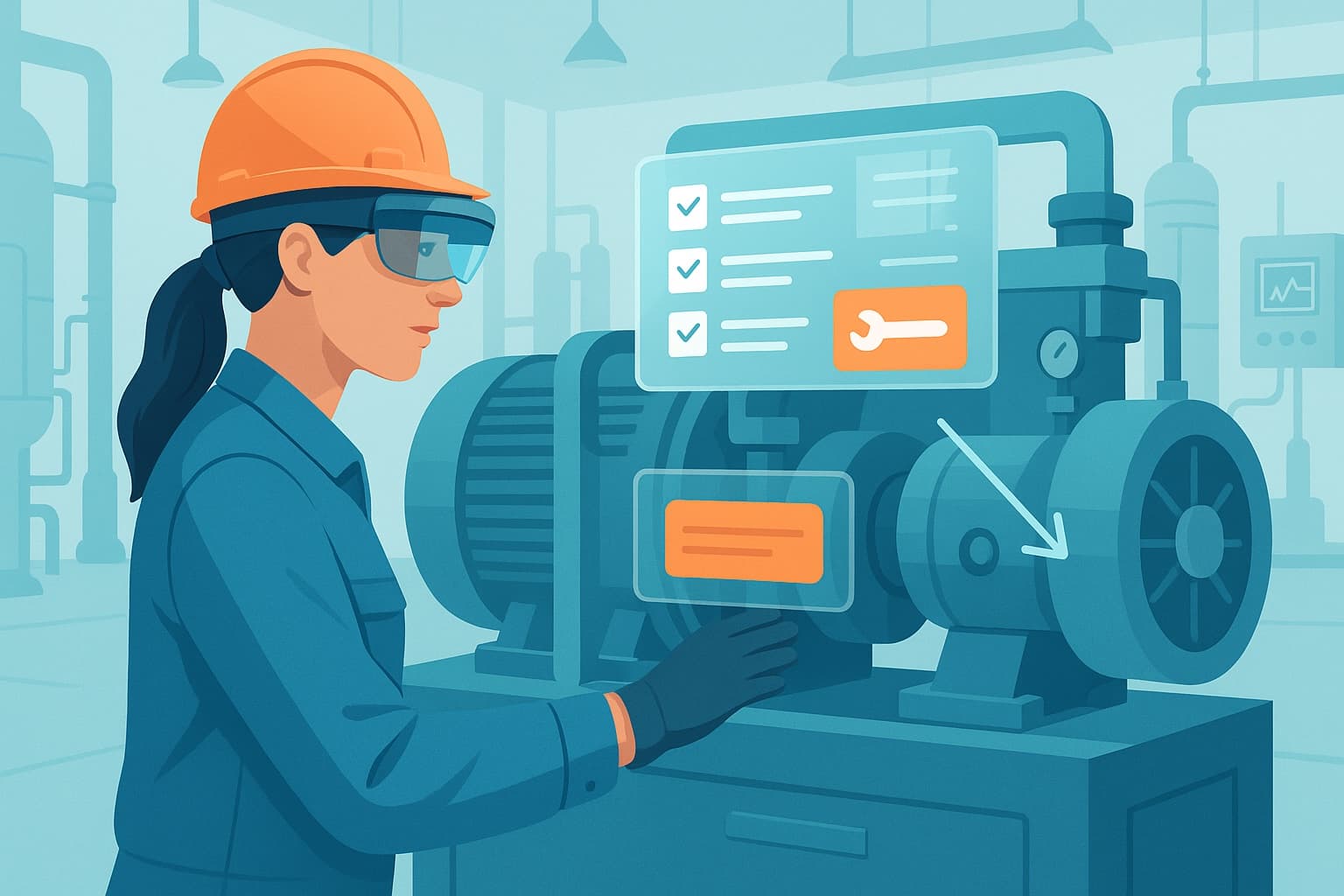
Industrial companies face constant pressure to maintain productivity, safety and quality while managing complex operations across multiple locations. Using AR for knowledge sharing across shifts, sites and countries helps teams capture and transfer expertise directly on the job, reducing errors and downtime.
The challenge of knowledge sharing in industrial environments
Industrial operations rarely stop. Teams work around the clock, often across different shifts and locations. Equipment, procedures and regulations vary between sites and countries, while experienced technicians retire or move roles. This leaves many companies struggling to:
- Standardize procedures and best practices across locations
- Onboard new hires and temporary staff efficiently
- Prevent recurring errors caused by inconsistent knowledge transfer
- Ensure compliance with ever-changing safety and quality standards
Traditional methods—paper manuals, static digital documents, classroom training—cannot keep up with the pace and complexity of modern industrial work. According to a 2023 report from the World Economic Forum, skills gaps and poor knowledge transfer are among the top five risks for manufacturing and process industries globally.
Why knowledge sharing needs to change now
Several industry trends make effective knowledge sharing a critical priority:
- Aging workforce: Many experienced technicians are nearing retirement, taking decades of tacit knowledge with them.
- Globalization: Operations span multiple countries, languages and regulatory environments.
- Increased complexity: Equipment, processes and compliance requirements continue to evolve.
- High turnover: Temporary and contract workers fill gaps but often lack site-specific expertise.
- Remote and hybrid work: Travel restrictions and distributed teams require new ways to collaborate and support each other.
The cost of not addressing these challenges is significant. Studies by the Aberdeen Group indicate that poor knowledge transfer can lead to up to 20% higher operational costs, increased safety incidents, and longer downtimes during shift changes or after staff turnover.
How AR and AI-guided work instructions support knowledge sharing
AR (augmented reality) combined with AI-guided work instructions offers a practical solution for capturing, standardizing and sharing expertise across shifts, sites and national borders. Here’s how it works:
- Visual SOPs: AR overlays digital work instructions, step-by-step guides and checklists directly onto equipment or workspaces, reducing ambiguity.
- Context-aware support: AI adapts instructions based on equipment version, operator experience, or local regulations.
- Remote collaboration: Experts can support teams in real time, regardless of location, using AR-enabled devices.
- Automatic documentation: As teams complete tasks, systems can log actions for compliance and continuous improvement.
- Multilingual support: Instructions can be delivered in multiple languages, tailored to the workforce at each site.
This approach moves beyond static documents and one-off training sessions, embedding knowledge directly into daily workflows.
Key use cases for AR knowledge sharing across shifts and sites
Standardizing maintenance procedures
A global chemical manufacturer operates plants in Europe and Asia. By using AR SOPs, they ensure every maintenance technician, regardless of location or shift, follows the same validated procedures for critical pump inspections. Visual overlays highlight exact components, torque values and safety checks, reducing errors and improving audit readiness. When a pump model is updated, instructions are updated centrally and rolled out instantly across all sites.
Supporting shift handovers
In a food processing facility, shift handovers were a common source of miscommunication and errors. With AR-guided work instructions, outgoing teams record notes and annotate equipment in real time. Incoming teams see these notes overlaid in context, alongside live data from IoT sensors. This reduces misunderstandings and helps teams prioritize urgent issues.
Cross-site troubleshooting and remote support
A wind energy company with turbines in multiple countries uses AR to connect field engineers with remote experts. When a technician encounters an unfamiliar fault, they can share a live AR feed. The expert draws directly onto the technician’s view, guiding them step by step. This reduces travel costs, speeds up repairs and builds local competence.
Accelerating onboarding and upskilling
A pharmaceutical plant faces frequent turnover among contract staff. Using AI and AR–guided work instructions, new operators access interactive, validated SOPs in their own language. Performance is tracked and knowledge gaps are flagged automatically, enabling targeted coaching. Time-to-competence drops by 30%, and compliance incidents decrease.
Results: measurable impact on safety, quality and productivity
Companies adopting AR for knowledge sharing report clear benefits:
- Fewer errors and incidents: Visual, step-by-step guidance reduces reliance on memory and prevents shortcuts.
- Faster onboarding: New staff learn on the job, in context, without waiting for classroom sessions.
- Consistent quality: Standardized instructions ensure every technician executes tasks the same way, every time.
- Higher productivity: Less time spent searching for information or clarifying procedures.
- Improved compliance: Automatic logging and version control make audits simpler and more reliable.
For example, a 2022 pilot with an automotive supplier found that AR SOPs reduced assembly errors by 38% and cut average task duration by 25%, compared to traditional paper-based instructions.
Addressing objections: practical considerations
Adopting AR and AI-guided work instructions brings up important questions for operations and HSE leaders:
What hardware is required?
Most AR solutions run on commercially available smart glasses, tablets or smartphones. Device selection depends on the environment—smart glasses for hands-free use, rugged tablets for harsh conditions. Many companies start with a small pilot using existing devices before scaling up.
How is content created and maintained?
Initial setup involves digitizing current SOPs and capturing expert workflows. Modern AR platforms allow subject matter experts to update instructions without coding. Governance is essential—assign responsibility for content validation, version control and local adaptation.
How do you manage change and adoption?
Clear communication, involvement of end users, and strong leadership support are key. Start with high-impact use cases, gather feedback, and show quick wins. Training should focus on both the technology and new ways of working.
What about data security and privacy?
Industrial AR platforms comply with data protection regulations and offer granular access controls. Ensure your provider meets your company’s IT and compliance requirements.
What ActARion brings to industrial knowledge sharing
ActARion enables industrial companies to deploy AI and AR–guided work instructions tailored to their operational realities. Our approach is grounded in decades of experience supporting safety, productivity and workforce development in manufacturing, energy, chemicals and other sectors.
With ActARion, you can:
- Digitize and standardize SOPs across sites and languages
- Enable real-time, context-aware guidance for every team and shift
- Connect experts with teams on the ground for remote troubleshooting
- Track compliance and performance for continuous improvement
We support your teams through every stage—from pilot to rollout—ensuring strong governance, data integrity and measurable ROI. See how digital work instructions for maintenance or AR onboarding for technicians deliver results in real-world settings.
Note: For a deeper dive into AR and knowledge transfer in industry, see the World Economic Forum’s Future of Jobs Report 2023.
Explore AR knowledge sharing in your organisation
If you want to see how using AR for knowledge sharing across shifts, sites and countries could improve safety, productivity, and workforce readiness in your operations, schedule an exploratory call with ActARion. There’s no commitment—just an opportunity to map out potential use cases and ROI for your environment.
Learn more about how ActARion works, or browse answers to common AR implementation questions. To discuss your specific process, schedule a discovery call.
Discover how AI and AR–guided work instructions can help your teams work smarter—wherever they are.
Go deeper
This article is part of our knowledge base on connected worker solutions. For a comprehensive overview, read our whitepaper:
Connected worker platforms: enabling knowledge transfer and operational support — Covers why knowledge breaks down in modern operations and how connected worker platforms address it.