
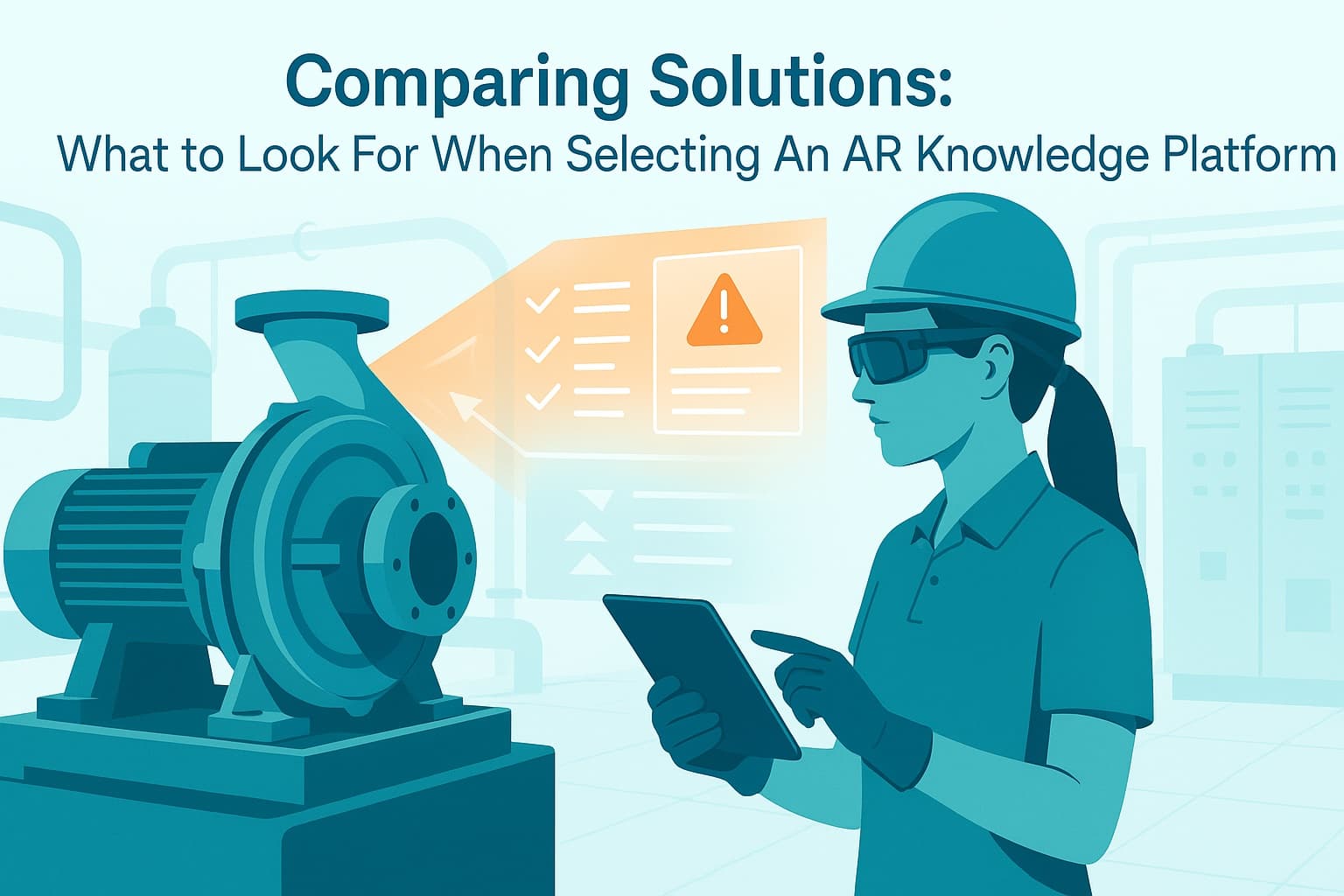
Augmented reality (AR) knowledge platforms are changing how industrial teams work. For operations managers, HSE leaders, maintenance leads, and L&D professionals, the right AR solution can mean the difference between safe, compliant, and high-performing operations—or costly mistakes and downtime. But with a crowded market, comparing solutions and making the right choice is not straightforward.
This article breaks down what matters most when selecting an AR knowledge platform for industrial use. It covers the practical criteria, must-have features, and concrete steps to ensure your investment delivers measurable improvements in safety, productivity, and workforce readiness.
The need for robust AR knowledge platforms in industry
Industrial environments face increasing complexity and pressure. Assets are more advanced, compliance demands are stricter, and skilled personnel are harder to find. At the same time, unplanned downtime, procedural errors, and safety incidents remain constant threats.
Traditional paper SOPs and static digital documents are not enough. Teams need just-in-time, context-aware guidance—especially for critical inspections, maintenance, and onboarding. AR knowledge platforms, which combine digital work instructions, AI-driven guidance, and real-time data, respond directly to these needs.
Current challenges driving AR adoption
- Skills gaps and experienced staff retiring, making knowledge capture and transfer urgent
- High stakes for safety and compliance; mistakes can be costly or dangerous
- Time pressure to get new technicians or operators up to speed fast
- Demands for consistent quality and uptime across distributed teams
A 2023 McKinsey report found that digital work instructions and AR SOPs can reduce error rates by up to 50% and cut training time by 30–40% in industrial settings (). But real results depend on selecting a platform that fits your operational reality.
Why careful comparison matters now
Selecting an AR knowledge platform is not just about features—it’s about fit, scalability, and long-term value. Industrial decision makers need to justify investments and prove ROI. A poorly matched platform can lead to:
- Low adoption among teams
- Difficult integrations with existing systems
- Content bottlenecks or quality issues
- Security or compliance risks
- Missed productivity and safety targets
The market for AR knowledge solutions is evolving fast. New vendors appear regularly, but not all can meet the demands of regulated, high-stakes industrial environments. A careful, criteria-based comparison is essential.
Key criteria for evaluating AR knowledge platforms
The best AR knowledge platforms do more than overlay instructions—they integrate with your workflows, adapt to your teams, and support measurable operational improvements. Use the following criteria to compare solutions:
1. Industrial-grade content creation and management
- Flexible authoring: Can your subject matter experts create and update AR SOPs and digital work instructions without coding?
- Content governance: Does the platform support version control, approval workflows, and audit trails?
- Media support: Can you combine 3D models, video, step-by-step text, and IoT data in your instructions?
A robust platform should make it easy to digitize inspections, maintenance routines, and onboarding processes—while ensuring content quality and compliance.
2. Usability for technicians and operators
- Device compatibility: Does the solution work on the hardware your teams use (smartphones, tablets, AR headsets)?
- User experience: Are instructions clear, hands-free when needed, and accessible in noisy or hazardous environments?
- Offline access: Can teams use the platform reliably in areas with limited connectivity?
User adoption is critical. Platforms that are hard to use or require expensive, specialized hardware often fail to scale beyond pilot projects.
3. Integration with existing systems
- ERP, EAM, and MES integration: Can the platform connect with your maintenance, asset management, or learning management systems?
- Single sign-on and user management: Does it support your IT security and identity protocols?
- Data export and analytics: Can you easily extract usage, compliance, and performance data?
Integration ensures that AR work instructions become part of daily operations rather than a siloed tool.
4. AI-driven guidance and analytics
- Context-aware assistance: Does the platform use AI to recommend next steps, detect errors, or adapt instructions in real time?
- Performance tracking: Can you measure completion rates, error types, and time-on-task?
- Continuous improvement: Is there support for feedback loops, so instructions can be refined based on real-world use?
AI and AR–guided work instructions should deliver smarter, not just digital, support.
5. Security, compliance, and scalability
- Data protection: Does the platform meet industry standards for data security and privacy (e.g., ISO 27001, GDPR)?
- Access control: Can you manage permissions for different teams, sites, or roles?
- Scalability: Is the solution proven in environments similar to yours, and can it support growth across sites or regions?
For regulated industries, security and compliance are non-negotiable.
6. Support, training, and change management
- Onboarding support: Does the vendor provide resources to help your teams adopt the platform?
- Change management: Are there templates or best practices for rolling out AR SOPs and digital work instructions?
- Ongoing support: Is help available when you need it—locally and in your language?
A platform is only as good as the support and expertise behind it.
Key use cases and operational impact
Industrial teams use AR knowledge platforms to improve safety, productivity, and training in several high-impact areas:
AR SOPs for inspections and maintenance
- Step-by-step, visual instructions guide technicians through complex inspections, reducing missed steps.
- Real-time data from sensors or IoT devices can be integrated to trigger specific instructions or warnings.
- Digital checklists ensure compliance and create an auditable record for regulators.
Digital onboarding and upskilling
- New operators follow interactive procedures, accelerating time to competence.
- Less dependence on shadowing experienced staff, freeing up senior technicians for critical tasks.
- Training content is always up to date, avoiding out-of-date paper manuals.
Remote support and collaboration
- Field engineers can connect with remote experts, who see what they see and guide them in real time.
- Complex troubleshooting is faster, reducing downtime and travel costs.
Quality assurance and compliance
- Every step is documented, with photos, videos, or sensor data as proof of execution.
- Immediate feedback and error detection help prevent defects and incidents.
Note: For more on how AR onboarding can reduce error rates and speed up training, see AR onboarding for technicians.
How to structure an effective comparison process
A structured evaluation process helps avoid common pitfalls and ensures the chosen AR knowledge platform delivers results:
- Define your objectives: Identify the processes (e.g., inspections, maintenance, onboarding) where AR SOPs would have the most impact.
- Engage stakeholders early: Include IT, HSE, operations, and training leads in requirements gathering.
- Pilot with real workflows: Test shortlisted platforms in real use cases—not just vendor demos.
- Evaluate content creation: Have your subject matter experts create or update digital work instructions to test ease of use.
- Check integration and security: Validate how the platform fits with your IT landscape and compliance needs.
- Assess support and roadmap: Interview vendors about their industrial experience, support structure, and product roadmap.
Document findings using a clear scorecard or checklist. Focus on operational impact, not just features.
Addressing common objections and limitations
Implementing AR knowledge platforms in industrial settings does present challenges. Decision makers should be aware of:
- Hardware readiness: Not all teams have access to AR headsets; ensure the platform supports smartphones and tablets.
- Change management: Teams may resist new tools. Success depends on clear communication, training, and leadership support.
- Content creation workload: Building high-quality digital work instructions requires up-front effort. Look for platforms with templates and efficient authoring tools.
- Data privacy: Ensure the platform meets your industry’s data governance requirements.
Vendors should be transparent about these challenges and provide strategies to address them.
What ActARion brings to industrial AR knowledge management
ActARion specializes in AI and AR–guided work instructions for industrial environments. Our platform is built for operations, HSE, maintenance, and training leaders who need measurable improvements in safety, compliance, and productivity.
Key strengths include:
- Industrial-grade authoring: No-code creation and easy updates for AR SOPs, digital inspections, and onboarding content.
- Flexible deployment: Support for smartphones, tablets, and leading AR headsets—online or offline.
- Seamless integration: Proven connectors for EAM, ERP, and training systems.
- AI-driven guidance: Context-aware assistance and analytics for continuous improvement.
- Compliance built-in: End-to-end audit trails, access controls, and data protection aligned with industry standards.
- Change management support: Templates, onboarding resources, and expert support to ensure adoption and ROI.
ActARion works with manufacturers, utilities, and technical service providers to digitize critical procedures and empower teams with just-in-time knowledge.
For more details, see About ActARion or review our FAQ on AR knowledge platforms.
Explore this in your organisation
Selecting the right AR knowledge platform is a strategic decision with direct impact on safety, productivity, and workforce readiness. To see how AI and AR–guided work instructions could support your operational goals, schedule an exploratory call with ActARion. There is no commitment—just a practical look at your processes and how digital work instructions can drive results.
Learn more about digital work instructions for maintenance or see how AI and AR–guided SOPs fit your workflows. For a broader perspective, read the McKinsey analysis on AR in manufacturing.
Meta description:
A practical guide for industrial decision makers on selecting the right AR knowledge platform for safer, smarter, and more efficient operations.
URL slug:
ar-knowledge-platform-selection
Go deeper
This article is part of our knowledge base on connected worker solutions. For a comprehensive overview, read our whitepaper:
Connected worker platforms: enabling knowledge transfer and operational support — Covers platform evaluation criteria, the role of AR, and key use cases enabled by connected worker platforms.