
Modern logistics operations face relentless pressure to deliver faster, safer, and with near-zero errors. Picking the wrong item, mispacking an order, or loading goods incorrectly can trigger costly delays, rework, and even safety incidents. For operations managers, HSE leaders, and training specialists, the challenge is clear: how can you enable teams to work smarter and more accurately, even as product complexity and order volumes rise?
AI and AR–guided work instructions are emerging as a practical solution. By providing precise, step-by-step digital guidance for picking, packing, and loading tasks, these technologies help reduce mistakes, support workforce training, and boost operational efficiency.
Logistics demands are rising—and so are the risks of error
The logistics sector is under pressure from all directions. E-commerce growth, just-in-time supply chains, and increasing product variety are raising the stakes for warehouses, distribution centers, and transportation hubs. At the same time, skilled labor shortages and high staff turnover make it harder to maintain quality and consistency.
Common pain points for logistics leaders include:
- High picking error rates leading to customer complaints and costly returns
- Packing mistakes that cause product damage or shipment delays
- Loading errors resulting in inefficient use of space or safety hazards
- Difficulty onboarding new technicians quickly and consistently
- Manual, paper-based SOPs that are ignored or out of date
According to the Logistics Bureau, picking errors alone can cost companies up to $50 per error, not counting the impact on customer satisfaction and brand reputation.
These challenges are not just operational headaches—they directly affect the bottom line, regulatory compliance, and workforce morale. For many logistics operations, reducing mistakes is now a board-level priority.
Why change is urgent: compliance, complexity, and workforce shifts
Today's logistics environment is more complex than ever. Regulations around product traceability, load securing, and worker safety continue to tighten. At the same time, warehouses are handling a broader range of SKUs, with frequent changeovers and custom orders.
Three factors are driving the need for smarter, digital work instructions:
- Increasing complexity: More SKUs, custom packaging, and mixed-load shipments make traditional paper SOPs inadequate.
- Skills gap: High turnover and seasonal surges mean many team members are inexperienced or unfamiliar with current procedures.
- Compliance and safety: Regulations require documented, auditable processes for handling hazardous goods, food products, or pharmaceuticals.
Traditional approaches—such as static checklists and on-the-job shadowing—struggle to keep up. Errors slip through, and tribal knowledge is lost when experienced staff leave.
How AR-guided work instructions reduce logistics errors
AI and AR–guided work instructions address these pain points by providing context-aware, visual guidance directly to technicians, operators, and field engineers as they work.
What are AR-guided work instructions?
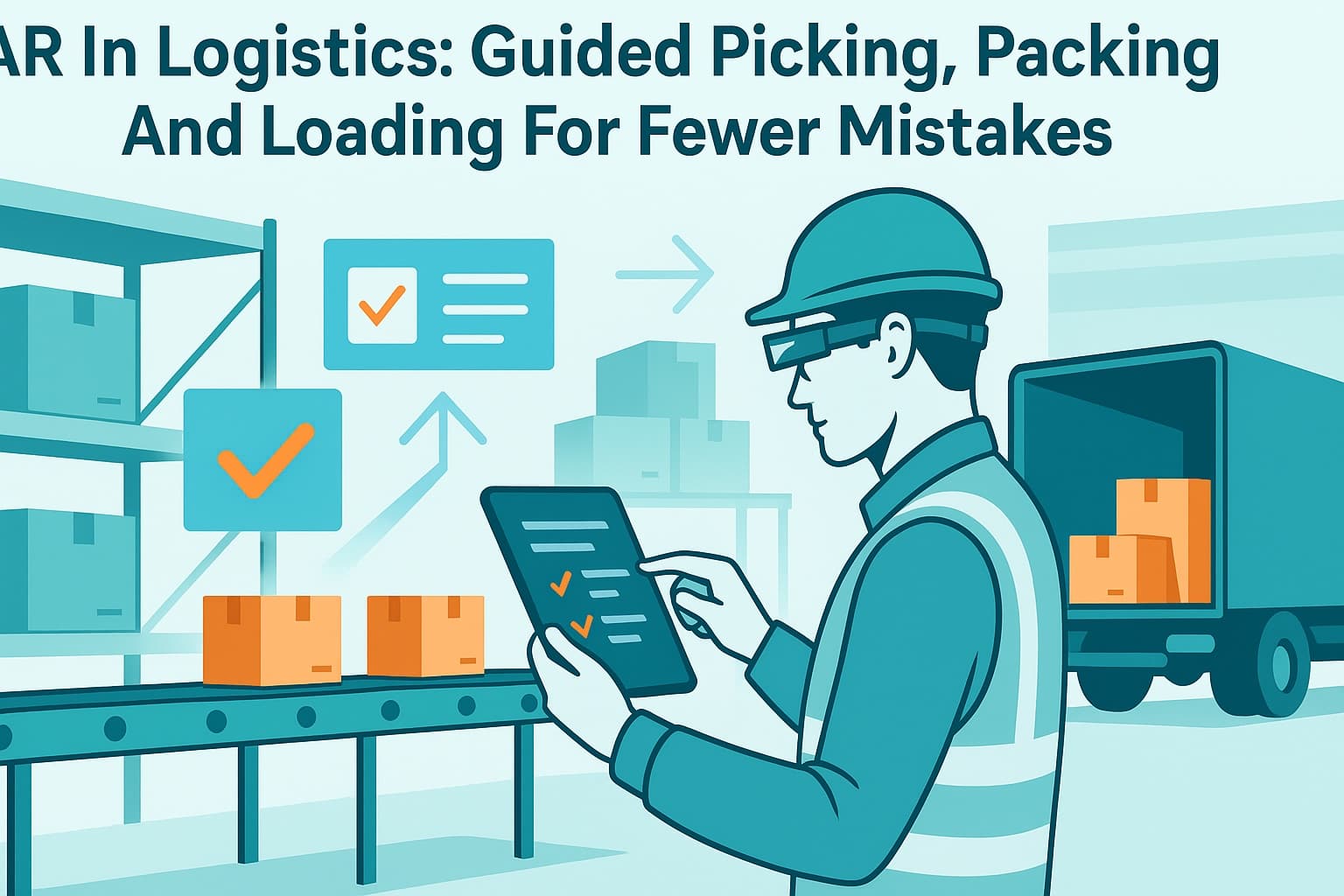
Augmented reality (AR) overlays digital information—such as step-by-step instructions, checklists, or visual cues—directly onto the operator's field of view, using smart glasses or tablets. When combined with AI, these instructions can adapt to the specific product, order, or location, ensuring that every step is followed correctly.
Key features include:
- Visual cues: Highlighting the correct bin, item, or package to pick
- Hands-free operation: Allowing operators to work safely without juggling paper or handheld devices
- Real-time validation: Scanning barcodes or using image recognition to confirm correct picks/placements
- Automated documentation: Capturing proof of process for compliance and training records
How AR supports picking, packing, and loading
Picking: AR displays the correct item location and quantity, reducing mis-picks. Operators can confirm picks with a quick scan, and the system flags any errors immediately.
Packing: Visual instructions guide the operator through the correct packing sequence, including material selection, labeling, and special handling for fragile or regulated items.
Loading: AR overlays show the optimal loading pattern for a given shipment, improving space utilization and ensuring that weight limits and safety rules are followed.
By standardizing these processes and making instructions accessible in real time, AR and AI help reduce the cognitive load on operators—especially valuable for new hires or during peak periods.
Use cases: AR in logistics on the ground
Several leading logistics and industrial companies are implementing AR-guided work instructions to address specific challenges. Common scenarios include:
1. Warehouse picking in high-SKU environments
A distribution center handling thousands of SKUs uses AR smart glasses to guide technicians through complex pick lists. Visual cues highlight the correct bin, and AI suggests the optimal route through the warehouse. The result: picking accuracy rises from 95% to over 99%, and training time for new hires drops by 40%.
2. Packing for compliance and quality
A logistics provider handling both consumer electronics and hazardous materials deploys AR SOPs at packing stations. Operators receive step-by-step guidance on packing materials, labeling, and documentation. Barcode scanning ensures the right products are in each box. Packing errors fall by 60%, and regulatory audits become easier due to automatic digital records.
3. Loading trucks for optimal space and safety
A regional transport company implements AR-guided loading for mixed pallet shipments. The system visualizes the ideal loading sequence, ensuring heavy items are placed first and hazardous materials are segregated. Loading times are reduced by 20%, and damage claims fall significantly.
Note: For more on real-world adoption, see the DHL AR pilot case study, which reported up to 25% productivity improvements during AR-guided picking trials.
Results: measurable improvements in logistics performance
Implementing AI and AR–guided work instructions delivers tangible benefits for logistics operations:
- Error reduction: Picking and packing errors drop by 30–70% in documented pilots
- Faster onboarding: New operators reach full productivity 30–50% faster
- Improved compliance: Automated documentation and process validation support audits and reduce risk
- Higher throughput: Teams work faster with fewer interruptions and less rework
- Better safety: Hands-free, heads-up operation reduces distraction and manual handling risks
For decision makers in operations, HSE, and training, these outcomes translate directly into cost savings, higher customer satisfaction, and a more resilient workforce.
What ActARion brings to logistics operations
ActARion specializes in deploying AI and AR–guided work instructions for complex industrial environments. Our platform enables logistics leaders to digitize SOPs for picking, packing, and loading, and deliver them through intuitive AR interfaces.
Key advantages of ActARion's approach:
- Rapid content creation: Convert existing SOPs and checklists into digital, AR-ready instructions
- Hardware flexibility: Support for common AR devices (smart glasses, tablets, mobile phones)
- Integration: Connect with WMS, ERP, and quality systems for real-time data and process validation
- Governance and change management: Tools for version control, user permissions, and audit trails
- Scalable support: From pilot projects to multi-site rollouts
Our expertise in logistics and industrial safety ensures that digital work instructions fit your operational reality—not just in theory, but on the warehouse floor.
Addressing common concerns: hardware, change, and content
Adopting AR in logistics raises practical questions:
- Hardware investment: Modern AR devices are more affordable and robust than ever. Many organizations start with tablets or shared smart glasses for pilot projects.
- Change management: Involving supervisors and operators early, and integrating AR SOPs with existing processes, is critical to adoption. ActARion provides training and support throughout rollout.
- Content creation: Digitizing SOPs can be done incrementally. Start with high-impact processes (e.g. picking for your top SKUs), then expand as confidence grows.
For more on managing digital transformation in logistics, see our change management guide for industrial AR projects.
Explore AR-guided logistics in your organization
AI and AR–guided work instructions offer a proven path to fewer errors, faster onboarding, and safer logistics operations. Whether you manage a single warehouse or a global supply chain, these tools help your teams deliver with greater accuracy and confidence.
To explore what AR-guided picking, packing, and loading could look like in your logistics environment, schedule a discovery call with ActARion. You can also download our logistics error reduction checklist or read more about digital SOPs for warehouse teams.
For more on industry trends and best practices, see the DHL AR in logistics insight page.