
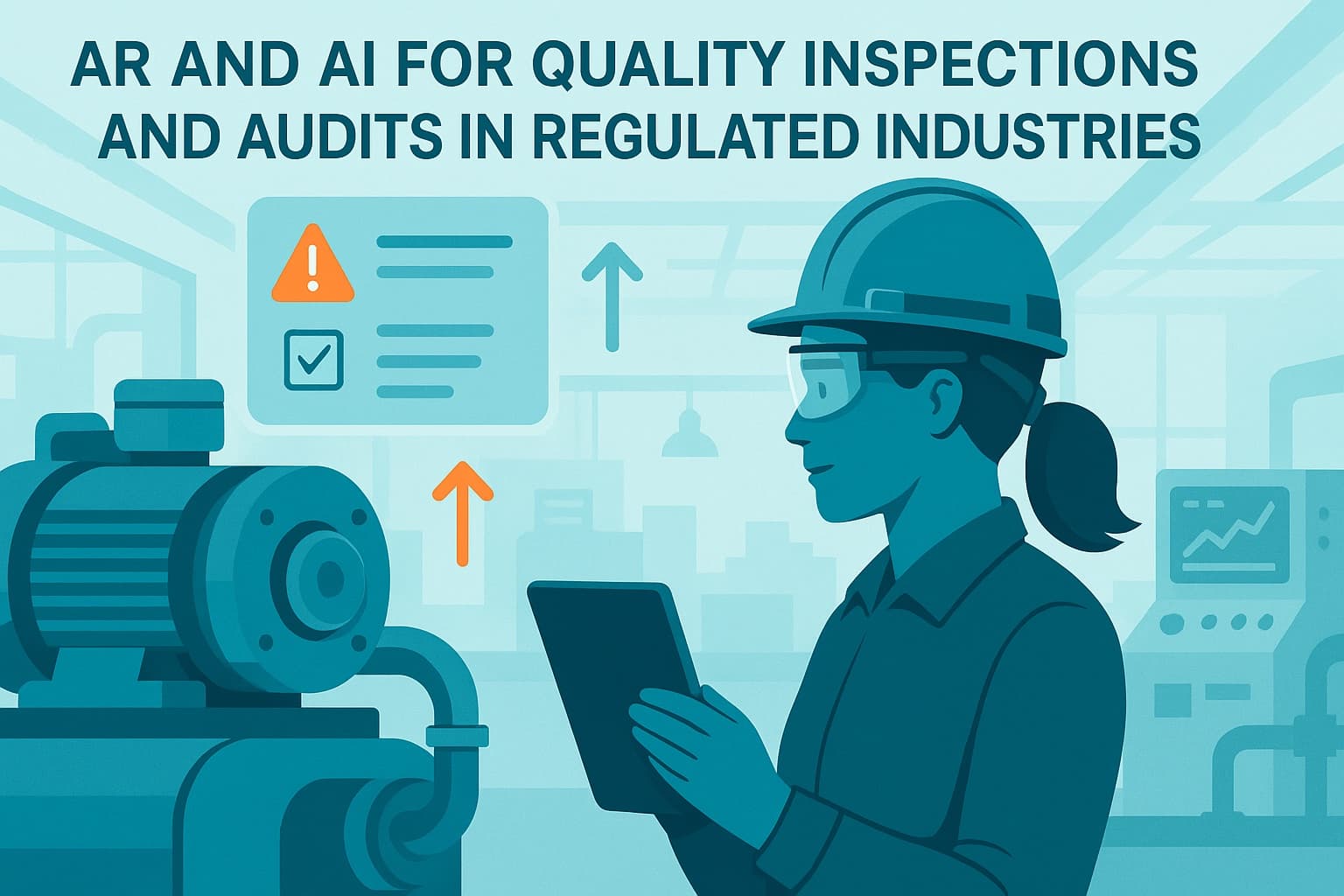
Quality inspections and audits in regulated industries demand precision, consistency, and documented proof. AR and AI for quality inspections and audits are now essential tools for operations, quality, HSE, and L&D leaders who need to drive compliance, reduce risk, and boost productivity—without adding complexity for teams on the ground.
Regulated industries face rising pressure on quality and compliance
Regulated industries—pharmaceuticals, chemicals, food and beverage, energy, aerospace, and medical devices—are under increasing scrutiny. Quality incidents, non-compliance, or documentation gaps can lead to fines, shutdowns, or reputational harm. At the same time, the workforce is changing, with experienced technicians retiring and new hires needing rapid onboarding.
Key challenges include:
- Ensuring every inspection and audit step is performed consistently
- Avoiding manual data entry errors and missed checks
- Maintaining up-to-date SOPs and audit trails for regulators
- Training new technicians quickly on complex procedures
- Proving compliance with clear, timestamped evidence
Traditional inspection methods—paper checklists, spreadsheets, static PDFs—are slow to update and prone to human error. Digital transformation is no longer optional; it’s a necessity for operational continuity and regulatory compliance.
Why change now: the cost of manual inspections and audits
Manual, paper-based inspections create hidden risks and inefficiencies:
- Incomplete or illegible records
- Missed steps or skipped verifications
- Delayed reporting and root cause analysis
- High training burden for complex procedures
- Difficulty showing auditors clear, traceable evidence
According to the World Economic Forum, digitalizing inspections can reduce errors by up to 40% and cut audit preparation time in half. Regulators worldwide are increasing expectations for digital traceability, real-time reporting, and proactive risk management.
The workforce challenge compounds this: as experienced staff retire, new hires may lack deep process knowledge. Standardizing complex inspections is essential to ensure a consistent level of quality and safety.
How AR and AI–guided work instructions enable smarter inspections
AI and AR–guided work instructions transform inspections and audits from error-prone manual tasks into efficient, auditable digital processes. Here’s how:
What are AR and AI–guided inspections?
- AR (augmented reality) overlays digital instructions, checklists, and visual cues on real-world equipment using smart glasses, tablets, or mobile devices.
- AI analyzes images, sensor data, and technician input in real time, flagging anomalies, verifying steps, and automating documentation.
Together, AR and AI provide step-by-step digital guidance, automated data capture, and immediate feedback—removing ambiguity and reducing errors.
Key features of AR and AI for inspections and audits
- Visual SOPs and checklists anchored to equipment or process steps
- Real-time AI validation of photos, measurements, or sensor readings
- Automated timestamped records and audit trails
- Remote expert support via AR for complex or escalated issues
- Integration with existing quality and compliance systems
Technicians follow standardized digital instructions, capture required evidence (photos, videos, data), and receive prompts for any missed steps. Supervisors and auditors access a full digital record—improving transparency and reducing audit risk.
Common use cases: AR and AI in regulated industry inspections
AR and AI–guided work instructions are already delivering value in regulated sectors. Examples include:
Pharmaceutical manufacturing
- Line clearance and cleaning validation: AR checklists ensure every step is performed and documented before batch startup.
- Environmental monitoring: AI analyzes sensor data and technician input for deviations, triggering alerts for out-of-spec results.
- Equipment calibration: AR overlays guide technicians through calibration sequences, capturing evidence for compliance.
Food and beverage production
- Hygiene and sanitation checks: AR SOPs walk operators through cleaning and inspection routines, with AI validating photo evidence.
- Allergen control audits: Step-by-step AR instructions ensure critical points are checked and recorded, supporting traceability.
Chemical plants and energy
- Safety-critical inspections: AR-guided walkdowns standardize checks on valves, pumps, and containment systems, with AI flagging anomalies.
- Permit-to-work validation: AI verifies that all required steps and signatures are completed before work begins.
Aerospace and medical devices
- Pre-flight or pre-production inspections: AR overlays highlight inspection points, while AI confirms correct assembly or configuration.
- Regulatory evidence capture: Digital records provide clear, time-stamped proof for FAA, EASA, or FDA auditors.
Measurable results: compliance, quality, and productivity gains
Companies implementing AR and AI for quality inspections and audits report:
- 30–50% faster inspection cycles (source: Capgemini, Augmented and Virtual Reality in Operations)
- 40–60% reduction in documentation errors and missing evidence
- Improved first-time-right rates and reduced rework
- Faster onboarding for new technicians and inspectors
- Easier, less disruptive audits with complete digital trails
Note: Results depend on process complexity, team readiness, and integration with existing systems. A pilot phase is recommended to validate impact in your specific environment.
Addressing obstacles: hardware, change management, and governance
Adopting AR and AI–guided inspections requires clear planning and change management. Common concerns include:
- Hardware selection: Smart glasses, tablets, and mobile devices must be rugged, compatible with PPE, and approved for use in regulated zones. ActARion advises on device selection and validation.
- Content creation: Digital SOPs and AR checklists must reflect current approved procedures. ActARion works with quality teams to digitize and validate content, ensuring regulatory alignment.
- User adoption: Technicians may be wary of new tools. Early involvement, clear training, and phased rollout support adoption.
- Data security and integration: Inspection records must be secure and accessible for audits. ActARion integrates with MES, QMS, and ERP systems to support compliance.
- Governance: Change control, versioning, and audit trails are built into the solution, supporting GxP, FDA, or ISO requirements.
ActARion’s approach combines proven technology with practical support for change management and regulatory compliance.
What ActARion brings to regulated industry inspections
ActARion specializes in AI and AR–guided work instructions for industrial teams in regulated environments. Our platform:
- Digitizes and standardizes inspections, audits, and SOPs
- Delivers visual, step-by-step AR guidance on any device
- Uses AI to validate evidence and automate documentation
- Integrates with your quality and compliance systems
- Supports change management, user training, and governance
Clients see faster inspections, fewer errors, easier audits, and a more confident, compliant workforce. We work with operations, quality, HSE, and training leaders to tailor solutions to site-specific needs.
You can read more about our approach to digital work instructions or see real-world use cases for AR SOPs.
Explore AR and AI–guided inspections in your organisation
See how AR and AI for quality inspections and audits can help your teams deliver safer, more consistent results. Schedule a discovery call to explore a pilot for your processes—no commitment, just a practical assessment of fit and impact.
Learn more about AR onboarding for technicians, or find answers to common questions in our FAQ. For industry benchmarks and regulatory trends, review the FDA’s guidelines on electronic records and signatures.
Take the first step toward error-free, audit-ready inspections with ActARion.
Go deeper
This article is part of our knowledge base on digital work instructions and compliance. For a comprehensive overview, read our whitepaper:
Digital work instructions and AR SOPs for standard work and compliance — A practical guide for quality, HSE, and operations leaders on transforming SOPs into executable, auditable AR instructions.