
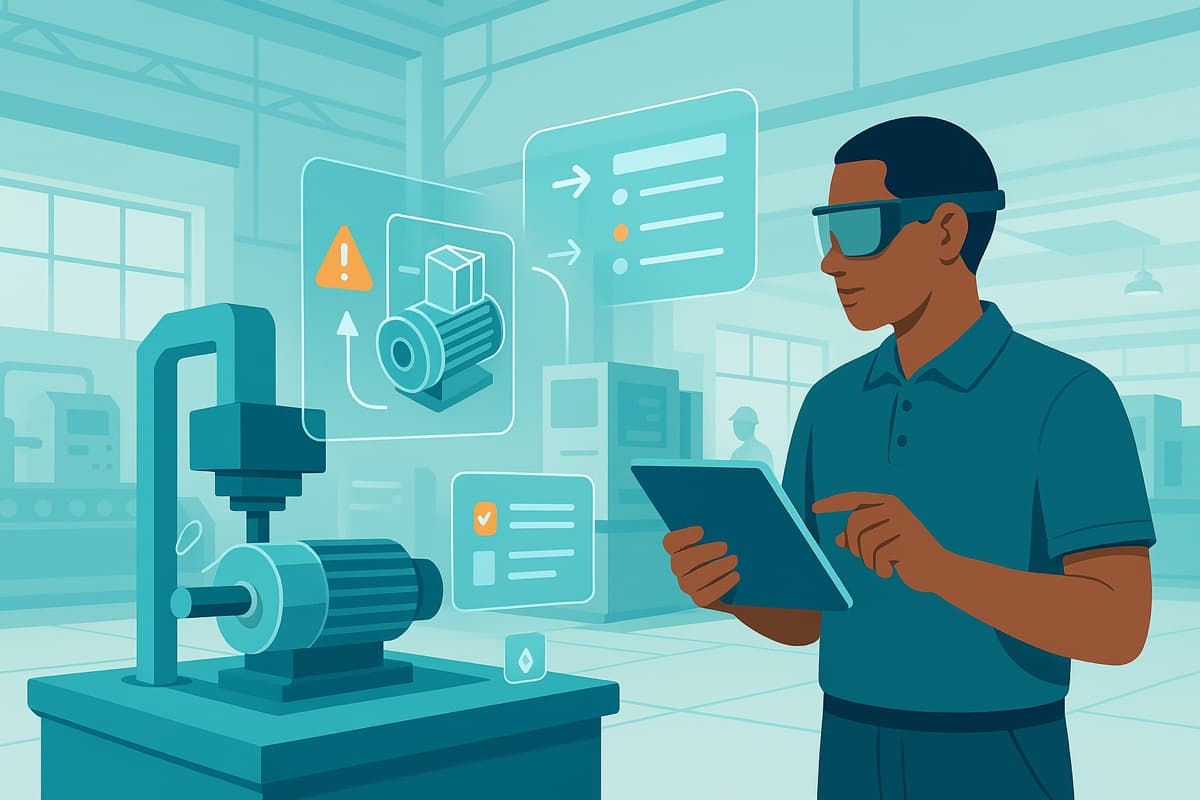
The term "connected worker" appears in almost every digital transformation roadmap. But what does it actually mean—and what should a connected worker platform deliver? Too often, the focus is on connecting people to systems: dashboards, notifications, mobile checklists. The real opportunity is different. A connected worker platform should connect knowledge to work, at the moment it is needed. This whitepaper explains what that means in practice, where AR adds value beyond mobile-only tools, and what to look for when evaluating platforms for your operations.
Why knowledge breaks down in modern operations
Industrial organisations have more documented knowledge than ever before. Procedures, training materials, equipment manuals, safety guidelines—all exist somewhere. Yet frontline workers still struggle to access the right information at the right time.
Expertise concentrated in few people. In most operations, a small number of experienced workers hold critical know-how. They know the workarounds, the early warning signs, the tricks that keep production running. When they are unavailable—or when they retire—that knowledge is inaccessible.
Tribal knowledge vs. documented procedures. Much of what experts know was never written down. It lives in their heads, passed informally to colleagues over years. Documented procedures capture the basics but miss the nuances that separate adequate from excellent execution.
Shift handovers and site-to-site gaps. Knowledge does not flow smoothly between shifts or across locations. Each team develops its own practices. Problems solved on one shift recur on the next. Best practices at one site remain unknown at others.
Complexity increasing faster than training capacity. Products, equipment and regulations grow more complex each year. Training programmes cannot keep pace. Workers are expected to handle situations they have never encountered, with limited guidance available.
These knowledge gaps show up as errors, delays, safety incidents and quality escapes. The cost is real, even if it is rarely measured directly.
What defines a connected worker platform
A connected worker platform is software that supports frontline workers in executing their tasks. But not all platforms are equal. The most effective ones share certain characteristics.
Content: knowledge made accessible. The platform stores and delivers work instructions, procedures, reference materials and training content. Workers can find what they need without leaving their work area or searching through folders.
Context: guidance tailored to the situation. The right content appears based on the task, equipment, location or user. A maintenance technician sees different guidance than a production operator. A trainee sees more detail than an expert.
Communication: connection to expertise. When guidance is not enough, workers can reach experts—colleagues, supervisors or remote specialists. The platform facilitates collaboration, not just information delivery.
Execution data: visibility into how work is done. The platform captures what workers do, not just what they are supposed to do. Completion times, step sequences, deviations and confirmations generate data for continuous improvement.
This is different from a traditional learning management system (LMS), which focuses on training completions, or a document management system, which stores files. A connected worker platform operates in the flow of work, supporting execution in real time.
Evaluate the business case. Use the ActARion ROI Calculator to estimate potential savings from faster troubleshooting, reduced training time, and fewer errors.
The limits of mobile-only connected worker tools
Many connected worker solutions are mobile-first: smartphone or tablet apps that deliver checklists, forms and notifications. These tools have value, but they also have limitations that become apparent in complex industrial environments.
Checklist fatigue. When every task becomes a checklist, workers check boxes without engagement. The checklist becomes a formality rather than a guide. Critical steps get the same treatment as routine ones.
Limited contextual guidance. A mobile app shows instructions on a screen. The worker must translate those instructions to the physical environment—interpreting diagrams, locating components, judging whether their work matches the description. This translation step introduces errors.
No spatial awareness. Mobile devices do not know where you are looking or what you are touching. They cannot highlight the exact valve, connector or inspection point. Guidance remains generic rather than specific to what is in front of the worker.
Hands-free limitations. Many industrial tasks require both hands. Holding a phone or tablet interrupts the work. Workers set down the device, perform the step, pick it up again. The friction discourages use.
Mobile tools are a starting point, but they do not fully solve the knowledge-to-work gap. Something more is needed for complex, hands-on tasks.
The role of AR in connected worker platforms
Augmented reality adds a spatial dimension to connected worker platforms. Instead of showing instructions on a separate screen, AR overlays guidance directly onto the real environment.
Visual overlays in real-world context. AR highlights exactly where to look and what to do. Arrows point to the correct component. Annotations explain the action. The worker sees guidance superimposed on their actual work environment, eliminating the translation step.
Hands-free operation for complex tasks. Smart glasses and head-mounted displays keep guidance visible while both hands are free. The worker follows instructions without interrupting their physical task. For assembly, maintenance and inspection, this reduces friction and errors.
Remote collaboration with shared view. AR enables "see-what-I-see" remote support. A field technician shares their view with an expert, who can draw annotations that appear in the technician's field of vision. Complex troubleshooting happens in real time, without travel.
Bridging the gap between expert and novice. AR guidance allows less experienced workers to perform tasks that previously required years of training. Expert knowledge is encoded in the guidance, available to anyone wearing the device. This accelerates onboarding and reduces dependency on a few key people.
AR is not a replacement for mobile tools—it is an extension. The choice of device depends on the task. But for the most complex and critical work, AR delivers capabilities that mobile alone cannot match.
Key use cases enabled by connected worker platforms
Connected worker platforms support a range of operational scenarios. Three use cases illustrate where the combination of knowledge delivery, contextual guidance and AR adds the most value.
Remote expert support
When equipment fails unexpectedly, the first instinct is to call an expert. But experts are often unavailable, in a different time zone, or spread thin across multiple sites. Remote expert support through a connected worker platform changes this dynamic.
A field technician initiates a video call, sharing their view through smart glasses or a mobile device. The remote expert sees exactly what the technician sees. They can draw arrows, circles and annotations that appear in the technician's view. Together, they diagnose the problem and execute the repair.
The result: faster resolution, reduced travel costs, and knowledge transfer that benefits future incidents.
Explore remote expert support for maintenance
Rare or complex tasks
Some procedures happen infrequently—annual calibrations, equipment overhauls, product changeovers for low-volume variants. Workers cannot rely on muscle memory. Paper procedures are hard to follow for tasks performed once a year.
Connected worker platforms with AR guidance make rare tasks accessible. Step-by-step instructions, visual overlays and confirmation checkpoints ensure correct execution even without recent practice. The platform becomes the memory that workers cannot maintain themselves.
Learn about AR-guided assembly for complex tasks
Cross-shift and cross-site collaboration
Knowledge often stays siloed within shifts or sites. A problem solved on the night shift is not visible to the day shift. A best practice at one plant never reaches others.
Connected worker platforms create a shared knowledge base. Procedures capture what works. Execution data reveals where problems occur. Remote support connects workers across locations. Over time, the platform becomes a repository of collective expertise—accessible to everyone, not locked in individual heads.
Discover training and knowledge transfer with AR SOPs
What to look for when evaluating platforms
If you are evaluating connected worker platforms, several criteria distinguish solutions that deliver real value from those that add complexity without results.
Content authoring ease. Can subject-matter experts create and update content themselves, or does every change require IT support? AI-assisted authoring—turning photos, videos and narration into structured instructions—accelerates content creation and keeps procedures current.
Device flexibility. Does the platform support the devices your workers already use? Can it scale to smart glasses for hands-free tasks without re-authoring content? Avoid platforms that lock you into a single hardware vendor.
Offline capability. Industrial environments often have limited or unreliable connectivity. Workers need access to guidance even when the network is down. True offline capability—not just cached content—is essential for field and factory use.
Integration with existing systems. Connected worker platforms should connect to MES, ERP, CMMS and LMS systems. Work orders trigger the right procedures. Training completions sync with HR records. Execution data flows to quality and operations dashboards.
Analytics and continuous improvement. The platform should generate insights, not just data. Which procedures take longest? Where do workers struggle? What steps cause the most errors? Analytics enable targeted improvements rather than guesswork.
Vendor approach vs. point solution. Some platforms focus narrowly on checklists or remote support. Others offer a broader vision but lack depth in execution. Look for a partner who understands your operational context and can evolve with your needs.
ActARion's AR-first approach to connected work
ActARion takes an AR-first approach to connected worker platforms. We believe the future of frontline work is not about more screens or more checklists—it is about delivering knowledge in context, at the moment it is needed, in a way that guides action rather than just providing information.
Together with our partner DeepSight, we provide AR-guided work instructions that work in real industrial environments. Our platform supports tablets, smartphones and smart glasses, with content that adapts to the device and the task. AI-assisted authoring helps subject-matter experts capture knowledge quickly. Integration with existing systems ensures the platform fits your IT landscape.
Our goal is to make expert knowledge available to every worker, every shift, every site. When knowledge flows to work, execution improves—and so do safety, quality and productivity.
Explore connected worker use cases in your organisation
Connected worker platforms are not a future vision—they are being deployed today in manufacturing, logistics and energy operations. The question is whether they fit your specific challenges and how to get started.
If you want to understand the potential impact, try the ROI calculator to estimate savings from faster troubleshooting, reduced training time and fewer errors.
If you prefer a conversation, schedule a discovery call to discuss your use case and see examples from similar organisations.
Related reading
Platform evaluation
- Connected worker platform vs traditional LMS: what is the difference and why it matters — Understanding the fundamental differences between platforms.
- Comparing solutions: what to look for when selecting an AR knowledge platform — Key evaluation criteria for platform selection.
- DeepSight and alternatives: pros and cons of AR-guided work instructions — Comparing AR work instruction platforms.
Remote support and collaboration
- Remote expert support with AR: resolving downtime without flying in specialists — How AR enables effective remote collaboration.
- Using AR for knowledge sharing across shifts, sites, and countries — Breaking down knowledge silos.
Integration and architecture
- Integrating AR work instructions with MES, ERP, or CMMS systems — Technical integration considerations.
- Mobile-first or AR-first: choosing the right starting point — Strategic decisions for platform adoption.
Related whitepapers:
- AI and AR–guided work instructions: a practical guide for operations teams — The foundational guide to AR work instructions.
- Digital work instructions and AR SOPs for standard work and compliance — Compliance-focused AR SOP implementation.
This whitepaper is intended as a reference guide for operations, IT and digital transformation leaders evaluating connected worker platforms. For questions or feedback, contact us.