
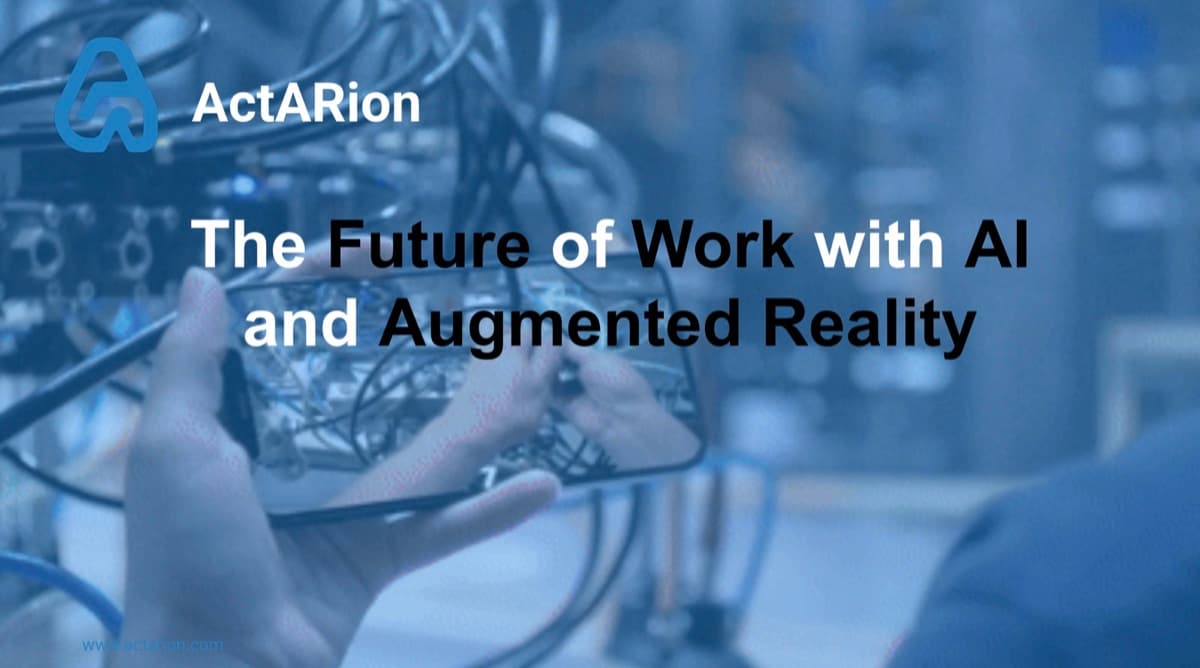
On 14 November, ActARion brought together customers, partners and peers for an in-depth session on “The Future of Work with AI and Augmented Reality”.
The focus of the event was clear: how can organisations work smarter, safer and faster by combining AI with AR-guided work instructions and digital Standard Operating Procedures (SOPs).
Why we organised this event
Many organisations face the same set of challenges:
- Increasing complexity in machines and processes
- Growing safety and compliance requirements
- Shortage of experienced technical staff
- Pressure to reduce downtime and training time
At the same time, technology has matured. AI can help structure knowledge and generate work instructions, while Augmented Reality can guide technicians step by step in the real environment.
The goal of the event was to connect these dots and show how AI and AR can move from “interesting demo” to practical value on the work floor.
The program in short
The afternoon was structured around three perspectives: vision, use cases and experience.
1. Setting the stage: why we must work smarter, safer and faster
In the opening talk, Ortwin Verreck (ActARion) walked through the bigger picture:
- How technology has changed the way we work, communicate and learn
- Why traditional manuals and classroom training no longer fit the speed of change
- How video, mobile and AR are becoming the new standard for knowledge transfer
- Why labour shortages and new safety regulations make digital work instructions a necessity
From there, he introduced the central message of ActARion:
“Smarter, safer and faster work with AI and Augmented Reality.”
2. Seven concrete use cases for AI & AR in operations
Next, Mark Dercksen (ActARion) translated the vision into daily practice with seven concrete use cases, including:
-
Onboarding and training
New employees follow AI-supported AR instructions instead of reading thick manuals. Learning becomes shorter, more visual and more engaging. -
Maintenance and repair
Technicians see step-by-step instructions in their field of view, with 3D overlays and checks that reduce errors and rework. -
Changeovers and setups
AR-guided setups help operators switch product lines correctly and quickly, with less dependence on a few experts. -
Safety and compliance
Critical steps, checks and safety instructions are embedded in the workflow, with digital evidence that tasks were performed as required. -
Remote support
An expert can see what the technician sees and guide them live, without travelling to the site.
Throughout these examples, the principle was simple:
“Think big, act small and show results.”
Start with one line, one machine, one procedure, prove impact and then scale.
3. DeepSight keynote: six years of experience with AR-guided work
The keynote was given by Nicolas Bearzatto, CEO of DeepSight, ActARion’s software partner for AR-guided work instructions.
He shared:
- Lessons from six years of implementing AR solutions in industrial environments
- What works well when introducing AR glasses and mobile devices on the work floor
- How to capture expert knowledge and turn it into reusable, visual SOPs
- How AI can assist in creating and maintaining work instructions at scale
Participants saw real customer stories where companies reduced training time, improved first-time-right rates and retained critical knowledge despite staff turnover.
Key themes and insights
Across all talks and discussions, a few themes kept coming back.
Learning is becoming visual, interactive and on the job
People no longer learn only from books or classroom sessions. They learn from:
- Short, targeted instructions
- Video examples
- Interactive AR overlays in the real environment
This shift makes it easier to transfer complex knowledge to a new generation of workers.
AI accelerates SOP creation and maintenance
Writing and maintaining SOPs used to be time-consuming. AI now helps to:
- Generate a first draft of work instructions from existing documents or recordings
- Standardise structure and wording
- Keep content up to date when machines, settings or regulations change
Subject matter experts still remain responsible, but their time is used where it adds most value.
AR brings instructions to where the work happens
Instead of asking people to go to a PC or binder, AR brings:
- The right step at the right time
- In the right context (on the machine, in the field, at the patient’s bed)
- With checks and confirmations embedded in the workflow
This reduces errors and makes it easier to comply with procedures.
Reactions from participants
During the networking part and Q&A, several points came back in conversations:
- The combination of AI + AR feels practical and close to today’s reality
- The use cases made it easier to see where to start in their own organisation
- Safety, quality and training teams see a shared interest in one central platform for work instructions
- Many participants are looking for a phased approach: start small, measure impact, then expand
For us, these reactions confirm that there is a strong need for a concrete roadmap towards smarter, safer and faster work.
What happens next
If you joined the event: thank you for your time, questions and feedback.
If you could not attend, but are curious about the content, there are a few options:
actarion-the-future-of-work-with-ai-and-augmented-reality from Ortwin Verreck
- Plan a discovery call to discuss your own use cases
- Schedule a demo of the AI and AR solutions we use with DeepSight
Interested in next steps?
Schedule a demo or discovery call and we will explore together how AI and Augmented Reality can support your teams in daily work.